Politics and war, science and sports, memoir and biography — there's a great big world of nonfiction books out there just waiting to be read. We picked the 100 best and most influential written in English since 1923, the beginning of TIME ... magazine
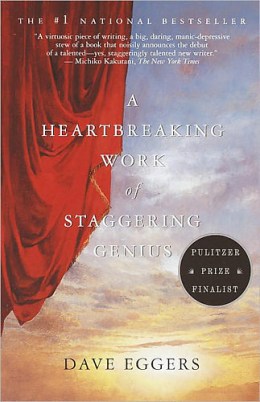
It may seem arrogant to refer to one’s first published book as a Work of Staggering Genius, but in Dave Eggers’s case, the truth is in the pages. The Pulitzer Prize nominated memoir, published in 2000, is easy to get lost in with its conversational narrative that’s at once paranoid and adept, casual yet sincere. And while it is heartbreaking to witness the deterioration of an otherwise unremarkable suburban family, as both Eggers’ parents succumb to cancer within a span of 32 days, the book is also undeniably uplifting and succeeds as an honest (if partly fictionalized) portrayal of the strength of family in the face of adversity. Eggers excels at conveying the weight of the burden laid upon him when, at age 21, he accepts the role of parent to his 8-year-old brother Toph. Though his “new model” parenting methods might not be considered normal by society’s standards, Eggers doesn’t hide from the fact that nothing about his and his brother’s situation is “normal.” Instead, he demands that the universe repay him and Toph for the heartache they’ve endured. Eleven years, six books, a successful publishing imprint and numerous nonprofits later, it seems that Eggers has been repaid in full.
The first in a series of autobiographical works, I Know Why the Caged Bird Sings is the most famous and acclaimed book by Maya Angelou, a poet, memoirist and civil rights activist who grew up in the South during the 1930s and California in the 1940s. Published in 1969, the story spans her childhood from age 3 to 17, following young Maya and her older brother Bailey as they bounce from their parents’ care to their grandmother’s and back again. Maya struggles not only with feelings of chronic displacement and insecurity but also a series of heartbreaking challenges: insidious racism, molestation and rape. Caged Bird was nominated for the National Book Award and is still beloved for its revolutionary depiction of what it meant to be young, female and black in America.
TIME meets the female Banksy bringing royalty to London’s streets
Melissa
Reblogged this on Swamp of Boredom and commented:
I’m reblogging this for my own reference and also to share with my readers (all 34 of you;)). Since the release of the 1001 Books App on Tuesday, I’ve been book list crazy. Since I like non-fiction – especially non-fiction centered on historical events and people, not so much current people – and have read a couple of excellent non-fiction books in the last year (Only Yesterday, Empire of the Summer Moon) I wondered if there was a list of recommended non-fiction books. Of course there is. I found one from the Guardain (UK) that is, obviously, geared towards British readers and that, unlike Time’s list, encompasses all non-fiction ever written. This list from Time consists of books only since Time began publishing, 1923. There are a few that don’t interest me at all and the biography choices focus too heavily on women and African Americans, IMO, but overall the list is excellent.
Enjoy!
As we prepare for the Game of Thrones finale, we recognize Joffrey and nine other baddies who showed us that terrible, horrible things can come in small packages