

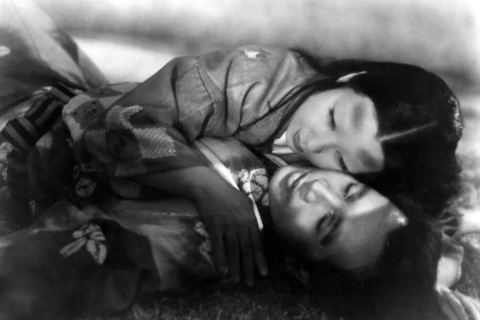
They came in rapid succession, as if off a Japanese assembly line: masterpieces galore in the early 50s, from Kurosawa and Ozu and Mizoguchi, who ended his career with four films (The Life of Oharu, Ugetsu, Sansho the Bailiff, Street of Shame) whose pained wisdom and fluidity of form are the film equivalent of Beethoven’s last Quartets. Ugetsu is both a magnificent war film and a parable of careless love. A villager, Genjuro (Masayuki Mori), leaves his wife to go to battle, not to serve the Emperor but to find wealth in war’s spoils. In a spooky castle he meets the glamorous Lady Wakasa (Machiko Kyo)and falls under her spectral spell. Ozu wants to define man’s restless, acquisitive nature and woman’s homing instinct. One creates adventure, the other continuity. These are the building blocks of any story—including the haunting ghost story that Ugetsu, in one of the great tracking shots in cinema history, reveals itself to be.