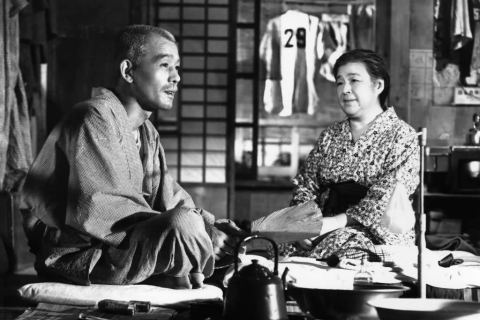
Yasujiro Ozu was the most austere of the Japanese masters—few camera movements or close-ups, a rigorously plain editing manner. His attention was intently focused on his people, who were usually ordinary members of the middle class. This is one of his most approachable movies: An old couple comes to the big city to visit their children, who are more irritated than pleased by this interruption of their lives, which are scarcely glamorous. “Isn’t life disappointing?” one of them says. “Yes, it is” another replies. But this wry, ironic movie is anything but, as it patiently, wisely explores the generational and universal—tensions between the generations.
Kung-fu movies came to the West via the grunting charisma of Bruce Lee. But his were standard revenge thrillers, showcases for the acrobatics of machismo. For a marriage of martial and cinematic art, King Hu was the man. And A Touch of Zen, the first Chinese action movie to win a prize at the Cannes Film Festival, is his masterpiece. In this three-hr. epic, a modest scholar (Shih Jun) hooks up with a resolute girl (Hsu Feng) to challenge a vicious warlord. Influenced, like so many major Hong Kong action directors of the period, by the samurai epics of Akira Kurosawa and other Japanese directors, Hu brought a unique buoyancy to the action genre. His performers literally bounced (on unseen trampolines) through forests and over hills, and — because Hu’s camera has a muscular grace as well — the viewer soars with them. Leading the acrobatic procession is Hsu Feng. Just 18 when the film was made, she remains the screen’s gravest, most ravishing woman warrior.
Sue me, but I like Betty Draper/Francis as a character. The problem is that Mad Men doesn’t. Betty’s not the worst character on the show, but she’s probably the worst-served.