

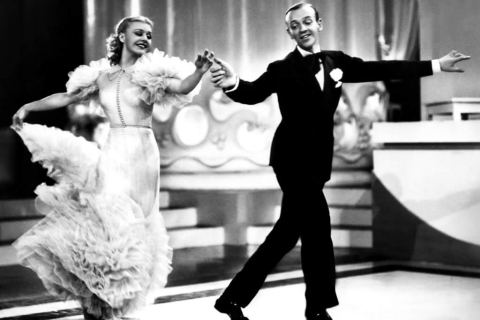
By most standards, this would be one of the least worthy films on our list. Silly story (a gambler courts a gal engaged to a bandleader), vapid dialogue, ordinary direction, acting that Stanislavsky or Scorsese would deem subpar. But it’s a musical, and oh those songs (by Jerome Kern and Dorothy Fields), oh those dances (choreographed by Fred Astaire and Hermes Pan). Astaire’s grace, as he gently steered Ginger Rogers across those parquet floors, defined easy elegance and defined the American style in Hollywood’s Golden Age. In the comic duet “Pick Yourself Up,” Fred turns Ginger from an angry competitor into a perfectly synchronous partner. The climactic number, “Never Gonna Dance,” pours courtship, conquest, lovers’ quarrel and loss into a five-minute poem in synchronized motion. With moves whose wit surpassed verbal cleverness, whose passion in a two-step or a twirl was warmer than any kiss, Fred and Ginger were a living metaphor for la belle, la perfectly swell, romance.
[youtube=http://www.youtube.com/watch?v=uNOMw2W-o8o]