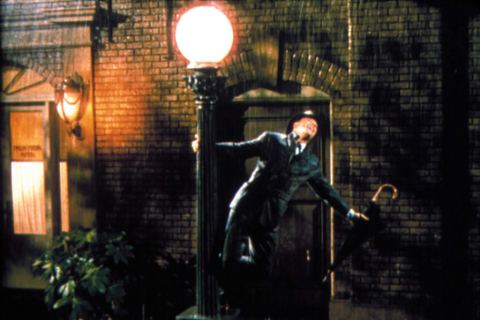
Everybody’s all-time favorite musical—and justifiably so. Ham actor (Kelly) falls in love with pert ingénue (Debbie Reynolds) while his best pal (Donald O’Connor) kibitzes from the sidelines. Meantime, Hollywood makes its panicky adjustment to the coming of sound pictures. The score is joyful, the comedy smart and knowing, the dancing spectacular in the most easily (and genuinely) likeable movie ever made.
Jon Amiel was the director of this magnificent six-part BBC series, and a suave job he made of it. But the true guiding and compelling force was the author, Dennis Potter. He poured much of his own biography into the script—a childhood in the Forest of Dean, a lifelong siege of crippling eczema—then extended it into the interior epic of a hospitalized pulp-fiction writer (named Philip Marlow!) whose agonized misery drives him into dark fantasy and bitter memory. It’s Potter’s voice that rages in every superb, suppurating monologue, that soars with each vintage tune running through the hero’s addled mind. A fable of degeneration (shown with brutal precision) and regeneration (not entirely persuasive), the piece alternates ferocious confessional elements with bursts of musical comedy. The anger is cathartic for Marlow, the music transporting; its lilt almost allows him to cruise down a river toward sanity. In what is essentially a one-man show, Michael Gambon gives one the fiercest, most acute performances in modern film. Yes, Virginia, it is a film, a 6hr. 48min. one, made with unflinching brilliance.
Sue me, but I like Betty Draper/Francis as a character. The problem is that Mad Men doesn’t. Betty’s not the worst character on the show, but she’s probably the worst-served.