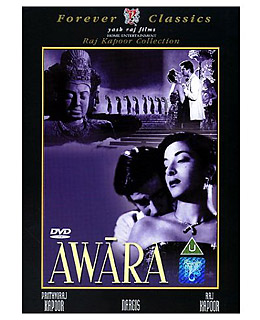
Great PerformancesRaj Kapoor, Awara

He was more than the primal star of Indian cinema. To most of the planet, Raj Kapoor was India in all its vitality, humanity and poignancy. Awara (1951) and the other ’50s films Kapoor directed, produced and starred in with Nargis, his muse and mistress, were sensations not only in India and throughout the Arab world but in the Soviet Union (where the movies’ songs became top hits) and Communist China (Mao once named Awara his favorite film). A Ronald Colman lookalike, Kapoor wanted to be India’s Charlie Chaplin; Awara translates as “The Tramp.” He plays Raju, son of a stern judge (Kapoor’s own father Prithviraj) who had banished his wife after she was abducted, perhaps ravaged, by a brigand. Raju, not knowing his prominent, blighted parentage, grows up a vagabond, falls in love with the judge’s adopted daughter (Nargis) and is charged with a crime that must be decided by … his father. With a wild dream sequence, enough passions and plot anomalies for a dozen Hollywood soapers, and a luminous, startling seaside seduction, Awara serves as a superb primer for Indian cinema and its actor-auteur, forever revered as The Great Showman.
Next: Judy Holliday, Bells Are Ringing
Great PerformancesJudy Holliday, Bells Are Ringing

She had a little, kewpie-doll voice and a large frame; the 5ft.10in. comedienne would have bought her gowns at the Big & Tall Ladies’ Salon. Judy Holliday was also the most dynamic, engaging musical comedy star of her generation. That makes her only movie musical, Bells Are Ringing, one to treasure. Adapted by her old Revuers pals Betty Comden and Adolph Green from their Broadway hit, with tunes by Jule Styne and direction by Vincente Minnelli, the film casts Holliday as Ella Petersen, an answering service operator who brightens her customer’s lives but has no control over her own. Dean Martin is the wrong guy who becomes Mr. Right, and Eddie Foy Jr. a bookie with a scheme to take phone bets disguised as orders for classical records (“Who is Handel? Hialeah! Hialeah!”). But it’s Judy’s show, and she’s a pearl: sweet, vulnerable, totally winning. Her farewell song (“I’m goin’ back / Where I can be me / At the Bonjour Tristesse Brassiere Company”) has an extra poignance because this was Holliday’s final film. She died of throat cancer five years later, at 44.
Next: Bill Murray, Groundhog Day