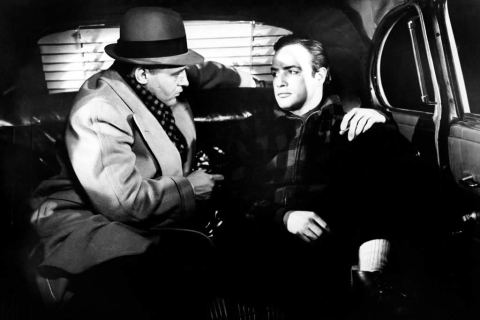
Brando gives his greatest performance as a young longshoreman who comes to political consciousness and helps oust a corrupt, mob-controlled union from the docks. That theme is now a little dated, but the yearning love affair between Brando’s roughneck and Eva Marie Saint’s hesitant convent girl is as fresh and poignant as it was a half-century ago, when TIME dismissed Kazan’s powerfully realistic film as no more than “a shrewd piece of screen journalism.”
In the 50s and 60s, moviemaking’s international decades, European auteurs came less frequently to Hollywood. Instead, Hollywood, in the form of itinerant American stars, came to them, where the directors could recast their love for old genres with their own distinct accents. One such was Leone, the Italian who had teamed with Clint Eastwood for the three Dollars westerns that brought fame to both men. Now, in a script co-written with Sergio Donati, he would expand his operatic vision to epic form. This is a story of the “civilizing” of the West through two agents: one coolly mechanical (the railroad), the other warmly human (Claudia Cardinale, representing womanhood at its most nurturing and radiant). Shooting in Italy, Spain and, for one spectacular moment, Monument Valley, Leone turned Charles Bronson into a leading man, and Henry Fonda into a sneering villain. The real stars, though, are Leone’s camera, going eye-to-eye with his actors or tracking through the labyrinth of his invented West, and Ennio Morricone’s score—arguably the richest in movie history.
Sue me, but I like Betty Draper/Francis as a character. The problem is that Mad Men doesn’t. Betty’s not the worst character on the show, but she’s probably the worst-served.