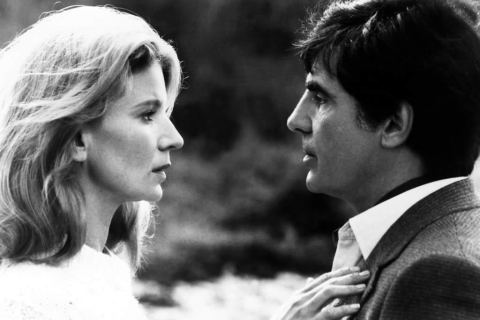
We humans supposedly use only five percent of our brainpower. Filmmakers are similarly timid with the possibilities of the medium. Virtually all directors employ the visual vocabulary established 90 years ago by D.W. Griffith, and the presumption of realism: that those actors are these characters. Resnais, in a career spanning a half-century, is not always so constrained. His Last Year at Marienbad had the smart set guessing what was real and what was fantasy—and missing the correct answer that, on screen, everything is a fantasy, literally an optical illusion. Mon oncle d’Amérique, written by Jean Gruault, is a science lesson, given by the biologist Henri Laborit, that is made lucid and entertaining by illustrative skits featuring three characters (Roger-Pierre, Gérard Depardieu, Nicole Garcia) and a lab full of white mice. Laborit’s questions about the impact of behavioral codes in inhibiting man’s so-called free will dovetail elegantly with Resnais’s and Gruault’s mission to overthrow the codes of film behavior. It’s an exemplary experiment, and the highest form of movie fun.
Robert Bresson, his detractors would say, has a lot to answer for. In 13 films over 40 years, he developed the whole slim repertoire of exalted minimalism. Blank glances that suggest both sanctity and reproach; pregnant silences that speak libraries of meaning; an hour of mundane injustices that often explode into beatings, murders, suicides galore—these have become the vocabulary, the very clichés, of European and Asian art-house cinema. But just as we needn’t hold Steven Spielberg accountable for every crappy-sappy kids’ adventure, we shouldn’t blame Bresson for creating an art form that literally hundreds of imitators reduced to non-movie sterility. Bresson’s films, however austere and obsessed with each man’s own private Calvary, have a precision of imagery, an understanding of character, that gives them life, makes them a joy to watch. Mouchette, one of the purest Bressons, is the story of a teenage outcast (Nadine Nortier) so abused by everyone in her village that death seems like God’s caress, and so maladroit that she must try three times before she succeeds in drowning herself. Its effect as you watch it is beautifully unforgiving; as you recall it, brutally radiant.
The Foo Fighters captured five Grammys and Adele won four, including the song of the year trophy for “Rolling in the Deep,” at a Grammy ceremony that had the difficult task of celebrating music’s best while mourning the loss of one of their greatest, Whitney Houston.
From Nicki Minaj’s Red Riding Hood getup to Katy Perry’s head-to-toe blue ensemble, TIME rounds up some of the best (and worst!) sartorial choices at the annual music awards show.