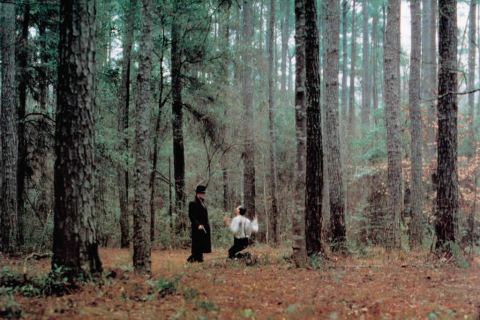
The American Independent movement can be sluggish and aimless: stories of sensitive dislocation told at a snail’s pace. Not so the films of the Coen brothers: writer-director Joel and writer-producer Ethan. Dextrously flipping and reheating old movie genres like so many pancakes, they serve them up fresh, not with syrup but with a coating of comic arsenic. Their wondrous facility can lead them into facetiousness; I for one still don’t get Fargo, which seems to be about how the folks in Minnesota (the Coen’s home state) talk funny and act criminally stupid. But in Miller’s Crossing (a reworking of the social chicanery in Dashiell Hammett’s novel Red Harvest), the antagonists are smart and out-smarter. Albert Finney runs a corrupt town in the 1920s, Gabriel Byrne is a brainy sort sometimes allied with Finney, and a stellar lineup of eccentrics (John Turturro, Steve Buscemi, Jon Polito) fills in the background of this marvelous, and pretty serious, fresco. It’s noir with a touch so light, the film seems to float on the breeze like the Frisbee of a fedora sailing through the forest.
We humans supposedly use only five percent of our brainpower. Filmmakers are similarly timid with the possibilities of the medium. Virtually all directors employ the visual vocabulary established 90 years ago by D.W. Griffith, and the presumption of realism: that those actors are these characters. Resnais, in a career spanning a half-century, is not always so constrained. His Last Year at Marienbad had the smart set guessing what was real and what was fantasy—and missing the correct answer that, on screen, everything is a fantasy, literally an optical illusion. Mon oncle d’Amérique, written by Jean Gruault, is a science lesson, given by the biologist Henri Laborit, that is made lucid and entertaining by illustrative skits featuring three characters (Roger-Pierre, Gérard Depardieu, Nicole Garcia) and a lab full of white mice. Laborit’s questions about the impact of behavioral codes in inhibiting man’s so-called free will dovetail elegantly with Resnais’s and Gruault’s mission to overthrow the codes of film behavior. It’s an exemplary experiment, and the highest form of movie fun.
The Foo Fighters captured five Grammys and Adele won four, including the song of the year trophy for “Rolling in the Deep,” at a Grammy ceremony that had the difficult task of celebrating music’s best while mourning the loss of one of their greatest, Whitney Houston.
From Nicki Minaj’s Red Riding Hood getup to Katy Perry’s head-to-toe blue ensemble, TIME rounds up some of the best (and worst!) sartorial choices at the annual music awards show.