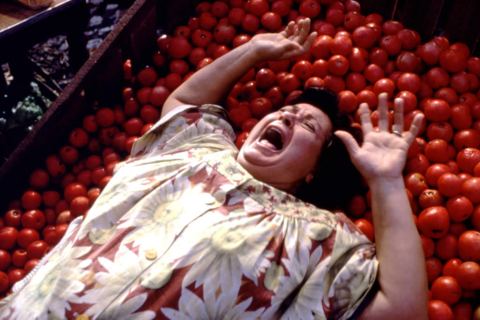
At some time in our youth, many of us have soberly concluded that these large people in our house cannot be our parents. They are clumsy or brutal, lacking the divine spark we surely possess; and rather than being stolen by gypsies, we were left on their doorstep by some superior beings as a test of our ability to absorb pain and indignity. Léo (Maxime Collin), 12, is nourished by this conviction as he watches his deranged Québecois brood mismanage their lives. He renames himself Léolo after determining that his mother had actually been impregnated by a Sicilian tomato. This is the first of Lauzon’s extravagant fantasies and, like other, odder ones, it is cogently grounded in the solitude that can smother any child— anybody. Lurching from the everyday obscenities of Léo’s home life to his rapturous dream life and back again, Léolo takes the elixir of Latin America’s magical realism and spikes it with the tartest French-Canadian satire. Our young hero does survive a (hilarious) suicide attempt, but Lauzon, alas, did not live to make another film. He died in a plane crash at 43.
Conceived and executed as one gigantic, 9hr. 18min. film, this faithful, innovative adaptation of the J.R.R. Tolkien trilogy kept children and everyone else hanging on to the grand story, though it was released over three consecutive Decembers. By disdaining the facetiousness that informed nearly every other fantasy (and most other kinds of Hollywood-type movies), LOTR located a narrative and emotional grandeur that had been missing nearly as long as the ring that carries Middle Earth’s destiny and Frodo the Hobbit’s doom. The digital effects work, however imposing, built on the achievements of generations of Hollywood technicians. What remains amazing about the enterprise is that, over seven years of planning, production and digital effects work, Jackson kept his eye on the prize, never losing the epic heft or stinting on the telling visual or character detail. It’s wonderful when moviemakers dream this big, and make their dreams ours.
The Foo Fighters captured five Grammys and Adele won four, including the song of the year trophy for “Rolling in the Deep,” at a Grammy ceremony that had the difficult task of celebrating music’s best while mourning the loss of one of their greatest, Whitney Houston.
From Nicki Minaj’s Red Riding Hood getup to Katy Perry’s head-to-toe blue ensemble, TIME rounds up some of the best (and worst!) sartorial choices at the annual music awards show.