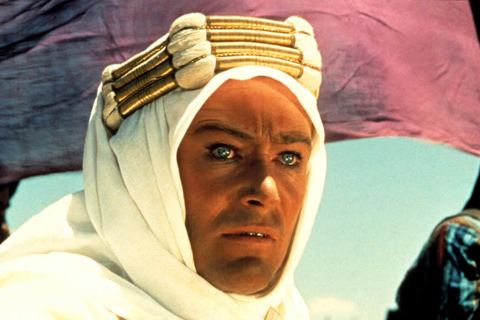
T.E. Lawrence was the British lieutenant who organized the Arab overthrow of the Ottoman Empire, then watched in dismay as the European powers reneged on their promise—his promise, actually—that “Arabia’s for the Arabs now.” A figure of enormous accomplishment and even huger charisma, Lawrence promoted himself as assiduously as he did Arab nationalism: a legend in the self-making. The film version met this epic in the flesh head-on. Robert Bolt’s eloquent, epigrammatic script traced Lawrence’s career from mapmaking in the British army’s Cairo headquarters to masterminding Arab nationalism. Lean, a superb pictorial dramatizer, filled the wide screen with an endless desert occasionally peopled by passionate warriors (well played by Anthony Quinn, Alec Guinness and an actual Arab, Omar Sharif). Peter O’Toole’s swashbuckling incarnation made Lawrence a towering, tragic, high-camp sheik of Araby. The film, which seemed nostalgic upon its release, looks prescient now, as the debate over Western influence in Arabia is written daily in blood.
At some time in our youth, many of us have soberly concluded that these large people in our house cannot be our parents. They are clumsy or brutal, lacking the divine spark we surely possess; and rather than being stolen by gypsies, we were left on their doorstep by some superior beings as a test of our ability to absorb pain and indignity. Léo (Maxime Collin), 12, is nourished by this conviction as he watches his deranged Québecois brood mismanage their lives. He renames himself Léolo after determining that his mother had actually been impregnated by a Sicilian tomato. This is the first of Lauzon’s extravagant fantasies and, like other, odder ones, it is cogently grounded in the solitude that can smother any child— anybody. Lurching from the everyday obscenities of Léo’s home life to his rapturous dream life and back again, Léolo takes the elixir of Latin America’s magical realism and spikes it with the tartest French-Canadian satire. Our young hero does survive a (hilarious) suicide attempt, but Lauzon, alas, did not live to make another film. He died in a plane crash at 43.
The Foo Fighters captured five Grammys and Adele won four, including the song of the year trophy for “Rolling in the Deep,” at a Grammy ceremony that had the difficult task of celebrating music’s best while mourning the loss of one of their greatest, Whitney Houston.
From Nicki Minaj’s Red Riding Hood getup to Katy Perry’s head-to-toe blue ensemble, TIME rounds up some of the best (and worst!) sartorial choices at the annual music awards show.