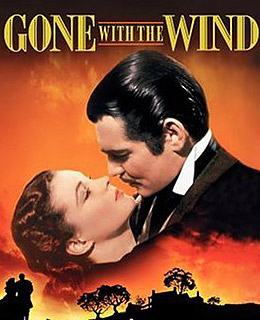
Guilty PleasuresGone With the Wind, 1939, Victor Fleming, U.S.

Here’s why this is not on our All-Time 100 Movies List: It is indefensible as social history; it lags in its second half; it lacks a strong directorial signature. All that leaves is the film’s epic ambition, its steam train of story propulsion, a ravishing visual design and performances of glamour and power. Which makes this super-production of the Margaret Mitchell best-seller the ultimate Hollywood movie. No question that this is a producer’s, not a director’s project; David O. Selznick’s grand and niggling obsession stamps the movie like Kong’s footprint. So what? In its first two hours, which moves with whirring assurance, the film establishes two pairs of potent contradictions: the mercantile North vs. the slave-owning South, and the rakish male (Clark Gable) vs. the ferocious female (Vivien Leigh, in a performance of spectacular drive, complexity and star quality). In 1939 GWTW was the longest and most expensive film made to that time. Today it retains another distinction: in terms of tickets sold, it is the most popular movie ever.
From the TIME Archive:
1936: Review of Margaret Mitchell’s book
1939: The premiere, and a look inside the movie’s production
Next: Tenth Avenue Angel, 1949, Roy Rowland, U.S.
Guilty PleasuresTenth Avenue Angel, 1949, Roy Rowland, U.S.

A word for the child actor. From Jackie Coogan in Chaplin’s The Kid to Edmund Moeschke in Germany, Year Zero to Patty Duke in The Miracle Worker to Mary Badham in To Kill a Mockingbird to Tatum O’Neal in Paper Moon to Mohsen Ramezani in The Color of Paradise to Alex Edel in Millions (to pick just seven of hundreds), children have shown an eerie affinity for the camera, and vice versa. What’s that magic? Are stars really born, not made? Or is it the serendipity of the right kid in the right role under the right director? No idea. But of all the movie moppets, Margaret O’Brien had the earliest and most acute understanding of the screen’s demand for charm and craft. It’s said that when as director asked her to cry, she said, “Right eye or left?” She was terrif in Meet Me in St. Louis and Journey for Margaret, but I’m picking the 1948 Tenth Avenue Angel because this soapy Christmas drama has no reason for being other than to get its little star to cry. More than that: to doubt the goodness of her family and the existence of God. (This was way before Bresson and Bergman did their God movies.) Margaret, then 11, did it with her usual winsome brilliance. And I cried too. Right eye and left.
Next: Sailor Beware, 1951, Hal Walker, U.S.