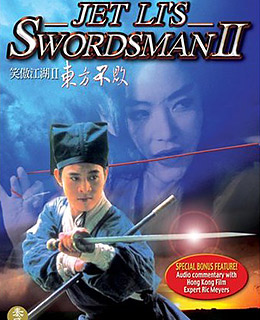
Great PerformancesBrigitte Lin, Swordsman II

“To talk about Ching Hsia is like talking about Grace Kelly,” cinematographer Christopher Doyle said in 1998 in Akiko Tetsuya’s book, The Last Star in the East. “Because even to me, she represents what we hope the image of beauty in our world is. She is perfect.” Ling Ching-hsia—Brigitte Lin to her western acolytes—was discovered on a Taipei street at 18 and became a star in her first film, Outside the Window. A ravishing presence for a decade in Taiwanese weepies, she came to Hong Kong in the 80s and changed her image. In the films of Tsui Hark (Zu: Warriors of the Magic Mountain, Peking Opera Blues, Swordsman II, East Is Red), she was cunning, sexy, enigmatic, often androgyne. Nobody could match her display of fiery charisma and tart wit. In the 1992 Swordsman II, Lin plays an evil male deity who has castrated himself to become a woman and achieve greater powers. Radiating a molten stare, and battling hero Jet Li in some of the most dizzyingly choreographed fights in Hong Kong history, Lin easily lives up to her character’s name: Invincible Asia. Though she quit movies when she married in 1994, she remains just that, invincible and indelible.
Next: Gone With the Wind, 1939, Victor Fleming, U.S.
Guilty PleasuresGone With the Wind, 1939, Victor Fleming, U.S.

Here’s why this is not on our All-Time 100 Movies List: It is indefensible as social history; it lags in its second half; it lacks a strong directorial signature. All that leaves is the film’s epic ambition, its steam train of story propulsion, a ravishing visual design and performances of glamour and power. Which makes this super-production of the Margaret Mitchell best-seller the ultimate Hollywood movie. No question that this is a producer’s, not a director’s project; David O. Selznick’s grand and niggling obsession stamps the movie like Kong’s footprint. So what? In its first two hours, which moves with whirring assurance, the film establishes two pairs of potent contradictions: the mercantile North vs. the slave-owning South, and the rakish male (Clark Gable) vs. the ferocious female (Vivien Leigh, in a performance of spectacular drive, complexity and star quality). In 1939 GWTW was the longest and most expensive film made to that time. Today it retains another distinction: in terms of tickets sold, it is the most popular movie ever.
From the TIME Archive:
1936: Review of Margaret Mitchell’s book
1939: The premiere, and a look inside the movie’s production
Next: Tenth Avenue Angel, 1949, Roy Rowland, U.S.