

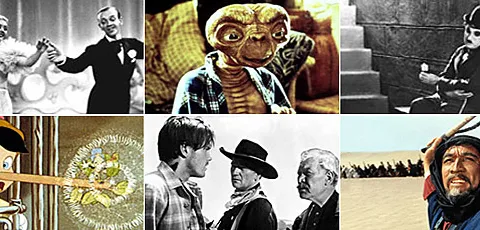
You like us, you really like us. You also hate us. Anyway, you click on us, which is the surest way a website has of measuring interest in its content. The All-TIME 100 Movies feature—compiled by Richard Schickel and me, and handsomely packaged by Josh Macht, Mark Coatney and all the smart folks at TIME.com—attracted a record-busting 7.8 million page views in its first week, including 3.5 million on May 23rd, its opening daym, in time for Father’s Day. Thousands of readers have written in to cheer or challenge our selections, and thousands more have voted for their own favorites. The response simply underscores Richard’s and my long-held belief that everybody has two jobs: his own and movie critic.
The idea was to assemble 100 estimable films since TIME began, with the March 3, 1923 issue. Later, each of us was asked to contribute five items in sidebars called Great Performances (acting), Guilty Pleasures (trash treasures) and Top Scores (soundtracks). Essentially, though, a century of movies from 82 years. That shouldn’t be hard: pick a picture for each year, with 18 slots left for honorable mentions.
Not so simple, in fact, for we faced a couple of complications. The first was that two of us were to agree on the selections; and, though my admiration for Schickel is hardly bounded, and he probably doesn’t mind me, no two critics will agree on all, or even most, great films. The other is the onus of the list-making process. It’s a truism that a list like this takes either an hour (go with your initial inspirations) or a month (weigh every film with Solomonic probity). Our effort clocked in at about four months, off and on. And the clock is still running.
Why do the list? I guess Josh and Mark and Jim Kelly, our peerless leader, hoped to sharpen the profile of the website, and indirectly the magazine. (Mission accomplished.) Our genial PR mavens saw some benefits in media exposure. (Schickel and I, in our first joint TV appearance after 25 years sharing the TIME film-critic gig, gassed with Charlie Rose last week.) It’s possible that someone involved with the enterprise wanted to make money. Not I, of course. As a TIME staff member, I write for the website pro bono, or rather pro ego. Or, honestly, for the fun of it. That’s how this TIME 100 started for me, and how it ended.
LISTOMANIA
I feel one of my grand gender generalizations coming on, and I can’t resist it, so here goes. Guys love to make lists. The assembling and codifying of useless information speaks to our inner math nerd, our rampant nostalgiast. Girls can play Little League baseball now, but the kid in the stands keeping the box score, and tallying individual achievements into season slugging percentages, is very likely to be a boy. Turning our pastimes into numbers is a way not only of quantifying but also of justifying them. They acquire an atomic weight; to rank them is to give them solidity, meaning.
As a kid I would study the major league batting averages in the Sunday paper more assiduously than any school subject, and I kept box scores of the games our neighborhood team played. Sometimes I devised imaginary box scores too. I know what you’re thinking: he must have been a lonely child. Actually, I wasn’t; I had a loving, indulgent family. But around the nation, countless other kids, more talented or preoccupied than I, were doing the same thing, bending the MLB numbers, reconfiguring the figures. Eventually they would form a group, the Society for American Baseball Research, SABR for short. One of their group, Bill James, coined the term SABRmetrics to describe the grown-up, boy-like study of those numbers. The statistics they produced, and the inferences they made from those stats, would enrich the game and change the way it was played. So there.
As with baseball, so with favorite movies, TV shows, comics. One of my youthful heroes was Fred Von Bernewitz, a Maryland boy not much older than I was. He created, mimeographed and published the E.C. Checklist, a compilation of every story in each of the dozen or so “New Trend” comic books (Vault of Horror, Weird Science, Mad, etc.) that EC published from 1950 to 1954. Bless his innocent obsession. His list was a signal to hundreds of other E.C. fan-addicts that our love was not a waste of time. I mean, how could it be, if so many other shared it? A half-century later, with the hardcover, much-expanded edition of the Checklist still in print (under the title Tales of Terror! The EC Companion), Von Bernewitz’s labor of adolescent love is easy to celebrate as trash-art pedantry. Back then, though, applying the rudimentary scholarship of list-making to comics was as radical as Brando’s first movie mumble, or the scream of Little Richard on “Long Tall Sally.”
I too was a teenage listmaker. I saw a lot of movies and, at year’s end, picked my favorites. I recently dug up my Top Five of 1959: The Seventh Seal, Some Like It Hot, North By Northwest, Rio Bravo and Imitation of Life. Looking at this quintet, I marvel at the maturity of my youthful tastes—or do I curse my lifelong adolescence?—since, 46 years later, I nominated all five for the TIME 100. The point is that listmaking is a first step to an informed enthusiasm. Juggling, sifting, thinking about the best films leads to measured judgments, the plundering of film histories, a nascent critical acuity. That’s how a hobby becomes a craft, sometimes a career. Just add verbs and thoughts.
Can the choices Schickel and I made have the shelf life of the Von Bernewitz checklist? Probably not; this is just one of what must be a hundred 100-best-films lists. Does film criticism have an equivalent to SABRmetrics—cinemetrics? Not really. You can’t calibrate genius. There are no Win Scores, no Favorite Toy, for movies and their makers. Many readers would say that Schickel and I have no greater claim than anyone else to impose our crotchets on you. Doesn’t everyone see a lot of movies and, gradually, amass some all-time preferences? Sure.
But, pardon me, we’re better. Our claims to expertise: 1. a combined 80 years (yikes!) writing about films; 2. even more years—going back to our movie-mad youths—as consumers, lovers and analyzers of this art-entertainment-business hybrid; and 3. a magazine, TIME, that has generously underwritten our cinephilia for, respectively, 32 and 25 years. Our employment is our diploma.
Still and all, list of favorites like the All-TIME 100 Movies is just that: a banquet, a groaning board of our fondest prejudices. You’re all invited to devour the food, or throw it at us.
ONCE, TWICE, THREE TIMES 100
There are 101 ways to choose 100 of anything. But I participated only in this century selection, so I’ll tell you what I did.
First it’s like a game: I’m throwing a party—who should be on the guest list? My idea was to invite different sorts for a richer mix. Highbrows and no-brows, the solemn and the frivolous, embracing many genres (musical, western) and forms (short films, experimental, documentaries). I want the Marx Brothers to co-exist with a Robert Bresson nano-drama. And Indian family melodramas to rub shoulders with 70s porno. An eight-decade, international melange.
Then it’s research. I re-viewed many of the films under consideration. I looked at the IMDb’s list of the top 250 films, as voted on by the site’s members. I dipped once more into Roger Ebert’s two volumes called The Great Movies, which contain some very thoughtful journalism on the subject. I also took a long browse through the stacks of that moldy old library of film trivia, my brain. The result was about 120 movies, leaving some wiggle room for negotiation. Richard the First (Schickel) had already compiled a list of 116 favorites. Neither of us knew the other’s preferences until we’d finished this initial round. After this double-blind taste test, the serious work began on the All-TIME 100 Movies.
Finally, then, it’s like a marriage—the intimate exchange of opinions and passions, the business of collating, collaborating and compromising. Once, twice, three times 100: Schickel’s list, my list, our list.
For movie critics, deciding which films are best is an anecdotal way of debating first principles. It’s theoretical and, toward the end of the process, it’s personal. Schickel and I were the co-captains of a lifeboat, with some of our favorites clinging to the sides, and we had to determine whose stiff fingers to pry off, which noble films to send into the sea of anonymity.
One of the great, not guilty, pleasures of this exercise was to spend lots of quality schmoozing time—on the phone, through e-mail and frequently in person—with my colleague on the other coast. I live and work in Manhattan, Schickel is based in L.A. But whereas I do all my work for TIME, the magazine and website, he is a busy-busy freelance: writing books, contributing a book review column to the Los Angeles Times and cobbling up feature-length documentaries on top auteurs, most recently Woody Allen, Charles Chaplin and Martin Scorsese. (He has a documentary on science-fiction films, Watch the Skies, premiering Tuesday, July 6, on Turner Classic Movies.) He’s a one-man film-critical conglomerate, a grand resource of probing, sensible thought.
My bibliography isn’t nearly as long as Schickel’s, but my will is as strong, So we had a few debates. He snorted at some of my selections (notably, The Fly); I yawned at some of his. He thought I was too much the China hand and Bolly-woosiast; I rankled at the inclusion of nearly every film noir melodrama ever made. I argued that, with A Streetcar Named Desire representing Marlon Brando and director Elia Kazan, the presence of the Kazan-Brando On the Waterfront was redundant; he trumped my nagging by citing Waterfront in the Great Performances and Top Scores sections. (I used the sidebars to introduce favorite films, performances and music not covered in the prime TIME 100.)
Over the months of discussion, I learned many things—not least that Schickel, whom everyone at TIME calls Dick, prefers to be known as Richard. (Hence my frequent use here of his surname, to avoid reader confusion.) And the debate never degenerated into rancor. Schickel and I knew we were playing a game; we did our research; and we’re still married.
CUTTING ROOM FLOOR:
Here are the films from our original lists that were dropped:
INSIDE THE LISTS
A scanning of both lists shows that Schickel and Corliss agreed on 31 films that got into the holy hundred: Sherlock Jr., Sunrise, City Lights, King Kong, Bride of Frankenstein, His Girl Friday, Pinocchio, The Lady Eve, Citizen Kane, Casablanca, Double Indemnity, Children of Paradise, Detour, White Heat, Kind Hearts and Coronets, A Streetcar Named Desire, Singin’ in the Rain, Ikiru, Ugetsu, Smiles of a Summer Night, Sweet Smell of Success, Yojimbo, The Manchurian Candidate, 8-1/2, Persona, The Godfather and The Godfather Part II, Aguirre the Wrath of God, Chinatown, Taxi Driver, E.T. and Talk to Her. Note that, as we approach the present day, agreement gets rarer. We had 10 coincidental selections in the 1940s, exactly as many as we did in the four-and-a-half decades from 1960 to today. That mirrors a consensus on classic films, especially classics from Hollywood, and a fragmenting of taste ever since.
There were also five movies on both early lists that didn’t make the final selection: Potemkin, Scarface, The Miracle of Morgan’s Creek, Raise the Red Lantern and All About My Mother. All worthy films. What happened? I guess we came to think of Potemkin an “official” great film that lodged in our memories more than in our guts. Raise the Red Lantern I reluctantly dumped in favor of another Gong Li-starring Chinese film, Farewell My Concubine, with its explicit approach to Chinese politics and a great performance by Leslie Cheung. As for directors of the other three films, they already had films on the final list—though Hawks, Sturges and Almodovar are all as deserving of being multiple-film directors on the TIME 100 as Scorsese, Lubitsch, Wilder, Bergman, Stanley Kubrick and Leone.
Ah, Leone. You see The Good, the Bad and the Ugly and Once Upon a Time in the West—consecutive films from the director of spaghetti westerns—and ask, Why both? (Perhaps you demand, Why either?) Well, because Schickel preferred the first film, and I love the second, and neither of us would budge.
A more general question: Why directors? Listen to the conversation Mark Coatney conducted with Schickel and me, and you’ll learn that, among the strategies Richard the First used in preparing his original list, one was to start with the directors he thought the best, then choose his favorite of their films. Further, he wanted to reward peak periods in the careers of great directors. Chaplin, Sternberg, Vidor, Lubitsch, Hawks, De Sica, Kazan, Godard, Scorsese, Allen and Almodovar all are cited for two works within a few years, sometimes consecutive films. Sturges gets three mentions in four years. A director-centric selection is one way to go. A film-savvy fellow I know said he would have found slots for all six of the films Sternberg made with Marlene Dietrich.
I didn’t work that way. For me, in compiling this list, the films were the thing, not their makers. In the Church of Auteurism, I’d be sitting in the back pew, sometimes agreeing with the dogma, sometimes whispering heresies. Not an anti-auteurist, but a not-quite. I’m a bit like Henry, the hero of Tom Stoppard’s 1982 play The Real Thing, who is agonizing over his choice of eight Desert Island Discs for a radio show. He knows he is expected to name eight pieces of “real music”—yet he is haunted by his unfashionable, unabashed love for the perkier forms of old pop rock. “I like Herman’s Hermits, and the Hollies, and the Everly Brothers, and Brenda Lee, and the Supremes,” he says, adding, “I don’t mean everything they did. I don’t like artists. I like singles.”
Well, I do like directors. But they aren’t the only artists who make films great. Hence Swing Time for the music and dance, Camille for Greta Garbo’s brave and merciless performance, and Baby Face for its thrillingly low moral tone. Schickel also had a few non-auteur choices, such as “Norman Z. McLeod’s” It’s a Gift. I guess Schickel would make the case, and I wouldn’t quibble, that W.C. Fields is the author of that rough comedy gem.
We have favorites, but we didn’t play favorites—reward friends with slots. Schickel, out in L.A., necessarily is on nodding terms with lots of filmmakers, some of whom are very good ones, and represented on the 100. I put four Chinese films on the list and, as it happens, I have dined congenially (once or twice) with the makers of all those films: King Hu, Chen Kaige, Jackie Chan and Wong Kar-wai. But that’s mostly because I do some reporting along with critiquing for TIME Asia movie stories, and because these filmmakers agreed to have a meal with me. (Conversely, I’ve noshed with only two of the Americans on the final 100, Scorsese and Spielberg.) Schickel can fairly say he dines with one of his honorees every night. He put the 2004 restored version of Sam Fuller’s The Big Red One on his list, and he did the restoration. Nice job too. But it didn’t make the cut.
Our work wasn’t over when we finished the 100. We still had the Guilties, the Greats and the Scores, and I did a selection of Short Subjects. Richard and I used these slots as a kind of B list for some of our original favorites. He worked Gun Crazy and Anatomy of a Murder showed up among his five Guilty Pleasures. I managed to get nine of these into subsidiary sections: The Rules of the Game and Awara in Great Performances, Jules and Jim in Soundtracks, Gone With the Wind and School Girl in Guilty Pleasures, some of the animated and experimental films in Selected Short Subjects. And if you’re wondering why Robert Bresson’s Mouchette (obviously a Corliss choice) appears on the final list but not on my original one, the answer is: the first time around, I forgot! If there’s a theme to this column, it’s that we’re all human, even critics.
POLITICS AND GEOGRAPHY
Of the 33 TIME 100 films before 1950, all but six were from Hollywood. Assessing the so-called golden age, we seem to be very Home Team. Ah, but of those 27 American films, nearly half, 13, were directed by men born abroad: three in England (Chaplin, Hitchcock and James Whale), three in Germany (F.W. Murnau, Wyler and Lubitsch), three in Austria (Sternberg, Wilder and Edgar G. Ulmer are all native Viennese), one each in Hungary (Michael Curtiz), France (Jacques Tourneur) and one in Sicily (Capra).
Why did they come to the U.S.? You may deduce that, at least for the Germans, Austrians and Hungarian, most of them Jewish, the answer was one word: Hitler. Yet except for Wilder, all the German speakers had emigrated during the Weimar years, when Nazism was barely a cyst in Mittel Europe’s eye. Another word explains the lure of these directors for and to Hollywood: Ufa. That was the German studio where Lubitsch, Murnau and others made the films that attracted the attention of the Eastern European men who ran the U.S. movie industry. They had made films at Ufa because that’s where the European action was. They came to Hollywood for the same reason—except that, there, not Europe but the world was their audience.
I argued, more stridently than Schickel, for geographical politics. “Ya gotta have an Iranian film!”, I said, even as Richard insisted on a representative of the 60s Czech New Wave. Yet we both ignored gender politics. Of the 100, 99 were directed by men, and the only auteuse, if that’s a word, is the German Leni Riefenstahl, Hitler’s favorite director. Pressed for a second film made by a woman, I would have chosen Kasi Lemmons’ magical melodrama, Eve’s Bayou, which was among my semi-finalists. It happens that Lemmons is an African-American, so the inclusion of her film would have addressed another nagging deficiency in the list—if you believe, as I half do, that the 100 should be as inclusive as possible. (The non-Caucasian directors, 11, are all Asian: Japanese, Chinese or Indian.)
Speaking of half-thoughts, here’s a half-serious suggestion. To compliment our selection of Guilty Pleasures, we might have had another sidebar called Guilty Conscience—a contingent of films from developing countries and other underrepresented regions and ethnicities. Such a U.N. General Assembly of cinema might comprise, from Egypt, Youssef Chahine’s Alexandria, Why?; from sub-Saharan Africa, Ousmane Sembene’s Moolaade; from Brazil’s Cinema Novo, Glauber Rocha’s Land in a Trance; from Korea, Im Kwon-taek’s Seopyeonje… I could go on singing. Last month TCM played more than a dozen Mexican movies from the 40s and 50s. As with Indian musicals, these robust artifacts made me wonder: What have I been missing? Life is a contnuing film education. And I remain a very impressionable lad.
Some readers might think that I shoehorned and strong-armed too many obscure titles onto the list—all those Asian films that were barely or never released in the U.S. It’s true that, when push came to shove, I deleted Hollywood movies I love and respect to make room for four Chinese-language films (A Touch of Zen, Farewell My Concubine, Drunken Master II and Chungking Express) and two Indian pop-musical dramas (Pyaasa and Nayakan). But even those titles are fewer than I’d wanted; I cut Awara and Peking Opera Blues at the last minute.
Anyway, I’d argue that a grand cinematic decade, from the mid-80s to mid-90s, belonged to the Chinese; their emergence and speedy supremacy was thrilling to watch. As for the Bollywood-style films, my recent inundation in India film instructed me in the subcontinent’s teeming movie achievements, and persuaded me that in its Golden Age, for about 20 years after Independence in 1947, India produced films whose quality matched Hollywood’s. Apparently some of you agree: Pyaasa, Nayakan and Concubine are often near the top of our readers’ poll. Which proves that one man’s obscurity is another’s great and glowing treasure. Thanks, India and China, for voting early and often.
And the half-argument against such a niche: great films don’t come from places, or groups, but from individuals. That’s one reason the list contains more entries—two—by each of six different directors (Lubitsch, Kubrick, Scorsese, Bergman, Kurosawa, Leone) than from the whole African continent. The other reason: we’re white males, and philistines!
IF WE ONLY HAD A HEART
We hear your pain. Reading some of the e-mail, Schickel and I sympathize, a little, that our selections didn’t always jibe with your favorites. “Bride of Frankenstein but not Gone With the Wind?” was a frequent keen. “Way too many old films,” one of you wrote. Sometimes, as I mentioned earlier, your criticism was about our color-blind, or color-myopic choices—why no Spike Lee film?
But the main complaint is that so few of the films we chose had heart. Among the movies deemed unfairly missing were Mr. Smith Goes to Washington, Sergeant York, A Tree Grows in Brooklyn, From Here to Eternity, La Strada, Ben-Hur, Parrish, To Kill a Mockingbird, The Sound of Music, Bang the Drum Slowly, Dances With Wolves and The Shawshank Redemption—all films that touched the people who saw them. The most frequently cited title was Mockingbird.
It’s true that, by nature, critics are skeptics. We have been trained to spot the puppet strings, to be suspicious of the heroine’s oh-so-noble renunciation, to note how the swelling of violins can cue a flood of audience tears. Aware as we are of all the manipulations, we find it harder to articulate an argument for humanist drama than for other kinds of films. Discussing a comedy, we can point to the wit and surprise, the shapeliness of construction, the Swiss-watch timing, the outsize bravura of a performance. We can even get away with the boast, “It made me laugh.” With a weepie, we can only say, “It made me cry.” For some reason, that is a confession as maudlin as the movie we’re trying to defend. Defending comedy is easy; defending sentiment is hard.
I saw that last month at the Cannes Film Festival, where the 10-film Competition contained exactly one forthrightly emotional film, Marco Tullio Giordana’s Once You’re Born. The movie, about a 12-year-old Italian boy whose sweetly naive outlook on life is tested when he is thrown in with some illegal immigrants, challenged the audience both to feel for these characters and to examine those feelings. It was both a sentimental movie and a comment on sentiment. Between us, reader, I sobbed through about half of the film. Most of the critics didn’t; it was roundly, often joyously scorned. And though Once You’re Born was one of my favorite films at Cannes, I soon stopped praising it while talking with other critics. I was ashamed to be thought a softie.
But I’m telling you, reader. So you know I wouldn’t be ashamed to put a movie that made me cry on the all-Time 100. Indeed, you will find there many films that stir powerful sentiments: City Lights, Dodsworth, Camille, The Shop Around the Corner, Meet Me in St. Louis, Children of Paradise, It’s a Wonderful Life (can you get any weepier?), Ikiru, Umberto D., Tokyo Story, Closely Watched Trains, The Singing Detective, Wings of Desire, Leolo, Farewell My Concubine, Kandahar, The Lord of the Rings, Talk to Her… and more, depending on whose heart is speaking.
If the list were a little longer, I would have been proud to stand up for Mr. Smith, A Tree Grows in Brooklyn, To Kill a Mockingbird, Shawshank and other personal favorites: One Way Passage, Letter from an Unknown Woman, The Miracle Worker, Empire of the Sun. Also a picture that was on my original, rough-draft list: Gone With the Wind. Until Schickel, the heartless bastard, snorted it off.
I don’t think of these films as sentimental (no one does, when itemizing his top sentimental films). I think of them as touching some honest emotion. Translation: They made me cry, and I felt elevated, not manipulated, in the process.
LIKING AND HATING
So thanks for liking and hating the list. All of us who worked on this feature got a lot of satisfaction from the lavish response. The Indian press was pleased that The Apu Trilogy and two Indian musicals were in the 100, and that Raj Kapoor and A.R. Rahman graced the sidebars (though my fact-checkers at Bollywhat.com were pissed that I used the Hindi, not Tamil, names for songs from Rahman’s Roja). Speaking of musicals, I was floored to get a thank-you note from Marc Shaiman, co-composer and arranger of the songs in South Park: Bigger Longer & Uncut. He teased me for calling him “SuperArranger”: “Maybe I can get them to add me into The Fantastic Four”…
And as for those complaints—”What are you smoking!” one reader asked—maybe this will help. Look, I helped make up the list, and I have a few objections. I’m sure Richard Schickel has his own grievances. It must have hurt to cut From Here to Eternity,his favorite World War II romance, at the last minute. But this is my column, so I get to kvetch. I mean, The Rules of the Game has for decades been in my all-time top ten. How come it’s not here? And two Ingmar Bergman films, but not The Seventh Seal? That movie changed my life, man! No Max Ophuls? No Antonioni or Rossellini? And Audrey Hepburn—was the screen’s greatest lady ever more radiant or ethereally seductive than in Sabrina?
Damn. I’m going to write an angry e-mail to the all-TIME 100 Movies.