
Tuned In

Mad Men Watch: Behavioral Modification

AMC
AMC

SPOILER ALERT: Before you read this post, sneak off into the woods with a friend and watch last night’s Mad Men.

Sincerity, as the joke goes, is everything. If you can fake that, you’ve got it made.

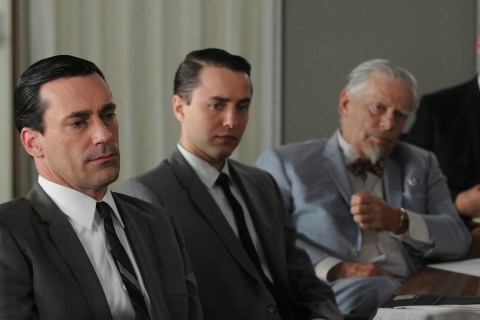
Last night’s Mad Men, “Blowing Smoke,” found Don Draper throwing a Hail Mary pass. trying to save his agency through another radical remaking of himself, this time taking Sterling Cooper Draper Pryce with him. And while the practical motivations behind Don’s conversion were obvious, that doesn’t mean it can’t be effective. Nor does it mean that Don was not on some level sincere—or at least, that the man who came to inhabit someone else’s identity can’t convince himself that he’s sincere about it, after the fact.

On the one hand, the reasons and timing behind Don’s we-didn’t-want-Lucky-Strike-anyway manifesto seemed clear: as Megan put it, it was a case of “He didn’t dump me, I dumped him.”He’s trying to jujitsu the possible death blow to SCDP as a stand of principle, and moreover, he’s taking his own advice, as presented to him by Peggy: change the conversation. Whether it proves to be genius or a disaster, Don has gotten people talking about something else besides his firm’s impending death. And yet it’s worth asking—after Don saw smack-addicted Midge living out her own private version of a Velvet Underground song, is it possible that he is also acting out of sincerity?

For Don, a believer in branding, who adopted another man’s identity so wholly that he became lost in it, it may just be that pretense and sincerity, calculation and transformation, are not entirely separable. That is, the way he has lived his life is that first you adopt the appearance and manner of the thing you want to be, and then you become that thing. You fake it ’til you make it.

In a sense, Don’s change of heart is more sympathetic if it’s calculated, if it’s not sincerely inspired by his seeing Midge’s addiction. After all, he’s been knowingly selling cancer for years; what does it say about him if it he doesn’t see the problem in it until he sees an ex-girlfriend strung out?

Maybe instead Don’s thought process is more complicated, his morality more situational. Yes, he knows what cigarettes do, and he’s seen the effects of addiction—especially to alcohol—in other’s lives and his own. But he’s lived his life in a certain place, in which that’s not his moral problem, in which someone is going to make money doing this job and it might as well be him. Well, now he’s not in a position to make that money anymore. But if he can move to this place—positioning himself in line with anti-tobacco sentiment that’s already out there, even if we haven’t seen much of it in Don’s world—well, then, maybe there’s market opportunity.

It is, perhaps, not the purest kind of conversion. And I’m not sure it will work—isn’t it Don’s motivation transparent to every ad agency and their clients (as it is to Teddy Chaough)? But at this point it’s worth a shot, because there seems no hope at SCDP trying to score conventional deals. (As Don points out, the accounts guys aren’t making things happen, so he has to take matters into his own hands.)

And it’s possible that, even if Don’s move is calculated, it can still actually and positively change him and his business. As Megan says, people feel good about Don’s move—which not only sounds principled but make SCDP seem like it is doing and not being done to—even though they can guess why he did it.

And the fact is, sometimes personal change comes after action, not before. In this episode, at least, Don seems to be maintaining an adult relationship with Faye, despite his dalliance with Megan last episode (which maybe really was a one-time thing). Maybe Don didn’t want to become the kind of man who could have a relationship with a strong confident woman with a career; maybe divorce, and then an alcoholic breakdown, forced that situation on him. But whatever his motivations, he has the chance tin his personal life as in his career to actually be the kind of man that circumstance has forced him to behave as. If that kind of change can save SCDP—if it can save Don Draper himself—then the purity of his original motives may be less important.

Meanwhile, the subplot returned to Sally’s struggle with Betty, a plot that might seem disconnected from the main storyline except for this: Sally too is employing a Don Draper fake-it-til-you-make-it strategy. Her psychiatrist congratulates her on how well she’s dealing with her mother—not necessarily by being less angry, but by modifying her behavior to seem less angry, which in turn removes reasons for conflict. You play the part of a happy person and, eventually, maybe you become a happy person.

For Sally, unfortunately, this strategy is less effective. For all of her progress in controlling her outbursts, she’s a child, not a free adult like Don, and she’s finally powerless to avoid conflict with Betty, who sees her meeting with Glenn and assumes the worst. (Informed partly by her weirdly intimate knowledge of the boy, which Sally is completely unaware of.) When it comes down to it, Don can takes matters into his own hands and publish an ad in the New York Times; but Sally is not the one who can decide whether the family moves to Rye.

Maybe Sally is running up against the limits of childhood. Or maybe she’s showing us that faking it can only carry you so far in the face of reality. With one more episode left in the season, maybe next week Don Draper will find out whether his faking it has made it.

Now the hail of bullets:

* It seemed pretty clear that the line of cigarettes Philip Morris planned to market to young professional women was what would become Virginia Slims, which launched in 1968. While it would have been intriguing to see the prospect of Peggy working on the account (as she undoubtedly would have), knowing that the brand was associated with such a legendary slogan—”You’ve come a long way, baby”—was a good hint that SCDP would not land the account. (Since, at least so far, we’ve seen the firm work with actual brands, but we haven’t seen it credited with actual ad slogans that we’re familiar with—although I could see a storyline where SCDP gets Virginia Slims, then loses it to the firm that would eventually come up with the famous line.)

[Update: Alan Sepinwall noted to me on Twitter that the pilot used the actual Lucky Strike slogan, "It's Toasted," though in real life it predated Mad Men by decades. Still, it seems that since the pilot the show made the decision to operate in the real world of real ad agencies and the real campaigns of the time—it's referenced the legendary VW ads, for instance—so it still seems seeing SCDP create a slogan that's still a household phrase would be jarring.]

* As with Betty, I’m glad to see that Mad Men is one of the only TV shows to realistically show that women do not magically lose their pregnancy weight the second they have a baby—even a tiny woman like Trudy.

* On a related note, this was maybe the first time in which we’ve seen significant division between Pete and Trudy on his career choices, as she warns him not to double down on a bad bet. Than Don spared him having to do so undoubtedly earned his loyalty for a while to come.

* Loved Teddy Chaough doing one of the most overdone Kennedy-borther impersonations this side of Mayor Quimby—and I was very relieved to find that Mad Men was not actually having RFK speak to Don on the phone that way.

* Jon Hamm did an excellent job showing the frightened desperation in Don before he decided to take the “quitting tobacco” gamble—from his trying-too-hard meeting with the Heinz beans man to his pacing and muttering, “red leather yellow leather” in his office. It seems as if Don became aware of how desperate he seemed, and decided he’d rather flame out on his own terms than lose out by frantically chasing business the old way.

* Great line from the Heinz meeting: “The way beans are funny, we can’t use that. We have to fight it, actually.” And a less funny but oddly insightful line: “There’s a time for beans and a time for ketchup” (meaning: a time of austerity and seriousness, and a time of plenty and frivolity).

* Don’s move may or may not save SCDP, but there were a lot of harsh words afterward—and Bert Cooper lost his poise and collected his shoes. Even if the firm survives, can the relationships amon the partners be the same?

* Most of you don’t have an office in the Time-Life building like I do, but I’m always a little thrown by scenes in the building’s lobby—for which I’m pretty sure Mad Men uses the elevator lobby of the building its production offices are in, and which looks nothing like Time-Life (or the Rockefeller Center area). This is only going to bother a few hundred Mad Men viewers, if that, but it’s one of those little drawbacks of using landmarks in a fictional setting, on a TV location and budget.

* It seemed obvious in retrospect that Peggy should see Faye as a model, but it takes Faye’s departure from the job to get her to say it: “They respect you, and you don’t have to play any games.” Faye’s response: “Is that what it looks like?” Has she really come a long way, baby?

One overall thought: this being the next-to-last Mad Men of the season, I expected this to be a setting-things-into-place episode, but I’m a little surprised that the closing crisis—will the firm survive?—is an awful lot like season three’s. Which leaves me wondering whether the finale will not find some dramatic way to unexpectedly change the conversation too.

* Finally, a discussion question: Matthew Weiner has said (and the first episode telegraphed) that the theme of season 4 would be identity, especially, “Who Is Don Draper?” With one episode left, do you feel closer to an answer?

Related Topics: Mad Men, Television, Tuned In
  • Latest on Entertainment

    IFC Films

    Kerouac's On the Road Comes to Cannes: Where's the Beat?

    Walter Salles’ film of the Beat Generation classic wastes a strong cast, including Twilight‘s Kristen Stewart, in a needless tribute to ’50s wanderlust

    Surprise! The Lowest-Rated Show in Broadcast History Is Actually GreatSlate

    Adam Rose/FOX

    Glee Watch: NYADA, NYADA, NYADA

    Spoilers for the season finale of Glee below:

    One beef I often have with Glee episodes is that they move too fast, go in too many directions, try to cram in too much at once. You might say that about “Goodbye,” the season 3 finale, but in this case that approach seemed about right. It’s an episode about graduation, and graduation is something that, no matter how much you plan for and anticipate it, still goes too fast. Graduating is something you do, but in the moment it feels like something that happens to you, suddenly and all at once, like going over a waterfall.

  • lobstershift

    I, too, was disappointed by the use of a generic ’80s or ’90s somewhere-else lobby for the unique and beautiful Time & Life Building, which not only employees but tourists and other workers have traveled through in nearly 50 years. Its terrazzo floors, stainless walls, artwork — all say stylish 1960s, which is what Bert Cooper kept complaining about.
    Low budget or not, I know that Time would have allowed filming there — good p.r., plus they already have a former archivist consulting with MM.

  • http://twitter.com/poniewozik James Poniewozik

    Yeah, I mean to be clear I don’t expect them to shoot at Time-Life, since Mad Men is produced in L.A. But it is really jarring, since even the architectural period doesn’t match. It’s just too bad they couldn’t use a better match in L.A.–obviously their ability to shoot locations is restricted.

  • foreshadower

    So james a quick food for thought post:

    One of the reasons why i respect Mad Men so much is that it keeps within the timeline of history to a certain degree. So the main question we were left with will SCDP survive this disbandment?

    Going back through the history pages and mad men recaps, we are somewhere between the summer of 1965 and the end of the year. To narrow it done it almost it seems as it late summer/fallish. Now, 1965 was the year that the Federal Cigarette Labeling and Advertising Act of 1965 which required companies to post labels on there boxes but it wasnt untill 1969 that it affected ad men. However this could be tied into the fact that don was contacted by the American cancer society. However i dont have a date when the act with passed, Im thinking fall session of congress which would go along with the timeline of Mad Men right now?

    Just another side note, i recognized from mad men website that the name of next weeks finale is named “Tomorrowland” which coincide with the closing of the New York Worlds fair in October of 1965 where the main feature was the furture such as General Motors Jetson type of gliding/flying car. Especially since don has the kids any chance this will tie into the finale?

  • Extraneous Ed

    I’m not sure I feel closer to an answer of “Who is Don Draper?”, but I think DON is closer to an answer to that question. And I think I would argue that is what the season is about. Not about us discovering who Don Draper is, but Don discovering it.

  • Chaddogg

    With next week’s episode being “Tomorrowland”, here is one thought: Draper doing ad work for Disney?
    .
    From Wikipedia’s history of Disney World, which involved Disney secretly buying most of the Florida property with dummy corporations so he’d control a massive amount of land before building/opening: “After most of the land had been bought, the truth of the property’s owner was leaked to the Orlando Sentinel newspaper on October 20, 1965. A press conference soon was organized for November 15.”
    .
    We’re in 1965. I think we’re probably near fall 1965 (creepy Glen was at football practice, after all). Disney World featured Tomorrowland, a land of the future. Don’s just publicly come out against tobacco ads (which don’t fit Disney’s family-friendly focus), and is best known for his ads for Kodak (Carousel of memories) and Glow-Coat floor wax — both of which traded in on childhood/nostalgia/family ideas. Harry Crane has connections with the entertainment industy/television industry, and might be Disney’s entry into SCDP…..seems like a lot of circumstantial evidence that could all fit together….

  • scooter27

    I’m surprised you think Don and Megan could be ‘one-and-done’! There were 2 great visual clues about the Don-Faye-Megan triangle; in the 1st shot of Don talking to Faye in the conference room, Megan is clearly seen as being in the middle! Later, as Don and Megan are walking back to his office, not only are they side by side, for a long moment it looks like Megan’s hand is resting on Don’s arm like a bride walking with her groom down the isle! And what about Faye’s parting words concerning meeting Don later; ‘I’ll get in touch with your girl’? That last on is a stretch, but unless everything about Megan has been a trick with foreshadowing for the overly image conscious Mad Men fans, I think Don and Megan become a couple by the end of next week.

  • foreshadower

    hint hint: search worlds fair 1965

    Epcot center did not open until 1982

  • http://lacharts.wordpress.com lacharts

    @foreshadower – While I agree that the title “Tomorrowland” more likely refers to the World’s Fair that took place in New York, EPCOT Center and Disney World are two separate parks on Disney property in Orlando. Within Disney World, there are different sections such as Adventureland. Frontierland, and, yes Tomorrowland. This makes Chaddogg valid in his reasoning.

    (BTW, at the November 1965 press conference, Walt Disney did present the original concept for the Experimental Prototype Community of Tomorrow which, with many changes, did become the EPCOT Center we know today.)

  • terryjmcd

    Foreshadower, you are way off. “Tomorrowland” DOES relate to Disney and it has absolutely nothing to do with Epcot, which as you pointed out didn’t open until 1982. “Tommorowland” is one of the themed areas in both the original Anaheim Disneyland, and in the Magic Kingdom (the “original” Disney World). I saw the name of the season finale episode weeks ago and pretty much assumed then it will be about landing an account with Disney, and the fact that SCDP cut all ties with tobacco and now has the type of “moralistic” image that Disney would require to be associated with their brand, I think it’s pretty much clear now, it’s Disney who comes to save the day.

  • lobstershift

    Sure, they couldn’t haul everyone to Sixth Avenue and 50th St., but somewhere in Southern California there must be an early-60s lobby that has at least a few corners that look 50-years-old….it’s this kind of touch that keeps bringing the viewer back into the present day and violates the sense of time that the producers so carefully build up. It wouldn’t matter quite so much if they didn’t fetehish their love and attention to period detail, down to silk stocking and wooden station wagon. Sometimes it feels like the young set designers and producers are visiting a time period of long, long ago that they don’t quite understand, and they throw in way too much detail in some scenes, and not enough in others. It’s never relaxed enough to let the characters just play their parts, wthout the scenery and constumes also on stage.

  • The Hoobie

    Here I was in this very space last week worrying about how Mad Men could possibly do something new and satisfying with the hardy perennial plotline “Don Draper brutally abuses Pete while unbeknownst to Don Pete has one foot out the SCDP door,” and the show did exactly that in one short, sweet line: “Don paid your share.”

    Wow. Matthew Weiner, I will never doubt you again.

    Scenes like that always make me remember Bert’s fantastic line in the first season about the unusual and surprising ways that loyalty is created.

  • jayindew

    Of all the characters on Rubicon, Michael Cristofer as Truxton Spangler is my favorite. Everybody else on the show inhibits their characters well, but Michael has this freakish alertness for how to make this character more maniacal than he already is. A memorable scene is Spangler learning that Will is on to him, his fury was quick and volcanic, and slamming that phone right there, I knew he wanted Will dead immediately. And what is often memorable is his impatient for anyone not of API, like the FBI, he shocks the air with his casual volatility. But last night episode saw Spangler smile at the success of the terrorist attack like a child who worked very hard at a mean prank, and his unwillingness to answer any calls from the head of the agencies. He laid in his chair like a dictator in his palace. I wish Michael Cristofer could get an Emmy for his work on Rubicon.

  • dkseeger

    Another interesting thing to note regarding the Walt Disney theories is that Walt Disney was a lifelong smoker of Lucky Strikes and was dignosed with lung cancer which ultimately killed him in… 1966.

  • canalstreetsk8boar

    Great final scene between Don & Midge. The completing a “circle/closure” with this time Don tearing
    up the check. Beautiful!

  • foreshadower

    okay so lets recap;

    partially wrong and partially right not way off. However i am still sticking by my orginal comment about 1964. However my reasoning wasnt in the right state of mind at the beginning.

    which i was signaling out one event however that one event was the beggining of tomorrowland terryjmcd.

    If you look up in the history books or wikipedia, walk disney debuted alot of the projects that would become tomorrow land at the worlds fair in 1964/1965. A little fact that i didnt know and it seems have been skipped over here.

    So while i now argee that SCDP will get some connection to disney if everything is looking up for the gang, however i believe the finale of mad men will encompass the worlds fair and disneys tomorrowland exhibits there which will lead to a disney contact.

  • Kemper

    Regarding Don’s level of sincerity. It’s interesting that earlier in the season when Peggy brought up the racism by their auto parts client, that Don instantly dismissed the notion of pushing them to change their public image. Yet here, he seized on the idea of taking the moral high ground to put a new spin on Lucky Strike leaving. And I loved how Don was reaching for his smokes right after fighting about the ad with the partners.

    Yet as JP pointed out here, sometimes the change comes after the action. And Don Draper is a complex character fully capable of embracing the PR move of slamming Lucky Strike, while possibly also quietly enjoying taking a stand after years of working for a cigarette company.

    Also, his response to Cooper calling him out about turning on Lucky Strike after taking their money for years, was that they destoryed his business. I think petty revenge could be a factor in Don’s motivation, too.

  • katy93

    That parting line was Faye telling Don she was wise to the situation with Megan and telling him to set Megan straight. That whole scene is Faye taking their relationship to the next level–our relationship is going to go public and you’re gonna tell “your girl” to make the reservations, just so she knows to step off.

  • mikeijames

    one can only imagine what the season finale has in store given the game changing nature of each of the three we’ve had to date from writer/director matt weiner. one of the most delicious aspects of this show remains all of the back story and tension-under-foot we get from each character. i just love lane’s throw-away line, “i just moved my family back here” given what we’ve seen about his life away from sterling cooper draper price. i love how peggy STILL thinks she might get fired after don has show time after time to rely on her counsel. and the hypocrisy of roger sterling showing any anger at all for what don did after he lost the biggest client either agency ever had. and what sort of things must run through pete’s head after don draper gave him money — for all intents and purposes — when his own father wouldn’t do the same.

    and in it all, i’m impressed that this show has managed to talk about the notion of change — and yes, not all of it for the better — in the sixties without relying on even one of the tropes from that time. the upheaval felt by each of these characters synchs with that of the time in such a beautiful way. sure, don draper’s own personal change may have felt less than sincere, but it rings true of much of the change that occurred in the sixties as a whole.

  • klebbe

    For much more on the women of Mad Men, check out Laurie Wheeler’s great interview with Erin Levy, Emmy-winning writer for the show, at
    http://www.psychologyofwomen.com/blog/interviews/interview-with-erin-levy-emmy-winning-writer-for-mad-men-on-women-the-60s-and-gender-equality/

blog comments powered by Disqus