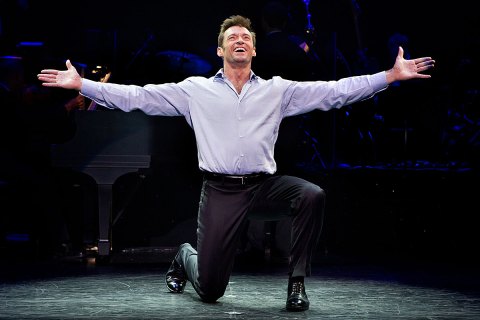
Review: Hugh Jackman Back on Broadway

He’s a metrosexual’s dream come true: A macho star of action movies (Wolverine in the X-Men series) who isn’t afraid to kick up his heels, act gay and confess his love of Broadway show tunes. Hugh Jackman Back on Broadway has already set house records at the Broadhurst Theater (partly because prime tickets have been jacked up to $350 apiece), and is attracting the kind of delirious fans — both inside and outside the theater — rarely seen since the Beatles left Shea stadium. Frankly, I don’t quite get it. Jackman has a clear, bright Broadway voice, but it’s too boyish and unmodulated to get much emotion out of big numbers like “Soliloquy” from Carousel, with which he closes the first act. But lord, the guy knows how to seduce an audience. He schmoozes with the crowd, plops himself in the lap of one or two of them, reminisces engagingly (with pictures!) about his life and family, and picks song medleys (favorite movie musicals; a “gotta dance” mash-up) with enough crowd pleasers to make Glee look avant-garde.
Jackman’s show is a no-calorie treat in an unusually earnest Broadway fall: not a single new musical has opened so far this season, while a number of straight plays have wowed the critics and drawn well at the box office. It’s a healthy sign that Broadway is not just candy-coated tourist bait these days, but that doesn’t automatically mean better theater. A look at some of the hits, the misses and the in-between:
Relatively Speaking: Two Winners, and Woody

It’s amazing what Woody Allen can still get away with. “Honeymoon Motel,” his contribution to this trio of one-act plays, is truly awful. But some critics (and much of the audience I saw it with) seem to find it hilarious. It starts with a totally arbitrary and implausible premise: a bride and groom enter their honeymoon suite, ready for a night of bliss. Soon members of the wedding party are trooping into the room (best man, bride’s parents, the rabbi), and we quickly learn that the supposed groom is actually the groom’s father, who has run off with his son’s bride at the altar. It’s the pretext for a series of scattershot one-liners pulled from Woody’s bottom drawer of rejects. E.g.: “Freud was a genius. Who else could make an hour into 50 minutes?” The sketch runs less than 50 minutes but feels like hours.
Woody’s misfire is especially unfortunate, because it brings down the whole evening, which until then has been modestly enjoyable. Joel Coen’s curtain-raiser, “The Talking Cure,” is little more than a fragment, but a neatly shaped series of short exchanges between a prison shrink and a recalcitrant inmate, followed by a longer, seemingly unrelated scene in which a married couple spew invective at each other over dinner. The link between them is a little too facile, but Coen’s ear is sharp, and his aim is true.
The best of the three is the middle entry, Elaine May’s “George Is Dead.” Like Allen’s sketch, May starts with a farcical premise: a spoiled Manhattan matron (Marlo Thomas) bursts into the apartment of her former nanny’s daughter to announce that her (Marlo’s) husband has just died on the ski slopes in Aspen. Unlike Allen, however, May turns the gag setup into a corrosively funny portrait of the infantilizing of the upper-class American female. Thomas’ character is so shallow that she can’t mourn; so clueless she doesn’t know how to make funeral arrangements (or even that she needs to make funeral arrangements); and so oblivious that she buries herself in TV sitcoms while the marriage of her reluctant host crumbles before her (averted) eyes. It’s harrowing and hilarious.
Next: Chinglish: Culture Clash


