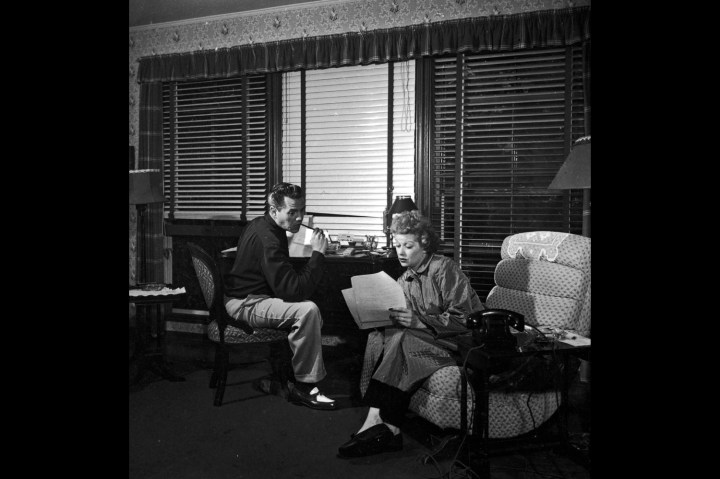
Lucille Ball and Desi Arnaz, the married co-stars of the sitcom I Love Lucy, created and made one of the most beloved hits in television history, and transformed the medium in the process. In this photo, the two stars work at home, c. 1950.
Ball met Arnaz in 1940, and married the same year. In planning I Love Lucy, Ball insisted that Arnaz be her partner instead of the actor CBS had planned. The two toured their own Vaudeville variety show in order to change the minds over the executives at CBS, pictured here in 1950.
Funder Phillip Morris required two things: that the show be filmed weekly and based in New York. The couple insisted on the West Coast location and took pay cuts of $1,000 a week in a deal to keep the show in a Hollywood backlot, which also required them to be the series’ executive producers.
Ball's comic side was present in Lucy Ricardo from the beginning. The show's reputation as a comedy of errors began with its premiere, "The Girls Want to Go To a Nightclub," which aired on Oct. 15, 1951. In it, Lucy and Ethel impersonate their husbands’ blind dates, dressed as hillbillies.
In the series' second episode, Lucy fears that Ricky has lost affection for her and tries to reignite their relationship by dressing like Carmen Miranda, in an attempt to reawaken memories of Ricky's Cuban childhood.
By the eighth episode, absurdity as a plot device is already ingrained in the show; Lucy divides the apartment in half to protest Ricky's messy lifestyle, which becomes significant when a magazine photographer visits the apartment, having planned to feature it in a photographic spread.
Ball and Arnaz's co-stars Vivian Vance and William Frawley became a critical part of the show's success. The four are best friends, and the older couple is often roped into Lucy's schemes. Here, the four are pictured in I Love Lucy's seventh episode, "The Séance."
To replicate Ball’s radio audience, I Love Lucy abandoned the traditional one-camera shooting method for sitcoms, becoming the first to film with three cameras. Another benefit: Arnaz decided to re-broadcast popular episodes after Ball had her first child, thus inventing the "rerun."
The show was a huge success. By the time LIFE magazine featured Lucy in its February 18, 1952 issue, it was seen by 20 million viewers, an extraordinary number for the time. The article featured shots (like this one) from the making of the first season's 19th episode, entitled "The Ballet."
I Love Lucy revolutionized the process of shooting television shows and won five Emmy awards during its run. Though the original series ended in 1957 its popularity has persisted; I Love Lucy is still watched by 40 million Americans each year, 60 years after its first episode aired.