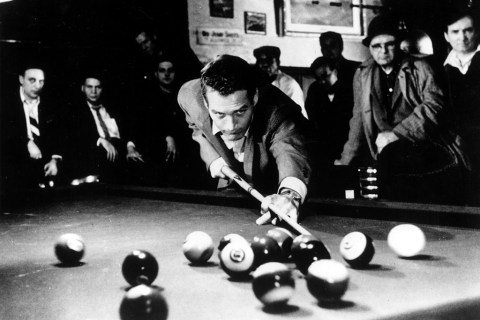
The Hustler

You might shed hot tears as some basketball or football underdog pursues its impossible championship dream, but no one ever got misty watching a movie about pool. The billiard parlor is ringed with all-night cigarette smoke, populated by sharpies and losers. Even the player’s posture, bent over as his cue taps the ball, suggests a safecracker’s posture at the tumbler. So the few pool-hall dramas must revel in seediness, with antiheroes as cavemen, learning to use guile over brute strength to earn their dominance.
In adapting Walter Tevis’ novel to the screen, director Robert Rossen (Body and Soul) cast Paul Newman as the hero-heel who’s a pleasure to watch in action, right up to the climactic comeuppance. Newman, who could fill most of a top-10 list of sports movies — boxing in Somebody Up There Likes Me, hockey in Slap Shot, race-car driving in Winning and Cars and baseball in the TV film of Bang the Drum Slowly, not forgetting the broken football star he plays in Cat on a Hot Tin Roof — had the prowling grace for any crafty athletic endeavor, including pool hustling. His Fast Eddie Felson saunters into some anonymous joint, pretends to be an average player and then, when real money is put on the table, crushes the opponent with his remorseless skill. He has talent, no question; but what the smart guys, like Minnesota Fats (Jackie Gleason), think Eddie lacks is character — that he’s “a born loser.”
The fun in this moody, pounding, overlong, rewarding bring-down of a film is seeing Eddie’s curled lip of contempt, which he flashes at all the suckers, freeze into a rictus when he gets his. Twenty-five years later, that grimace had softened, when Martin Scorsese directed Newman and Tom Cruise in The Color of Money, based on Tevis’ sequel novel. Newman’s older, wiser, not quite so Fast Eddie earned the actor his only competitive Oscar.
The Freshman

Considered the third great comic actor of silent film, after Charlie Chaplin and Buster Keaton, Harold Lloyd was as eager as they to display his athletic, balletic prowess, and paid a higher price: he lost part of a finger while shooting a 1918 short. That didn’t deter Lloyd from trying death-defying stunts, most memorably his hanging from a giant clock hand 12 stories above the ground in 1923′s Safety Last! So of course he was game for a football movie in the first decade that the sport seized the American spirit with college rivalries and that sensational innovation — the forward pass.
New at Tate University, and so desperate to be popular that he practices college cheers until he’s hoarse, the skinny, bespectacled Harold outlasts the derision of the coach and the meatier undergraduates to get a spot on the football team: as tackle dummy. Demonstrating the masochism at the sport’s heart — he likes being tackled — Harold is kept around as water boy, until the big game, which of course depletes the Tate roster until Harold has to be let in to score the winning touchdown, becoming an instant football hero and winning the love of a beautiful girl. (Really, did that piece of information merit a spoiler alert?) Directors Fred C. Newmeyer and Sam Taylor shot the final sequences in the Rose Bowl, with crowd reactions taken from a Berkeley-Stanford game. Twenty-two years later, Lloyd used that climactic sequences as the intro to a melancholy sequel, The Sin of Harold Diddlebock, a.k.a. Mad Wednesday, written and directed by Preston Sturges. The Freshman is the rare silent film that provokes the same rapturous laughter today as when it was released 86 years ago.
More Best & Worst Lists
View AgainWinning
- The Big Lebowski
- Body and Soul
- Breaking Away
- Bull Durham
- Caddyshack
- The Damned United
- Downhill Racer
- Eight Men Out
- Field of Dreams
- Hoop Dreams
- Hoosiers
- The Hustler
- The Freshman
- Lagaan
- Major League
- Million Dollar Baby
- Million Dollar Mermaid
- Olympia
- Raging Bull
- Rocky
- Shaolin Soccer
- Slap Shot
- Speed Racer
- Tokyo Olympiad
- When We Were Kings


