Speed Racer

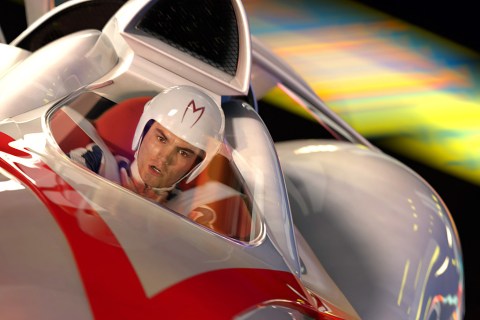
In the assaulting, astonishing sound-and-light show that Matrix brothers Larry and Andy Wachowski based on the ’60s Japanese animated TV series Mach GoGoGo, Pops Racer (John Goodman) is a mechanic turned car designer, Mom (Susan Sarandon) is the family’s emotional center and a font of dewy wisdom, older brother Rex (Scott Porter) is a champion racer who disappears after a car crash, and young Speed (Emile Hirsch) is the tyro driver ready to win the big rallies against formidable drivers and a rigged system. The men in the Racer clan could be the garage geeks who paved Silicon Valley with cybergold or Hollywood’s visual-effects alchemists, translating their fantasies into pixels to create gorgeous movies like these. Speed Racer is a hymn to practical ingenuity and manual dexterity, to real American innovators like Edison and Ford, Steve Wozniak and Dale Earnhardt — to the grease monkey as genius.
The entire film exists in another, nether, Neverland where standard narrative and visual decisions are dismissed as way too confining. In the big races, no actual cars were used; the magnificent set pieces are almost totally animated. The races aren’t just 200 miles of left turns; the tracks are designed as crazy theme-park rides, with 360-degree loops, chasm-wide broken tracks, roads that wind around mountains and across rivers. Here, the texture is the text, and it’s deliriously dense, with more than 2,000 effects shots, often layered on top of one another. More than the story of the Racer family, Speed Racer is the visual autobiography of the Wachowskis and their pit crew of computer-nerd Einsteins, using the tools of their trade to transform the movie medium. The effect, if you get into it, is more than a store window of technology. It is, as Mom says of Speed’s mastery behind the wheel, “inspiring, and beautiful, and everything art should be.”
Tokyo Olympiad

Of all the filmmakers called on to document the Olympics (including the 1972 Munich team that included Arthur Penn and Milos Forman), Kon Ichikawa was the one with the most imposing résumé. The director of such profound war films as The Burmese Harp and Fires on the Plain, Ichikawa cared little about sports statistics; Tokyo Olympiad is a splendidly self-conscious work of art. And though he had 150 cameras at his disposal, the feeling Ichikawa imparts is one of intimacy: a closeup of a sneaker pressed against a starting block; a women’s race shown with no sound but the falling of a hurdle. Ichikawa’s telephoto focusing on process over results infuriated the Olympic committee, which initially allowed the film to be released stateside in a 93-min. version — barely half its full 3-hr. length and majesty, which was eventually made available on a Criterion DVD.
It happens that the 1964 Games lacked the breakout star athlete that Leni Riefenstahl’s Olympia found in Jesse Owens. That suits Ichikawa fine. His one up-close-and-personal subject, Chad’s Ahamed Isa, manages only seventh place in the 800-m semifinals; to the director, Isa’s journey from a nation “younger than he is” is a personal victory revealing the Games’ true value. Often, Ichikawa suggests, the spectators are the stars. A child muffles his ears as ritual gunshots punctuate the opening ceremony; when doves are let loose, women hold purses over their heads for protection. During a race, the camera holds on faces in the stands as runners pass in a blur. Everyone, Ichikawa suggests, was a participant at this world event; we are all Olympians.
More Best & Worst Lists
View AgainWinning
- The Big Lebowski
- Body and Soul
- Breaking Away
- Bull Durham
- Caddyshack
- The Damned United
- Downhill Racer
- Eight Men Out
- Field of Dreams
- Hoop Dreams
- Hoosiers
- The Hustler
- The Freshman
- Lagaan
- Major League
- Million Dollar Baby
- Million Dollar Mermaid
- Olympia
- Raging Bull
- Rocky
- Shaolin Soccer
- Slap Shot
- Speed Racer
- Tokyo Olympiad
- When We Were Kings


