
Tuned In

Game of Thrones Watch: Sons of No One, Bastards of Young

HBO
Episode 7 scene 2d

Spoiler alert: Before you read this post, set up your DVR to record the big joust later, and watch last night’s Game of Thrones.

One complaint, or at least comment, that I’ve heard about Game of Thrones so far is that the episodes are not really episodes. That is, even more so than most HBO series (excepting maybe David Simon’s) it is utterly serial; the episodes don’t contain individual stories but play like chunks of a book, so they don’t reach closure so much as stop.

This is true to an extent. Game of Thrones (this season anyway) is an adaption of one book, and can be seen more like a movie in ten parts than ten episodes of television. That said, even in the early episodes with a lot of exposition (episodes 5 and 6, no spoilers, pick up the action considerably), Thrones’ hours have still had unifying themes. In “Cripples, Bastards and Broken Things,” there are at least two. First, as the title signifies, this is a harsh world for the weak and unconnected; and second, the harshness of the world means that respect is something that needs to be earned, not demanded.

The first unfortunate we encounter this week is Bran, still bed-bound and resigned to the fact that he will not walk again. As Tyrion mentioned earlier, however, it is much better in this world to be a rich cripple than a poor one—and in this case, one with a connection who is willing to custom-design you a saddle. Even if he may also have plotted your death! The episode does a nice job both setting up the swords-drawn cliffhanger, as Catelyn takes Tyrion into custody, and complicating our picture of him. On the one hand, his offer to Bran is an unrequired act of kindness (which also enables him to high-road the hostile Robb who receives him at Winterfell).

And yet there are just enough suggestions that Tyrion’s mission at Winterfell is not entirely altruistic, and about more than getting a bed for the night. He brings a gift but also questions: whether Bran remembers anything of his fall (the first thing Tyrion asks), where Catelyn has disappeared to, and whether Theon should really feel allegiance to the Starks (who appear to be treating him well, but who took him into their household essentially as a hostage of war, after a failed rebellion by his sealord father).

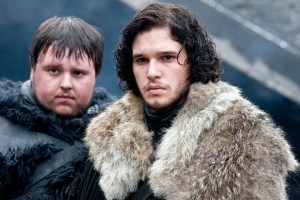
Bran, at least, is fortunate enough to have people looking out for him. Feudal families are not so kind everywhere in Westeros, we learn at the Wall, as Jon encounters Samwell Tarly–a tubby noble, unfit for the harsh service, who was given the choice between the Night’s Watch and a “hunting accident” by his own father. You and I did not grow up in Westeros; our society values compassion for the week and sponsors anti-bullying campaigns. So we’re conditioned to cheer, and become more sympathetic to the deeply feeling Jon, when the bastard puts himself in the role of protector, trying to bring Sam into the ersatz family of his new northern brethren.

Is it really a kindness, though? The recruits’ trainer, Ser Alliser, is clearly an old bastard of the metaphorical kind. But amid his taunting of “Lady Piggy” and attempts to unite his men in bullying the portly new boy, he has a chance to explain the harsh reality behind his methods: a story of a ranging expedition in winter—which, beyond the Wall, is more like a polar nightmare—that turned his men cannibal for survival’s sake. To Alliser, Sam is a sacrifice necessary to turn his men into a hardened, cohesive unit—not unlike literally feasting on his body to survive a blizzard. He may be wrongheaded and needlessly cruel, but we see that he came to this worldview through experiences that are still painful to recall, and while he may not be sympathetic, his contempt for Jon’s moralizing is at least understandable: “”They’ll call you Men of the Night’s Watch. But you’d be fools to believe it. Come the winter, you’ll die like flies.”

Can a good man make it in this world? That’s the question Ned faces, albeit in much warmer climes. The first few episodes of Game of Thrones have been on the talky side: a lot of scenes with two people having Socratic dialogues about family trees and Westeros history. In King’s Landing, however, events started rolling forward this week, as the political intrigue developed into something else: a mystery, and possibly a murder mystery. Leading, in this case, to another bastard: Gendry, Robert’s illegitimate son, working as a blacksmith’s apprentice. (To my eye, by the way, he looked a bit old for a character who, if my math is right, would be around twenty.)

Ned gets there with a little help from not-necessarily-his-friend Littlefinger—though why he wants to help Ned is a mystery itself. There are a lot of parties interested in this question, and Littlefinger hints to Ned that he’s playing a dangerous game, as the capital is infested with spies. This, of course, is not Ned’s style. He is a sword that slashes straight and in one direction—warned that he is exposing himself by visiting the blacksmith personally, he says, “Let them look.” There are a lot of interested parties who might be watching: Cersei, Varys, Pycelle and Littlefinger himself. Is he helping Ned for the right reasons? Does it matter? Here, as on the Wall and with Tyrion at Winterfell, the episode makes the point that self-interestedness does not automatically mean evil, nor is righteousness automatically the best guide.

Nor, necessarily, is loyalty, a conclusion that Dany finally reaches after another confrontation with her brother in Vaes Dothrak. Viserys is another metaphorical bastard—she already knew this. What has changed is yes, partly that Dany is newly confident in her role as khalessi. But more than that, for the first time in her life, having been raised a royal child in exile, she has been exposed to actual rather than nominal leadership and power—and she sees that Viserys doesn’t have it. His cruelty she might have been able to tolerate, if not for the fact that she now sees it embodies a weakness: he will never be able to motivate people to follow him. If the Dothraki will never be his army, can she make them hers?

Now for the hail of bullets:

* Because I’m traveling, I had to write this review well in advance, on a screener missing a lot of FX shots—in particular, the panorama of the Dothraki capital Vaes Dothrak. How did it look in the finished version?

* The Viserys bathtub speech made for a-guy-giving-exposition-with-a-prostitute scene number two so far (after Tyrion in the Winterfell whorehouse). But I’ll listen to someone talk about dragons pretty much endlessly, and the backstory performs a more important purpose: it reminds us that the fallen world that we are seeing used to be much different. The dragons weren’t just metaphorical; a few hundred years ago the Targaryens used them as mounts and weapons of war. One thing that distinguishes Game of Thrones as a series is that it’s about a world whose magic is in the past (true in a sense of The Lord of the Rings, but the elves and wizards were still on the scene).

* For all that, I still find the Dothraki scenes the weakest in execution, though often fascinating in content. And I have to wonder if part of the problem, though this may sound shallow, is simple aesthetics: the design (the Pier One Imports vibe is especially strong in Vaes Dothrak), the mishmash of cultural signifiers and little things like introducing each scene with kitschy drum music. It’s not the acting, I think—Harry Lloyd makes Viserys a more appealing villain than I recall from the books, and Emilia Clarke is strong in scenes like the confrontation with Viserys. But the dialogue across the Narrow Sea is more stilted and humorless than that in the Westeros scenes, and it all has an alienating effect.

* Hodor! Those of you who’ve read the books, I know, have been dying to see Bran’s mentally-impaired, giant bodyguard / human conveyance. I hope he was all that you imagined.

* So, hope no one bet on Ser Hugh in the joust. The first time I watched this screener, the lingering on his blood-spurting last wheezes seemed excessive. The second time, though, I noticed that Sansa and Arya were in the stands almost directly on top of where he lay; the point was not to show us a horrible thing, but to show us the Stark children being shown a horrible thing.

One more thing—the usual rule about spoilers from the books applies. Feel free to discuss anything from the book that covers the events to date in the series, but please: absolutely no discussion of future events or scenes from the books (or of past revelations covered in the books but not revealed yet in the series). I’m trusting you on this one.

Related Topics: game of thrones, Television
  • Latest on Entertainment

    Matt Stroshane / Disney Parks / Getty Images

    Disney's Fantastic Voyage

    The kids are the go-to demographic on the Fantasy, the newest vessel in Disney’s fleet of floating theme parks

    14 Revelations From A New Tell-All Book On Christian BaleHuffington Post

    Bambi; Photo: Ruth Corney

    Grafitti Artist Bambi Paints Jubilee Tribute to the Queen

    TIME meets the female Banksy bringing royalty to London’s streets

  • rhys1882

    The “panorama” of Vaes Dothrak was nothing of note. You only get a hint of huts over a hill on the road leading through the horse statues. Viserys is accurate in the way he disdainfully refers to it as huts and mud. I might say it was disappointing – except that I’ve read the books and now the “city” is not much but a hodge podge of semi-permanent huts where the Dothraki meet and accumulate spoils of war.

  • chriskw

    There was a little too much reminiscing in this episode. Such conversations didn’t bother me in the first two episodes. Probably because they were used to introduce characters and connect the Targaryen storyline to the main story.

    I know this might be a little inside baseball. But Septa Mordane testing Sansa about Aegon the Conqueror seems a little strange. Not knowing who Aegon is, is like a kid not knowing who George Washington is. Sansa is someone who knows the songs and histories of Westeros. So I thought that was a lazy way to bring up some back story. And I don’t know why it was necessary.

    I know the ratings have gone up since the premiere. So I don’t want to see viewership go down right before the show gets good (most critics have said the fifth and six episodes were the best of the six).

  • charlieromeobravo

    I think I’d have to agree with the criticism that the episodes don’t really survive on their own as stories. I’m looking forward to marathoning the whole season when it comes out on DVD because it really does feel like the episodes are just pausing points in one continuous story. I think that’s just a result of the adaptation. Each of the book’s chapters all take place from the point of view of 1 of 8 or 9 different characters and you can just tell that Weiss and Benioff just had to make some tough choices to make, especially early on. They have budgetary limits and a finite amount of screen time to work with so they had to choose their priorities carefully.

    Theon Greyjoy is a good example. I’m sure folks who haven’t read the books must have been confused about him and his place in Winterfell. The wolves are another example. Particularly with Jon Snow, the kids’ relationships with their wolves was much more prominent but they’re barely seen in the show, probably in deference to building relationships between characters instead.

    Every critic that has been following the show has indicated that ep 5 is where things start to really get rolling. Hopefully the majority of the exposition and character introductions are behind us and the show can get started telling its story for real now.

  • http://lacharts.wordpress.com lacharts

    I have read, not only in this recap, but also the one on EW.com and in the comments, that there are concerns that people who have not read the books will be disuaded from watching by the serial nature of the show as well as the time it is taking in setting up the characters, their relationships, and the Stark’s relationships with the dire wolves. As someone who has not read the books, please let me assure you that I am NOT disuaded from watching for ANY of these reasons. I love the fact that I am slowly learning about the characters and their motivations as well as their histories, and I am slowly immersing myself into their world.
    .
    For instance, I am not concerned over my initial lack of backstory on Theon Greyjoy. I thought the interaction between him and Tyrion set up his character well enough, and I am interested in seeing when/if/how his character is important to the story later on. I think I have been given a sense of the importance of the dire wolves to each of the Stark children based on Sansa’s anger over the death of Lady, Arya sending hers away rather than having it face death, and the fact that Bran’s is always by his side in the bed protecting him. I am sure more will be revealed as time goes on, but I don’t feel the need to be told everything all at once.
    .
    Please don’t worry about us non-readers. We are slowly falling in love with Westeros on TV just as past readers of the books slowly fell in love with it in the pages of the books.

  • gnatalby

    I also haven’t read the books and I am enjoying the series and the pace of its reveals.

    I don’t have an issue with things being a little mysterious, although sometimes I have a hard time keeping track of newly introduced characters.

    But that’s also true of The Wire, which was very expositional for the first half of its first season, and also didn’t hold it’s viewer by the hand.

    It’s a challenging show, but not unprecedented.

  • evizle

    I think it’s because I’ve read the books, but the show seems to be moving very fast. The scene where Jon and Ghost threaten the boy, whose name I forget, seems to last maybe five seconds. (And, where has Ghost been? I haven’t seen him for a while. Suddenly he appears to growl at a kid, not to be seen again for a while I’m guessing). The Mountain appears for one brief scene and we don’t see any of his cruelty or rage. We don’t even really see him. We just see him joust in full armor. (All we get is the Hound’s story from Littlefinger, which is supposed to be told to Sansa by the Hound himself). And when are we ever going to get more than a thirty second long conversation with any of the Dothraki? We’ve only had one and that was between Jorah and Dany’s nameless bodyguard. Dany calls the Dothraki her people. Do we have any reason think that other than her telling us that’s the case? Because I only remember scenes of her feeling alienated and disconnected from the Dothraki.

    There are some serious flaws to this show, the most important of which is that they’re telling us a lot but not showing us much. Do remember Thoros of Myr? Do you know who Aegon the Conqueror was? Do you know how the Hound was burned? These scenes are all very weak and uninteresting. Show us Thoros in the tournament. Show us the remnants of Aegon’s conquering. Let the Hound tell Sansa his story.

    And why change that from the books? It makes the Hound an interesting character and forever shapes his relationship with Sansa. I questioned the choice to have Cat try to stop Ned from going to King’s Landing, but accepted it as just a change resulting from the adaptation. But now that change seems even more grating. The decision to send Ned to King’s Landing fills Cat with guilt and is a defining part of her character. Why change that? It’s not like they were time constraints. What, she couldn’t have said “you have to go” instead of “don’t go.” Same thing with the Hound. He couldn’t have told Sansa that story instead of Littlefinger?

    It’s not that I want the series to be scene for scene copy of the books, it’s that I want these characters to be interesting. Cat isn’t interesting, nor is the Hound, nor the Mountain, nor Drogo, nor Varys. The only characters that are interesting are the ones guaranteed to be so, like Tyrion or Littlefinger. Hell, Sam is more interesting than the characters I named and that’s because we’ve had some actual scenes with him and some measure of his history. Imagine how boring he would be if some other character told us the story of his father and not Sam himself.

  • gnatalby

    It seems like you’re defining “interesting” as “exactly like the books.”

    I haven’t read the books yet and I definitely think all the characters you mention are interesting.

    Nearly always a book translated to the screen is disappointing to fans of the book because it’s hard to pack as much detail in. It doesn’t mean it’s not a good or interesting show– it just means you prefer the book.

  • evizle

    I really don’t prefer the books. The second and third books aren’t that great, in my opinion. Those books have the same flaws that the show does, a lot of telling the audience things instead of actually showing them. I find the show’s version of the relationship between Ned and Arya far more interesting, as Ned seems to have a greater understanding that Arya isn’t like her sister and other highborn girls. The book only shows this as an indulgence of childhood fancy. Which means the show’s version of Ned is less stolid than he would appear, less interested in custom and honor as he is in the books. In the show, he’s more of a father to Arya. That’s interesting.

    Jorah’s conversation with Dany’s Dothraki bodyguard is merely exposition in the books. He just tells the reader about Dothraki fighting and weapons. But the conversation in the show reveals a history about the Dothraki and the pride the bodyguard has because his father was bloodrider to a great Khal. It reveals Jorah’s respect for that history and that title as well. That’s interesting.

    Jaime’s conversation with Robert and Barristan isn’t even in the books, but it shows us the awful position that Jaime was in, being servant to a mad king. He had to watch him burn people alive, he had to defend that madness. And after Jaime stabbed him, his madness persisted. What Jaime did was a mercy to realm, displaying greater honor than the “honor” of the Kingsguard. Now all people remember is that he’s the kingslayer and he hates it. That’s interesting.

    You can’t say the same for many of the other characters or parts of the show. The Dothraki are your stock-barbarians, Robert is your stock-fat king, Joffrey is your stock-prince, Kat is your stock-mother, and most of the others are just standing around until the plot needs to be moved along. It makes you pine for more scenes with Tyrion, or Littlefinger, or Arya.

  • shootthecritic

    I agree that while the series is evidently a larger story divided into parts, each episode still manages to find a balance and tell its own, individual “story” — or at least address with more focus certain issues/aspects of this fantastical world.

    Tyrion is that great, morally ambiguous, intelligent but comical character needed for any drama to work. I find his movement through Westerlos to serve as a kind of guide for me through these episodes, especially because I know nothing about the books.

    I loved the closing scene. I get that most scenes feature dialogue and little action, but much of what is said serves as a motor force for the plots and characters. I wasn’t expecting that kind of boldness from Lady Stark, and I loved to see it played out that way–very cleverly and theatrically.

    I really like the added presence of Petyr Baelish or “Littlefinger,” played by The Wire actor Aiden Gillen. The moral ambiguity he is very straightforward about adds a nice touch to all the hush-hush of the drama.

    In a story where the clear “hero” is given as the Stark family, and particularly Ned, I’m excited by the fact that there is a character such as Dany Targaryens (now khalessi). I sympathize with her position and find her personal “path” to be a very engaging part of the show. Even though she is set up to be an enemy to the Starks (maybe the most threatening, with the Dothraki army at her disposal), I am still, in some way, rooting for her.

    - Shoot the Critic, http://shootthecritic.com

  • http://dreamlife613.wordpress.com The Dreamlife

    Winterfell: Great to see Hodor (one of the most endearing characters in the book). Also, seeing Bran’s crow dream brought a smile to my face. I’m glad they’re…going there…with his storyline.

    Tyrion’s chilly encounter with Robb followed by the exchange with Theon was about right. They did a good job explaining a bit of Theon’s backstory without it messing up the flow of the episode. Still, they probably need to explain further as the season progresses…

    PS: where is Rickon Stark?! I haven’t seen the youngest Stark since the pilot.

    The Wall: I really love Jon Snow. In such a corrupt world, he’s one of the few genuinely decent guys. While I found Sam to be kind of annoying in the book, I really like the friendship these two develop. The added scene where Jon confesses why he’s a virgin to Sam seems absolutely in character even though it was written in the book. I also like how he’s gone from rival to friend of Pyp and some of the other recruits.

    Vaes Dothrak: What I liked about the bathtub scene is we get a chance to see a different side of Viserys, even if it is for a brief moment. The thing with history is it’s all about perspective. Robert is a hero to those he liberated from the Mad King, but a brutal usurper to the Targaryens. That said, Dany owned every scene she was in, particularly when she stands up to Viserys.

    King’s Landing: Gendry! And his helm! I thought he was in his teens, maybe 15 or so in the book. Looks like he’s been aged way up for whatever reason. Also, I pictured him as more socially awkward and physically stronger. Anyway, no biggie.

    Jaime is very much the way I imagined him in book 1, except I could have sworn he cracked more jokes and smirks. So far he’s making a lot of sarcastic comments and only feels engaged when he’s with Cersei or talking about killing/fighting. His chat with Jory was weird. Wonder what was in the letter Jory wanted to give Robert and what would have happened if Jaime decided to read it? PS: I really don’t know. I don’t think this scene was in the book.

    Loved Arya’s brief scene with Ned where she informs him that marrying and having babies just isn’t for her.

    A lot of people didn’t like the Sansa/Septa history lesson, but what I took from it, aside from learning some things about Westeros history, is Sansa is seriously terrified of married life with Joffrey and the royal family. I feel kinda sorry for her…until I remember Lady/Micah…

    The Hound/Mountain information was pretty chilling.

    I can’t wait until next episode. :)

  • olivececile

    Count me in as a non-reader who is enjoying and having no trouble following. It’s interesting; generally when I do reas epics, I’m almost paralyzed by my need to go back and forth from the story to any supplements, like the maps in LOTR or family trees. Not having any of that handy (and not wanting to spoil myself on Wikipedia) has made for a very relaxing viewing experience. I just take it as it comes and it’s all pretty clear.

    I’m glad you brought up the dual nature of Jon’s kindness to Sam, James. I was surprised by his actions there, and thought it was a nice illustration that good men don’t always make the best possible choice.

  • jimatl

    I’m not watching the show but enjoyed the Replacements shout-out in headline.

blog comments powered by Disqus