



NBC
Spoilers for Steve Carell’s last episode of The Office:
“The people you work with are people you were just thrown together with. I mean, you don’t know them, it wasn’t your choice. And yet you spend more time with them than you do your friends or your family. But probably all you have in common is the fact that you walk around on the same bit of carpet for eight hours a day.” –Tim (Martin Freeman), the UK The Office finale
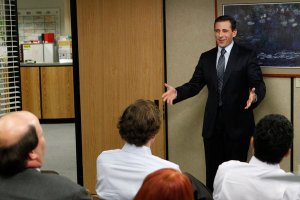
“The people who you work with are just, when you get down to it, your very best friends. They say on your deathbed you never wish you spent more time at the office. But I will. Got to be better than a deathbed.” –Michael Scott (Steve Carell), in “Goodbye, Michael”
It’s probably tiresome at this point to compare the American Office with the British one, which went off the air just before its US cousin debuted. But those two quotes represent the similar themes of the two shows, their different spirits and the way each ended–in one case the series, in the other the star–in a way that was distinctive and right for each.
The UK office ended on a bittersweet note, and Tim’s quote perfectly captured the show’s theme of the absurdity and randomness of the connections one makes at work. Michael Scott, on the other hand, has spent 19 years at Dunder-Mifflin immersed in the job and the people around him. For him, and his magical-thinking way of viewing the world, there is nothing random or arbitrary about these connections at all. And in a performance well modulated between ridiculousness and poignance, Steve Carell showed Michael saying goodbye not just to his friends, and to a good part of his life.
“Goodbye, Michael” focused as well on what Michael had meant to his staff. Toward the end of the episode, Jim Halpert sees Michael in his office and, playing along with the fiction that Michael is not leaving for another day, says: “Tomorrow I can tell you what a great boss you turned out to be.” NBC has been playing the line in advance, and in the clips it came across simply as a sentimental goodbye, but there’s more to it—the operative phrase is “turned out to be.” The farewell, from Office producer Greg Daniels, was very conscious not only of the goodbye moment, but the arc of the show’s run over seven seasons and the way Michael’s relationship with his colleagues has evolved over time.
I’ve written about this before, but the development of Michael Scott into a sympathetic and even (sometimes) competent boss and person is more than a cultural difference with the UK version; it was also a necessity of American TV’s longer schedules and the series’ longer run. It would beggar belief for David Brent to stay on the job for seven seasons and dozens of episodes.
So Michael moved on from the cringe-making boor we met at the beginning of the series. Part of this was evolution (he matured over time from a man-child with a loose relation to reality and developed some self-awareness) and part revelation (we had to see that he had been good enough at his sales job, and thus dealing with people, to have got his job in the first place). But it was a process: the Michael who is leaving to make a life with Holly is more mature, but he still has aspects of the old Michael.
So his sendoff served two purposes. First, structured as a series of goodbyes, it give him a moment with each of the significant characters on The Office, in a plausible way. But it also gave us glimpses of each stage of Michael as we’ve known him, the good and the bad. There is still the hilariously inappropriate Michael: the one, for instance, who gives Kevin a caricature of him as a pig eating pizzas in the belief that he’s giving the “gift” of motivation, or who still can’t hide his contempt for Toby.
But there’s also the Michael who has the emotional insight to give Erin fatherly advice about her romantic dilemma, and to surprise Phyllis by making a sweet rather than offensive remark about her having been cute in high school. (“I thought he knew about the baby I gave away.”) And in his giving away his best clients to Andy, we see both Michaels: the move is undiplomatic and insane but it also ends up being—in an elliptical, Rain Man–like way, perceptive and, yes, wise.
One of the funniest and most exemplary of Michael’s goodbyes was with Oscar, whom he gives a crudely-made scarecrow (in honor of Oscar’s “brains”). The gift is ridiculous, and you laugh at it—but then we cut to Michael, who is cracking himself up over Oscar’s condescending thanks over the present, which Michael created on purpose to look like it was made “by a two-year-old.” (“He has the lowest opinion of me of anyone ever!”) An earlier version of Michael could never have done this—he couldn’t have been self-aware enough to realize how Oscar saw him, sophisticated enough to play into it or mature enough to laugh about it, entirely in good humor.
Just as your last day on a job is not necessarily going to be your most memorable, this episode, with its necessarily checking-off-a-list structure, may not be remembered eventually as one of The Office’s all-time best. But Daniels came up with the excellent device of having Michael go through the process of saying goodbye to everyone, one by one, without their knowing that he was saying goodbye for the last time. The Office is at its best—as is Carell’s performance—when it’s playing with the tension between outer facades and inner feelings.
And watching the tension on Carell’s face as Michael, the worst-secret-keeper in America, struggles not to let on that he’s going for good at 4 p.m., gave what could have been one long curtain call a special emotional resonance. Having Michael try to deflect his sadness by trotting “Ping” into his last staff meeting was the most moving use of a racist comic persona I ever expect to see.
At the same time, “Goodbye, Michael” allowed us to see the distinctive relationships that Michael has established with each of his coworkers. Dwight has often stretched the bounds of cartoonishness, but it was good to be reminded that, yes, Rainn Wilson is an actor; the way he showed Dwight containing his emotion by trying to critique Michael’s recommendation while reading it was measured and excellent. God help me, Dwight Schrute made me cry.
The episode also returned to the show’s structural roots, with several references to the documentary crew that (wisely) the show does not call too much overt attention to. (“You guys are filming people when we go to the bathroom now?”) The last allusion was absolutely beautiful: “Hey, will you guys let me know if this ever airs?” Michael says—an un-mics himself, effectively cutting himself off from us after seven seasons. Then Pam catches up with him at the last moment at the airport, saying goodbye to him silently outside of microphone range (a device the show has occasionally used for past, earned emotional moments like Jim’s learning that Pam was pregnant).
When The Office began, it would have been hard to imagine that it would become a story of personal growth, but that’s what it turned into. Michael Scott never became perfect, but over the seasons—from the first introduction to his horrible time with Jan to the Michael Scott Paper Company and finally reaching happiness with Holly—we saw him become ready to stand on his own. Although the show didn’t harp on it, the show was really about Michael’s search for family: even more than he wanted to be a comedian or a movie director, Michael wanted to be a husband and a dad, but he had to go a long way to be ready for it.
And for a long time, the Scranton branch was the practice family that helped him learn—at the end of which, he was ready to walk down the hall of that airport terminal and, finally, fly.