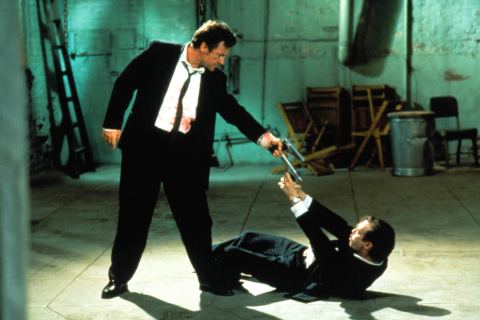
Reservoir Dogs

Just before making his first feature, Quentin Tarantino shot a long-take dialogue sequence at a Sundance workshop and showed it to three veteran directors; they all thought it stank. The next week, a new group of directors came in; this time there were raves for the same sequence. Tarantino says this taught him an important lesson: “People are gonna really like my stuff or really not, so get f—in’ used to it.” Enough people really liked Reservoir Dogs‘ crime-caper machismo — all the long coats and long takes, the ornate argot and the ear-cutting scene — to set QT on his epic Pulp Fiction, unquestionably the definitive movie of the ’90s, which grossed $100 million at home and another $100 million abroad. Not bad for a video savant.
El Mariachi

Robert Rodriguez’s idea was to make three cheapo Mariachi movies for the Mexican home-video market. “Then I was going to clip together the best scenes for a demo film to get backing for a real feature film, like sex, lies and videotape or Reservoir Dogs. And then I was just going to explode out of nowhere. That was the original plan.”Alas, overnight success got in the way.
This funny-grungy “taco Western,” which the 24-year-old writer-director-producer-cameraman-editor-craft-service-guy made for a preposterously low $7,000, won the Audience Award at Sundance, was bought by Columbia Pictures and earned about $2 million in theaters. “If I thought a lot of people were going to see this,” he said, “I would have changed a lot of things that people ended up liking.” In the end, Rodriguez didn’t go Hollywood; Hollywood went Rodriguez. The do-it-all auteur still makes his movies in Austin, Tex., where he’s turned experiments in 3D and green-screen into hits like Spy Kids and Sin City (which had a scene shot by Tarantino). Like El Mariachi, these cunning, high-adrenaline indies are made for audiences, not film festivals.


