



FOX
Spoilers for last night’s Glee coming up:
One of the many tightropes that Glee walks is that it makes a dramatic argument against stereotyping while employing many characters who are in some ways stereotypes themselves. This is not necessarily a criticism. At best, it can be a way of further complicating the show’s stories about difference and acceptance: just because a character seems stereotypically gay, for instance, does not mean that person is gay, but it also does not automatically mean they’re not gay, &c. Likewise, the show takes risks, sometimes successful and sometimes not, by taking a serious subject—teen pregnancy, religion—and treating it earnestly and with bizarre comedy at the same time.
All this balancing can pay off, as in the flawed but intriguing “Grilled Cheesus” episode earlier this season, or Artie’s stories in “Wheels” and “Dream On.” But it also means that when Glee decides to get dead serious about something, as “Never Been Kissed” was with bullying, the result can be a series of forced moments, preachiness and mixed messages.
Let’s start with the main bullying storyline, whose founding flaw may have been that it was essentially Glee deciding to take very seriously a problem that it had taken not so seriously in the past. The first time we saw Kurt, after all, he was being thrown into a dumpster, which may play like harmless comedy on TV, but in real experience would be anything but.
Kurt’s harassment by the jock—who himself turns out to be a stereotype, the overcompensating closet case—is played as more violent and hostile, and Chris Colfer is a strong enough actor that he sells that, this time, Kurt is genuinely frightened and disturbed by it. Still, in the context of the show, it comes across as a sudden change in attitude dictated by the script: this bullying, it appears to say, is real bullying, and we must take it seriously.
Now this makes sense on one level. Kurt is more assertive and confident now that he’s out; he’s more conscious of homophobia and more willing to call it out. But bullying is not just about being offended. It’s an extended, concentrated and terrifying effort to crush someone and deny their humanity. It is serious, as “Never Been Kissed” recognizes. But because of that—especially given the spate of suicides among gay teens—Glee suddenly has to find an entirely new mode of dealing with it than it’s used for a season and a half.
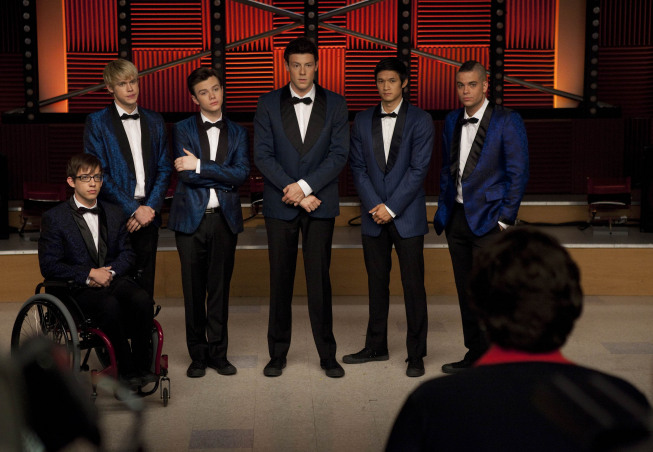
So it goes into afterschool special mode, with Kurt discovering a paradise of tolerance, and a potential love interest in Blaine, at the boys’ academy. Again, there’s no denying the good intentions: demonstrating that there’s another way, that bullying isn’t inevitable, that it gets better, &c. But by contrasting McKinley High with an almost otherworldly paradise—a Teenage Dream indeed—the episode passes on the more interesting challenge of showing an actual flawed high school dealing with the problem. Instead, the choice is between dysfunction and perfection. (It also flattens out some of Kurt’s complexities; after all, he is picked on not simply because he’s gay, but because he is dramatically and resolutely different.)
Which is too bad, because throughout the episode there were the seeds of something better. Kurt’s dawning realization that McKinley, in a hundred little ways, accepts behavior that is just not cool, is potentially fruitful, but the way “Never Been Kissed” addressed its topic shut that messier, more interesting avenue down. The episode is evidently part of a longer arc dealing with bullying, and its saving grace is that it at least centers the story on Colfer, probably the strongest actor with the most interesting character among the Glee kids, so I’m hoping it can turn around.
Meanwhile, the subplot tried to mirror Kurt’s outsider experience with Shannon Beiste’s, but didn’t do justice to an interesting character. From the get-go, the storyline seemed to be trying to have things two ways: we learn that the kids’ objectification of Beiste is cruel and wrong, but first we get several scenes in which we’re invited to join in on the joke by seeing her portrayed as a boner-killer. (And that’s beyond the introduction of the character, who after all has a name that rhymes with “beast.”)
Again, an idea that, on paper, could be brilliant: the show is making the audience complicit in her humiliation, then brought to see the problem with it. (And in contrast to the gay-jock stereotyping, I liked that the episode not only made the point that Beiste is not gay, but that she’s used to people assuming that she is.) But the attempt was undercut by turning Beiste from an object of derision to one of pity, as she gets a tearful moment with Will that he ends by—with amazing condescension—kissing her as if he had romantic interest in her even though he doesn’t. (Was I the only one who thought that this was actually worse than the kids’ fantasies about her? Will, after all, is a grown man.)
If there’s a show that could pull this off, it’s Glee, which is alone among today’s biggest TV shows in telling stories about gender nonconformity. But to do it really effectively, it needed to make Beiste a real, three-dimensional person before it made her an object of pity. (And it wouldn’t have hurt, too, if the music were better integrated; having girls-vs.-boys gender-switching songs in an episode about gender stereotypes felt like a missed opportunity here.)
The irony of all this was that Puck’s subplot may have actually been the best and most authentic of the night, even though it stemmed from the ridiculous premise of his suddenly disappearing for trying to steal an ATM. Credit to Glee for not simply forgetting that storyline, as I thought it might, and for giving Mark Salling a chance to showcase some genuine, but not overstated, acting, as he dealt with learning that there are entire levels of thuggery beyond his high-school tough-guy act.
I often want to give Glee extra credit for effort, because it’s a show that’s so fascinating even when it doesn’t work and tries things other TV shows would not. But there’s a flip side to that: if there’s any show that should have been able to pull off an episode about cruelty and gender conformity, it’s Glee. The problem here, ironically, was the opposite of the one Glee often has, which is sacrificing plausibility in the interest of pushing buttons; “Never Been Kissed” seemed so interested in doing the right thing that it fought against the complications and ambiguities that are the heart of Glee.
I will give it credit, at least, for committing to this storyline for a multi-episode arc rather than giving it one Very Special Episode and dropping it. Let’s hope the next try is better.