



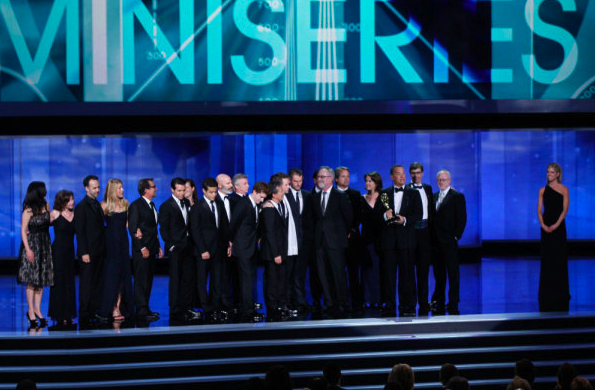
Tom Hanks and entourage collect another Emmy for HBO's The Pacific. / NBC
The Emmy Awards are over, but as always, the complaining about them isn’t. This year, however, the gripes are not coming from critics—who mostly found it in our two-sizes-too-small hearts to enjoy this year’s Emmycast—but from the major broadcast networks who televise them.
Their beefs are various, but they simplify to: we’re not winning enough awards, and we’re tired of giving free advertising to the cable networks that do. Among the changes under discussion: shunting off the most cable-heavy portion of the Emmys to a separate telecast, or starting a new, and more broadcast-friendly, awards show altogether.
One buzzed-about threat—that networks would stop airing the Emmys altogether after their current deal expires—seems to have subsided after the big broadcasters at least picked up a few nods (Modern Family, The Good Wife, The Big Bang Theory) at Sunday’s Emmys, whose ratings stayed roughly on par with recent years. Currently, the Emmys rotate on a “wheel” among ABC, CBS, Fox and NBC.
But the networks have been talking about creating, with the help of the Paley Center, a new TV awards show that—maybe by incorporating some type of fan voting—would skew toward shows with more mass appeal (read: shows on broadcast networks). I have nothing against awards shows per se, nor the idea of popular voting for them. (I’m not sure fans at home could do a worse job than the Emmys have in some past years.) But the idea of creating a show expressly designed to let big broadcasters collect hardware and pretend their shows are better than they actually are would be a terrible idea. (Especially under the auspices of The Paley Center, whose mandate is celebrating great TV, not doing publicity for the biggest networks.)
OK, I’m a critic. Therefore, I’m an elitist. I believe awards shows should honor the best work, period: no grading on a curve. Nobody has ever said: “You know what, this show sucks, but considering the business pressures and content restrictions the network has to operate under, it could be worse, so I’ll watch it anyway.” And there is, as I’ve said, already an award for the most popular shows, and they call it the Nielsens. A popular show can be creatively great, but it’s not creatively great because it’s popular; if that were the case, there would be no reason to have awards at all.
But really even the most populist awards and TV fans are elitist as well. Even something like the People’s Choice Awards is based, rightly, in the premise that works should be recognized for something other than sheer mass appeal. The most populist awards show is still about rewarding a work for something other than the raw number of people who consume it. Maybe it’s recognition by a small circle of professionals and colleagues, maybe it’s voting by fans, but either way, the premise is that something—artistic quality, or intensity of fandom—matters more than simple ratings.
The “publicizing cable on our own dime” argument is specious too. It’s not as if the big networks air the Emmys as a charitable service; all those ads you saw in the awards and red-carpet show were not public service announcements. And after all, if the problem were really that broadcasters were unfairly publicizing the competition, they could just share Emmy-airing duties—the whole awardcast, not just part of it—with cable channels that want to participate. Except, oops, turns out the big networks have resisted that too.
The broadcasters’ other complaint, and possible solution, is more reasonable. The movies and miniseries category has become almost entirely dominated by HBO, because HBO, a scant few other cable channels, and sometimes PBS, are the only ones making movies and miniseries anymore, and we’re probably not going to see an Emmy for Syfy’s Mega Python vs. Gatoroid. The third hour of Sunday’s Emmys was basically a massive DVD ad for The Pacific, Temple Grandin and You Don’t Know Jack. Now the networks are talking about shunting off those awards to a separate broadcast (probably on cable).
Fair enough. This move I could see—not for the broadcasters’ sour-grapes reasons, but because, for this viewer, it makes for a long, predictable dead spot in the awards night. I’m not sure getting rid of it will do the networks any favors; after all, it enables them to trot out stars like Tom Hanks and Al Pacino, and assuming they don’t cut the Emmys to two hours, they could well be replaced with something even more dull.
But let the broadcasters kick the movies and miniseries Emmys out of primetime if they want to. In fact, the way things are going, pretty soon they can kick the drama awards into cable too, since the big nets are less and less seriously competing there creatively. And comedy can go next. And the late-night comedy/variety awards, since those all go to The Daily Show now. In a decade or so, we can all settle in to watch a three-hour primetime Emmys devoted to the genres big-network TV seriously competes in: newsmagazine specials and reality shows.
Oh, except that Bravo’s Top Chef won the competition-reality Emmy this year. Oh, well: the Network Newsmagazine Emmys are going to be awesome!