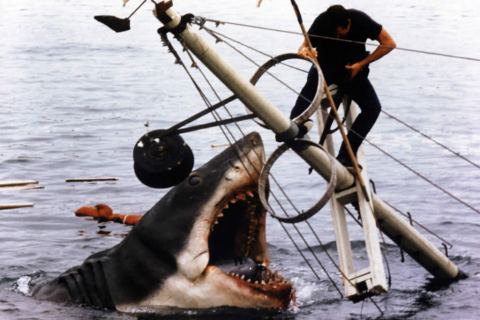
Jaws

In this, the first true summer blockbuster, a lone great white shark trolls the waters surrounding the small island community of Amity. Despite his fear of the water, police chief Martin Brody obsessively investigates the vicious attacks and eventually follows the beast out into open water — where it tries to eat him, his two fish-hunting mates and their boat. The shark makes for the ultimate predator, striking at random and for no apparent reason. The chilling John Williams score signals impending doom with its now famous minimal two-note theme, and Steven Spielberg’s wise decision to limit glimpses of the shark itself (caused mostly by the mechanical fish’s talent for regularly malfunctioning) resulted in many an audience member questioning whether or not they would (or could) ever step back into the ocean.
The Birds

Birds are not inherently scary. They’re small and have hollow bones and mostly keep to themselves unless someone’s handing out bread crumbs. So give credit to Alfred Hitchcock for masterly turning our fine feathered friends into terrifying agents of destruction in his 1963 thriller The Birds. What Hitch realized was that, while a single bird can easily be swatted away, a whole flock of them is a nearly unstoppable wave of feathers, talons and beaks. Indeed, what makes The Birds unique compared with other killer-animal films is the extent to which our heroes (society girl Tippi Hedren and smarmy lawyer Rod Taylor) are impotent against the ornithological threat. They can’t fight back; they can merely watch helplessly as the birds ram into windows, poke out farmers’ eyeballs and stab the exposed fleshy bits of terrified schoolchildren. In the end, there is no victory: the humans simply run away, hoping they are spared from the next unexplained avian apocalypse. Truly, the beaks have inherited the earth.


