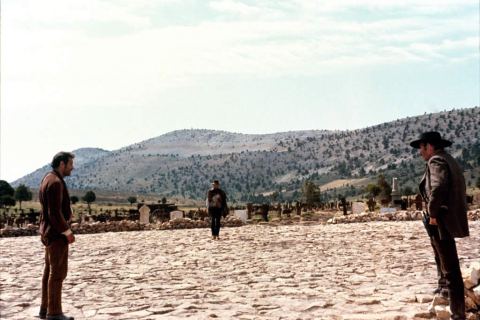
Sergio Leone’s most famous spaghetti western culminates in what’s possibly the greatest standoff in film history. The movie’s three titular characters converge on the rumored site of buried treasure — a graveyard in the desert — and, in a scene of spine-tingling tension, face an ultimate reckoning. It’s a dramatic masterpiece. Building in an airy stillness with each twitch of the jaw, each grimace, each cold, calculating look, the set piece has an almost cosmic majesty. Underlying the whole thing is the score of legendary Italian film composer Ennio Morricone. For this climax, he was reportedly instructed by Leone to make it sound as if the “corpses were laughing from inside their tombs.”
Ah, the Black Knight. Has anyone ever suffered from greater denial? His classic confrontation with Arthur, King of the Britons, in Monty Python and the Holy Grail took cinematic duels to a whole new hilarious level. Arthur, of course, doesn’t want to fight the Black Knight, who disappointed him by ignoring his invitation to join the Round Table (as the monarch explains, “You make me sad”). But Arthur has no choice when the knight blocks his passage. And that’s when limbs start to fly, demonstrating the Black Knight’s remarkable pain tolerance and capacity for self-delusion. “‘Tis but a scratch,” he insists after his left arm is sliced off. Besides, he’s “had worse.” And the right arm? “It’s just a flesh wound!” Undeterred by his lack of arms and sword, he kicks. And when he’s down to one leg, he head butts. When the Black Knight is but a head and torso, he continues to taunt his reluctant opponent, who is free to ride off on his imaginary horse.