
Tuned In

Mad Men Watch: A Welcome Distraction

AMC
AMC

SPOILER ALERT: Before you read this post, order out for some fried chicken and watch last night’s Mad Men.

After two episodes that took in a pretty wide swath of characters, updating and establishing a number of storylines, “The Good News” closed back in to focus on three Mad Men characters: Don, Joan and Lane. It took place on and around the New Year’s holiday—holidays being a theme of the three episodes so far this season, so look out, Feast of Epiphany!—and dealt with the theme of vacation, as each character attempted to escape troubles that are in the end unescapable.

Don Draper left New York for the New Year’s holiday looking for a break, a little restoration, emotional and physical. A little sand and sun in Acapulco, a heart-to-heart with his ex-in-name-only wife and confidant Anna and, he ends up hoping, a little somethin’-somethin’ with his former fake niece Stephanie. (Former fake niece once removed? Divorce and sham marriages make things so complicated!) But upon putting the moves on the young lady in his rental car—which, ewwww—Don learns something as weighty as any trouble he was trying to escape: Anna has terminal cancer and very little time left.

(I will have to take on faith, by the way, that it’s an accurate representation of medicine circa 1964 that Anna’s sister could have learned her diagnosis from her doctor and made the decision with him to hide the news from a terminal patient. Certainly Don seemed about as surprised as I was.)

The news is a multiple blow to Don. It threatens the one healthy long-term platonic relationship he has with a woman. (Ironically, the woman whose husband’s identity he stole and whom he sham-married and divorced is one of the few women in the world that Don can say he’s truly done right by.) It takes away a support he was seeking after the breakup of his marriage; he can confide in Anna because she may know more about who he really is than anyone. She affirms and tries to understand him without judging. She tells him, “I want you to do everything that you want to do,” which is not necessarily something Don has had a problem with, but it really means that she gives him permission to truly be himself—which has been impossible for him. Just as he is having his crisis of identity—”Who is Don Draper?”—the one person who is closest to Don Draper’s formation, the woman who is more Draper than he is, is dying.

I know the California episodes of Mad Men have divided fans in the past (e.g., “The Jet Set”). I like, though, how they provide contrast for the show’s depiction of both Don and the era. As the show moves to SoCal, the palette and the references change. You begin to realize that Mad Men’s distinct take on its era comes largely from being set among the East Coast establishment. So much of what we would normally associate with “a TV drama about the ’60s” is connected or originated in the West, as we saw here: student protests (referenced in the Berkeley sit-ins), surfer music, people smoking grass and referring to it as such.

Moreover, Don is a different person when he’s in California—literally, as “Dick,” and figuratively. We’re so used, I think, to seeing how Don carries himself, like a movable fortress, that it’s hard to remember that it’s Jon Hamm acting. But in these scenes, with Don/Dick in open collars and hanging out informally, Hamm shows the physical lightness that comes over him here; it’s like he’s just shed a 75-pound backpack. With Anna’s news delivered to him, Don has to shoulder a new weight, and he ultimately decides—right or wrong—that the best thing he can do is to carry it with him, just as Anna’s sister told him to. Rather than tell her (which might have been a service he uniquely could provide, precisely because he’s not part of the family), he stays a little longer, repaints her water-damaged wall, and leaves a note, “DonDick & Anna ’64,” like an epitaph and leaves her believing that he’s crying for himself.

Joan, meanwhile, gets her first sustained screen time of the season and it also ends in ambiguous tears. We open the episode learning that she wants to have a baby with Greg (worrying to our favorite chain-smoking gyno that her previous two abortions may cause complications). The question for her is perhaps not what she’s crying about—beyond the finger-slicing that precipitates the breakdown—but what isn’t she crying about? Her anxiety about Greg’s impending (though he’s still in denial) shipment to Vietnam? Her anxiety about a baby? The string of disappointments in life that have led her to this situation? Or is it a simple release from having always to be hypercompetent and in command—taking charge to fire Lane’s secretary on his behalf even as she’s furious with him for denying her time off—and, for once, literally putting herself in someone else’s hands?

Lane for his part serves as the bridge between Don and Joan’s stories, and his personal crisis was probably the least compelling, partly because it occurred offscreen, partly because it was a fairly generic story of marital strife. (The kind of very generic strife that it seems perfectly appropriate that Lane would have, but still.) But the construction of the episode was intriguing, as it revealed, after the fact, that Lane’s hardassed attitude toward Joan (and everyone) was affected by his crisis on the home front. And it was a revelation to see Jared Harris show us the wild man who’d been stoppered up for so long in that proper English bottle, as Don took him out for a boys’ night of monster movies, comedy and whores. There’s something almost childlike about Harris’ performance as Lane—he’s like the class prefect excited and grateful that one of the popular boys has given him a night to be bad.

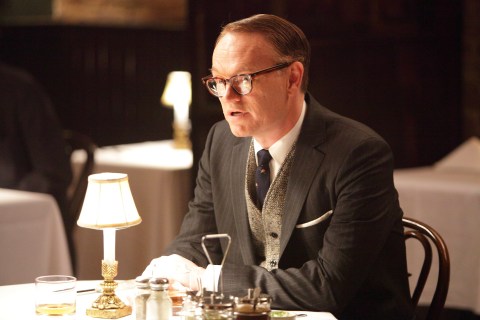
But it is a vacation, and we see that Lane knew full well that Candace’s “friend” was a hooker. It was a lie, but it’s the thought that counts, and he takes a moment to thank Don for it before he leaves, leading up to maybe the episode’s strongest image, that tableau of the characters back at SCDP, as Joan says, “Gentlemen, shall we begin 1965?” In another context, it might read as a very optimistic line—as Lane said, it has, for all the pain, been a remarkable 1964—but not after the events of this episode. Vacation is over, the morning light is harsh and it is back to business.

A quick hail of bullets:

* Anyone ID the Japanese monster movie Don took Lane to? My guess is Godzilla vs. Gamera, which I believe is period-correct (I was a big fan as a kid), but I may be wrong. Update: On closer inspection I must be wrong—not sure if they ever battled—but in any case I can’t make out which monster picture this in fact was. (Also, nice fakeout: I thought for sure cinephile Don would go for The Umbrellas of Cherbourg.)

* As pitiable and loathsome as Greg has been in his past, it offered some nice shading for his character to see him actually competent in his field—even if in as small a thing as stitching up a hand. Joan’s initial insistence on the hospital (“Isn’t there some medical-ethical law against operating on your wife?”) also made me wonder whether she trusted him to do the job right.

* The rose mixup made me laugh as hard as anything on Mad Men in a long time—especially the foul-up being compounded by Lane’s wife receiving flowers with the note, “Joan, please forgive me.”

* Did Don tell Lane, and Candace, that his spare room was off-limits because that’s where his kids sleep when they visit? It’s also interesting to see that he and Candace have something like a relationship beyond face-slapping—a professional relationship at least. (Also, here again I am taking on faith that $25 was the going rate for a night with a hooker in New York in 1964.)

* As in Don’s earlier visit to California, it offers him a brief encounter with the future: in this case Stephanie, a member of a generation whom Don’s business (like Don) covets, but who increasingly has contempt for the consumer ideal: “It’s pollution.” “Then stop buying things.” “Don’t think it can’t happen.” The future may be even more tougher.

Related Topics: Television, Tuned In
  • Latest on Entertainment

    IFC Films

    Kerouac's On the Road Comes to Cannes: Where's the Beat?

    Walter Salles’ film of the Beat Generation classic wastes a strong cast, including Twilight‘s Kristen Stewart, in a needless tribute to ’50s wanderlust

    Surprise! The Lowest-Rated Show in Broadcast History Is Actually GreatSlate

    Adam Rose/FOX

    Glee Watch: NYADA, NYADA, NYADA

    Spoilers for the season finale of Glee below:

    One beef I often have with Glee episodes is that they move too fast, go in too many directions, try to cram in too much at once. You might say that about “Goodbye,” the season 3 finale, but in this case that approach seemed about right. It’s an episode about graduation, and graduation is something that, no matter how much you plan for and anticipate it, still goes too fast. Graduating is something you do, but in the moment it feels like something that happens to you, suddenly and all at once, like going over a waterfall.

  • http://www.monstersoftelevision.com/ Noel Kirkpatrick

    Gamera didn’t appear until late 1965, so not sure which one it was, unless someone got the movie dates wrong on the production side of things.

  • charlieromeobravo

    I loved The Good News. Each character a touch of melancholy that was beautifully delivered. Poor Allison still looking at Don and trying to figure out if there’s any subtext to his question “What are you dong for New Year’s?” I think she’s still curious about him, or a little hung up on him. Don left town looking forward to a break and instead got smacked with the worst news he could probably ever hear. Lane’s marriage trouble had been weighing on him and was comically brought into focus. Joan’s fears for the future were especially sad I thought. I wonder what kind of year 1965 will be. The air is thick with potential human scale tragedy….

  • http://twitter.com/poniewozik James Poniewozik

    Actually, you’re right, scratch that: does not appear Godzilla and Gamera actually battled.

    http://en.wikipedia.org/wiki/Gamera

  • pathologickt

    Hiding a terminal diagnosis from a patient still happens today – I’ve seen it occur with families of non-English-speaking patients here in Australia (I’m a doctor – I wrote an essay on the subject during medical school). It’s a cultural thing and differs around the world. It’s a medical ethics minefield.

  • http://twitter.com/poniewozik James Poniewozik

    This I could see, since (I assume) the patient has to rely on intermediaries who speak English. I was left wondering how, simply logistically, it would have happened with Anna. The doctor reached a diagnosis and–I’m trying to determine for what reason–chose to call her sister instead? Because he thought it best to hide the diagnosis from her? I’m not saying I don’t believe it, I’m just genuinely curious how common this is or was in 1960s America. (Or for that matter, now.)

  • lubanj

    That was “Godzilla vs. The Thing” (aka “Mothra vs. Godzilla”), which opened in New York on Nov. 25, 1964.

  • healthspiel

    On the cancer no-tell, it was very common (& legal) up through the ’80s, believe it or not! In fact, it was funny that one of the films that was listed was “Send Me No Flowers” (a Doris Day-Rock Hudson film that most definitely would not have been a serious choice for boys night out…). We got the reference to Lane’s flower mix-up, but it deals with a hypochondriac (Hudson) who asks his physician whether he would tell a patient if he had a terminal illness — the answer is no, as long as his will is up-to-date & insurance in place! Paternalism ruled medical practice in the golden years of medicine & patients were thought to be too delicate to hear such news. Patients’ rights movements didn’t really grow in earnest until the ’70s…Also, another factor in the physician’s perception of compassion was the serious lack of real treatments to offer. But the main thought was “innocence is bliss” where diagnoses were concerned…Makes me wonder what Joan’s gyno really thought/knew about her future fertility too…

  • evietoo

    This episode finally didn’t feel hopelessly grim, despite Don losing the only person who loves him unconditionally — probably because he was not fall-down drunk through the whole thing, and we were spared the details of his hooker sex. And I liked hearing Lane say it’s been an extraordinary year. It’s the first time anyone has said anything remotely positive about the move.

    Notice they finally got a conference table as well? Things are looking up.

  • stopper474

    The price for prostitutes was mroe than $25 (I seem to remember that it had been mentioned at some point that it was $100, but that simply good be my prurient imagination).

    Don was treating Lane, but knew that Lane was a money guy so once he brought it up, he knew that Lane wouldn’t let it go until he paid something, so Don just through a low number out there. That’s how I took it anyway.

  • sherrildc

    When my aunt had terminal brain cancer — in 1964 in fact — her husband and her doctor decided not to tell her about it. She was told she had a benign tumor and eventually figured it out on her own. Remember that this was before Elisabeth Kubler-Ross and the stages of grief — a terminal diagnosis was just terrible news back then, not something the patient needed to process and fight. I can imagine a doctor deciding that the diagnosis would be too much of a shock for her already fragile state.

  • Scott Hamilton

    The movie shown was probably supposed to be Gammera the Invincible, the American release of the first Japanese Gamera film. It was the only one in black & white and the only one to play in theaters in the US.

    However, it was highly anachronistic in the scene by not just one year, but two or more. Gammera the Invincible didn’t start its US run until the end of 1966, and I don’t think it played New York until much later if at all.

  • rhys1882

    The movie is definitely “Gamera” – the first Gamera movie, and the timing is wrong. Gamera and Godzilla don’t fight because they are competing franchises. Gamera was created by a rival Japanese study to try and capitalize on the success of the Godzilla movie.

  • mathomhouse83

    I enjoyed last season immensely. I liked the interaction/lack of interaction between the characters Betty and Don. It paralleled my life then. Now, I am a jaded old woman. This year’s episodes are not resonating…Do you have different writers?

    Cancer: I have not had every form of cancer known to man, but did have lymphoma twice: 1975 and 1987. The pain was so bad a year before I was officially diagnosed that life would have been unbearable with strong pain pills that I was able to obtain from my doctor. The fatigue alone is debilitating. I am very stubborn and must have a high pain threshold because I was working on a project and did not have time to be sick. “Give me a break,” the character Ann would know she was deathly sick and would not wake up in a bouncy mood to cheer Don on as he painted the wall in his shorts. Who would paint with no protection on the floor and furniture? Who wrote this episode?

  • iamnotpete

    But her sister thinks that if Ann notices any pain, she’ll attribute it to the polio. Does this make the scenario more believable?

    Also, I have a friend whose uncle was diagnosed with brain cancer as late as 89/90, and neither his doctor, nor his family told him about it.

  • daveyde1886

    Although I have been an avid fan of Mad Men since day one, I found this weeks episode boring. Damn near fell asleep. Have this award-winning series’ writers burned out? Maybe they have a new crew of writers this season. If so, bring back the former group of amazing writers. Am I alone in this regard. . . or was I just suffering from too much scotch and cigarette smoke?

  • mathomhouse83

    To daveydei886…’right on’ The last episode was boring. Don, the character, seems bored.

    Oh, I also liked his interaction with his children last season. He’s very loving to his children. Betty is not nice to her babies.

    Pain/cancer…there is also ‘denial’ We can know we are desperately sick and if one does not acknowledge it, one does not have to accept it. I maintain the pain is so bad it is almost unbearable. There are all kinds of ways to dull pain…maybe the writers will explain, after the fact. I just found the scenes unbelievable.

    My favorite death scene…Marlon Brando in the garden with his grandchild…”The Godfather”, just a peaceful dozing off.

  • shara says

    It reminded me a bit of the early scene in season one where Betty confided in her shrink, only to have the shrink call Don to discuss the case and what she had talked about after the session.

  • sirdonic

    She was also self-medicating her pain with the grass, a subtle precursor to today’s medical marijuana movement, especially in California?

  • http://sunkenanchor.wordpress.com antena99

    Yes, James, I too would look forward to the arrival of “Monster Week” on the Channel 7 Four O’Clock movie in Detroit. Sadly, that timeslot is now occupied by Oprah [insert your own Gidrah the Three Headed Monster joke here].

  • rosseau

    SCDP is continuing the curse of the harmful secretaries: one mangled a guy’s foot; another mangled a guy’s marriage. They should really work on their hiring strategy.

    The episode was the best yet of the season, meaning it just was incredibly sad. Three lean stories focused on three characters, segueing from one to another with elegance. The theme for me was loved ones leaving. The episode played with the divide between the characters’ emotions and the viewers.’ I’m kind of indifferent to the Anna character. I know she is Dick’s sanctuary and I’m happy he’s happy when he’s with her, but frankly, as Seinfeld said, it doesn’t do anything for me. So getting cancer was not as shattering for me as it was for Don. Notice he let the sister continue thinking he slept with her daughter.

    On the other hand, Lane’s adventure with Don was just so sad. Jared Harris really sold the role of a very lonely man who has realized there’s little to live for and so abandoned himself. The whole night from the movie to the comedian to the dinner and the hook up was just so forlorn and pathetic. To me. To Lane, it may have been just what was needed. He may have kept his dignity intact and felt no shame, or felt it and chose to ignore it.

    The middle story with Joan also played on disparate emotions. Though her fiance’s mending was not a redeeming quality–he became more of a egotist jerk. He patronized her, treating her like a child patient, and put her finger at risk by operating on her without proper sterilization and with shaky hands, in a living room, not a hospital. Joan will probably see him as a creep soon enough. Oh and Don is totally marrying his secretary.

  • katy93

    The turtle sure looks Gamera-ish, but I have enough faith in the series being time-appropriate that I think it’s Godzilla vs. Mothra (M.W. won’t even use a phone or a lamp from 1965 in 1964, and Gamera is too verifiably out of context).

  • monya7

    To me, Mad Men could be subtitled, “The World as I Knew It Is No Longer”. It’s so often about characters responses as their ad-enhanced dreams settle into a disappointing reality, like a souvenir snow globe. After the rug has been pulled, they size up how their counterparts are coping and go for it, no matter how desperate and unfulfilling.

    Lane is another case in point. James, you’re so right about his responsible nature looking for acceptance by one of the fun and dangerous boys. He says that Don reminds him of that person.
    Btw, I think his meat belt buckle was a drunken salute to LBJ, and that the other diners thought so too. He’s atuned to US politics and culture (eg, his acknowledgement of racial shift during the Admiral fiasco while his American coworkers tow a “safer” dated line).

    As relaxed as Don is with Anna, he’s not real with her either. What would Anna say if she could’ve seen him shoving Betty around, calling her a whore after his many betrayals.? Or saying to the stewardess, “I’ve been married a long time; you get many chances”.

  • katon51

    Are you going to write this column every Monday? Is this the Man Man fan group or do you write this for the poor souls without AMC? It’s sounding a bit Monday-morning-quarterback-ish and is about as interesting as an art show critique. There’s a whole world of TV out there, James. Watch it – and get off the Mad Man analysis.

  • deweycrain

    Quote: “”"To me, Mad Men could be subtitled, “The World as I Knew It Is No Longer”. It’s so often about characters responses as their ad-enhanced dreams settle into a disappointing reality, like a souvenir snow globe. After the rug has been pulled……..”"”

    Oh Monya ….. Could your remarks be anymore topical, than they are? Is it the mid-60′s or is it 2010?

    Indeed — the World as We Knew it is No Longer….

  • abbydelabbey

    “the World as We Knew it is No Longer….”

    Mad Men fits for certain segments in American Society, but for too many in the early and mid-1960s it was a period of discrimination and a fight for equality. Johnson in his first state of the union address spoke about “The War on Poverty.” Life was pleasant indeed for the advertising folks and the corporations who sold us Coca Cola, Alka Seltzer, etc. (Something about liquids that fizzed — we even had a product called “Fizzies.”)

    But for the working poor, for minorities — it was not a land of martini lunches (brunches and breakfasts), board rooms with willing secretaries….

    It was a hard life. There was divorce, families broken, just like the rich — but there was also young men (many drafted) beginning to be sent to Viet Nam….

    I enjoy Mad Men, but I see that time through different lenses….

    I guess I think it would be better to say “the world we thought we knew never really existed”….

  • jump71

    I think Joan started to see Greg in a new, more positive light as he confidently handled a situation that made her panic. She became emotional when she thought about what would probably be his fate in Vietnam just as she was starting to have stronger feelings toward him.

  • chyooz

    “Paternalism ruled medical practice…patients were too delicate to hear the news”

    Matt Weiner must be wistfully recalling that final Sopranos episode when Tony and family are waiting (terminally) on his little princesa-to gun them all down

    You gunned a long way baby!

  • jump71

    19.1 This sets the scene for tragedy in the future for Joan. And I still think Joan and Don may be drawn together in the future – maybe due to mutual loss?

  • gnatalby

    It happened in a Jacqueline Susann novel– The Love Machine, I think. In that case a boyfriend is told and conceals it.

    So my guess is that it happened more than never.

  • barceno

    Re: Don and CA

    Did anyone else notice that baby Eugene’s birth certificate indicated that mom Elizabeth was born in Pennsylvania and dad Donald was born in California? Was that just to conform to the “real” Don Draper’s bio? Because Dick Whitman apparently was born in Illinois and his family moved East.

    Have there been any clues as to exactly where Betty and WIlliam grew up on Philadelphia’s suburban Main Line?

blog comments powered by Disqus