
Tuned In

Lost vs. Inception: Solving the Puzzle of Ending a Puzzle-Story

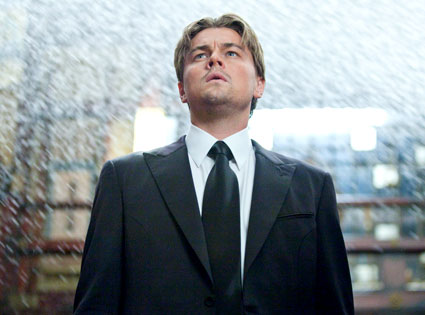
Leonardo DiCaprio as Cobb in Inception.

SPOILER ALERT: This post totally spoils the TV series Lost and the movie Inception. If you haven’t watched either and don’t want to be spoiled, stop reading. I said stop!

Over the weekend, Lost producer Damon Lindelof tweeted his admiration for Christopher Nolan’s new movie: “I wish that someone would break into my dreams and give me an idea HALF as good as INCEPTION.” If you’ve seen the movie (and a lot of you did, apparently) and watched Lost (and I have to imagine that Venn diagram has a pretty big overlap), you may already have thought that, in some ways, Lindelof already had that idea, and it was called “Lost.”

There are, of course, plenty of differences between the TV series and the movie. But there are also enough similarities—superficial and more deeply thematic—that the two raise some questions about the genre of the puzzle-like story, and what constitutes a good ending and a good narrative in it.

The superficial similarities are pretty glaring to any Lost fan seeing the movie.* The primary action takes place on a flight fron Sydney to LAX. (And the scheme—to plant an idea in a businessman’s head during a long in-flight dream—was enabled by the subterfuge of a mogul, though it involved buying the airline rather than faking a plane wreckage.) The entire story involved multiple levels of reality, leaving characters (and sometimes us) at points to doubt which level was real. Both stories had characters use an object (in Lost, a “constant”) to anchor themselves so as not to lose their minds. The very premise of the movie—that what you perceive as reality could all be a dream—was a theory advanced at one point for Lost. And in a larger sense, both were stories constructed on one level as puzzles—mind-pretzeling constructions that required the viewer to simultaneously juggle multiple narrative threads and timelines.

*Apologies in advance if I’m remembering any details of Inception wrong. I saw a screening a couple weeks ago, with no specific plan to blog about it.

I won’t give a review of Inception here, except that I thought it was an incredibly fun and satisfying piece of entertainment and a remarkable piece of plot-engineering, but not so much a work of art or or an especially moving story. (Cobb’s guilt and mourning for his late wife, and his desire to get home to his children, worked mechanically, but the relationships felt too generic to really work emotionally.) I don’t know if the movie wrote around every implausibility or hole—I’m still trying to figure out why, since the team had to rush the inception ahead of schedule, they nonetheless emerge from the dream minutes before landing—but as with Lost, I don’t really care that much.

What I’m really curious about, though, is how well Lost fans—those who loved and hated its finale alike—thought Inception handled answering its own questions and tying up its own ending.

ABC
LOST - "The End" - One of the most critically-acclaimed and groundbreaking shows of the past decade concludes in this "Lost" Series Finale Event. The battle lines are drawn as Locke puts his plan into action, which could finally liberate him from the island, on "Lost," SUNDAY, MAY 23 (9:00-11:30 p.m., ET) on the ABC Television Network. (ABC/MARIO PEREZ) JOSH HOLLOWAY, ELIZABETH MITCHELL

Obviously, a six-year series and a two-and-a-half-hour movie have different advantages and challenges. It’s easier, on the one hand, to tie up loose ends and make all the pieces fit together in a (relatively) short story for which you have a complete script before shooting. It’s easier, on the other hand, to develop characters beyond familiar situations and gestures if you have six years to deepen the story.

I was struck, watching Inception unfold, with how its elements meshed together in the way that the ideal version of Lost would have in many fans’ minds: the timeline of each dream-within-a-dream, for instance, resolved in sync with one another. But Inception was able to do this by using devices that Lost probably wouldn’t have been able to get away with: had the finale of Lost, for instance, in any way suggested that the series had been a dream, I’m guessing there would have been rioting in the streets.

But more important, consider the last image of Inception: Cobb finally arrives home to see his children. He sets a top spinning on a tabletop. The top, we learned, was a totem that Cobb’s wife had used in her own dream-travel; when she saw her personal object, she knew that she was not in the middle of someone else’s dream. (Or was it her own dream? Again—I saw the movie once.) The special property of that top: when she set it spinning, it would never stop. Cobb spins the top and goes to see his kids. The top spins. And spins. And wobbles. And spins. And—credits.

Your mileage may have varied—and you may have read the last image differently—but I thought it was a brilliant if infuriating question mark to end the movie on. Was Cobb really free at last, or was he in yet another dream? But I think it’s safe to say that if Lost had ended on a similar note of unresolved ambiguity (a la The Prisoner), fans would have gone absolutely nuts. [Update: Oh, and for all I know, audiences did at the end of Inception—that's a disadvantage of seeing movies at small press screenings.]

Of course—as we saw with Lost’s finale, which brought the characters together in the afterlife—not ending on a note of ambiguity has its own perils. Does Inception’s basing its resolution in science (albeit a “science” that amounts to “plugging wires into someone’s arm and entering their oddly literal dreams”) make all the difference?

Two stories with similar themes and similar pleasures, resolving themselves in very different ways. I don’t want to argue which is better—the apple or the orange—but for a fan of both, the TV series and the movie are an interesting study in how to build a story and a puzzle, and how to reconcile the story part with the puzzle part.

So, alumni of the Lost Discussion Group: what did you think of Inception?

Related Topics: inception, lost, lost discussion group, Uncategorized
  • Latest on Entertainment

    IFC Films

    Kerouac's On the Road Comes to Cannes: Where's the Beat?

    Walter Salles’ film of the Beat Generation classic wastes a strong cast, including Twilight‘s Kristen Stewart, in a needless tribute to ’50s wanderlust

    Surprise! The Lowest-Rated Show in Broadcast History Is Actually GreatSlate

    Adam Rose/FOX

    Glee Watch: NYADA, NYADA, NYADA

    Spoilers for the season finale of Glee below:

    One beef I often have with Glee episodes is that they move too fast, go in too many directions, try to cram in too much at once. You might say that about “Goodbye,” the season 3 finale, but in this case that approach seemed about right. It’s an episode about graduation, and graduation is something that, no matter how much you plan for and anticipate it, still goes too fast. Graduating is something you do, but in the moment it feels like something that happens to you, suddenly and all at once, like going over a waterfall.

  • ljolsen

    Interesting post, James. I found some of the same Lost connections, particularly the similarity of totems to the constants.

    In my interpretation of Inception’s ending, I had to return to the old Cuse-lof defense of the “its all a dream” interpretation. If the whole movie/series is a dream, then there are no real stakes and no reason for the audience to be invested in what’s going on. Similarly in Inception, I have to believe that Nolan didn’t ask us to watch 2.5 hours of stuff that didn’t really happen. I choose to believe that the stakes were real.

    That doesn’t mean that in the end he’s not dreaming, but I don’t believe that he (Dom) was dreaming the whole thing. That would be too much of a slap.

  • mstromenger

    I think the reasons for the rushed inception were that Saito got shot in the first level of the dream (didn’t want him to die within the dream) and that they got noticed way too soon in the first level (subconscious turning on the invaders). This didn’t give them much time to complete the mission (the guy in the van held on for as long as he could before he initiated the kick by driving off the bridge).

    On another note, I believe the ambiguity of Inception’s ending (although I have firmly come down on one side of the equation and believe there is plenty of proof to back it up) is acceptable to an audience because A) we hadn’t invested 6 seasons in the world, only 2 1/2 hours, and it doesn’t feel like a cheat on our investment, and B) just the nature of the film itself, the dream world, automatically opens up the possibility that ANYTHING we are watching in the film is a dream, even the “reality” ending. If this had been a film about doctors in a hospital (or people who crashed on a mysterious island), the jump to the “dream” possibility would suddenly feel like a solution out of left field, one that feels cheap and not thought through.

  • http://twitter.com/poniewozik James Poniewozik

    To clarify my question about the rushed inception: I get *why* they had to rush it. But I don’t get why rushing the inception did not in turn end the dream early, and thus have them awaken on the plane earlier than planned. Given what we know about the relative passage of time in each level of dream (a week in one = 6 months in the next = years in the next), wouldn’t accelerating the inception mean that they would have to awaken in the real world, on the plane, earlier?

    Or should I assume that the main dream ended and the various characters slept the rest of the flight under sedation, having various non-engineered dreams about losing their teeth, showing up to class in their underwear, &c.?

    Maybe I’m not explaining it well. Also, maybe I’m not understanding it well.

  • mstromenger

    Ahh. I get your point. My only thinking is (and I’d have to rewatch the end sequence on the plane to make sure), that Cobb and Saito wake up later than everyone else. I may be remembering this wrong, but I think they show Cobb waking up, looking around and seeing the rest of his crew already awake, smiling at him, then Saito wakes up and makes the phone call. BUT…in thinking on this, I believe they show Fischer waking up too…which blows a hole in my short-lived theory that Cobb and Saito woke up later because they spent more time in limbo than the others did in the dream. :)

    But your point is well taken. I’m just glad to have a film that still has me thinking about it days later. This happens more often with TV shows than movies these days. Glad there are still filmmakers out there willing to put out a project like this.

  • archstanton68

    I think this is accurate. It’s also possible that Fischer was more heavily sedated than the rest. I assumed there was some time between them actually leaving the dream and waking up from sedation, since they wouldn’t want to risk Fisher waking up and seeing the equipment.

  • Mipiace

    To answer your question about audience reaction to the ending, this is what happened in my packed theater on Friday afternoon. When it cut to black after focusing on the spinning top for several seconds, most of my audience erupted in an appreciative but frustrated groan, with audible “nooo”‘s peppered in. Then they burst into applause.

    Speaking with other people who have seen it, we all felt a deep appreciation of Nolan leaving the ending up to interpretation. I don’t know how to describe my feelings, but the ambiguity was somehow satisfying. I felt respected as an audience member. And I’ve been thinking about the movie ever since. That makes it brilliant in my books.

  • denisemorris

    I am SO happy to see this post!

    I saw Inception yesterday and I loved it. Although, a lot of people keep saying that they need to see it again to fully understand it. Maybe I’m arrogant, or maybe I’m just so used to watching Lost that I’m extra attentive, but I don’t have the need to see it again to figure it out. I think I got it the first time.

    Anyway, I thought Inception was fascinating. And when they said that the flight was from Sydney to LAX, I smiled like an idiot and looked over at my friend who totally didn’t get it.

    And, I half expected to see the “Lost” logo flash on the screen at the very end of Inception. That spinning top was awesome and very much reminded of a season finale of Lost — especially the season five finale when we were left to wonder if the bomb worked or not. (Also, I’m going with the theory that the top was about to topple.)

    In the theater I was in, everyone audibly gasped/laughed/exclaimed at the very end of the movie. No one seemed angry; everyone just seemed to think it was cool. I feel like an ending like that worked for well for Inception and worked very well for season finales of Lost. It would not have worked well for the series finale of Lost, though. Like you pointed out, James, after investing so much time in the show, people wanted a satisfying ending to Lost. But it worked very well for the movie.

    The dream vs. reality stuff, the “constant,” the theme of letting go — all of it reminded me of Lost.

    Also, I finally decided to watch the series finale of Lost again last night. I hadn’t watched it since May 23rd. As I was watching it, I was much more struck with the similarities between it and Inception. The whole dream world very much reminded me of the Sideways world.

    Also, since I hadn’t watched “The End” in two months, it was interesting to watch it again. I’ve decided that I really love it. I liked it way, way more than I did the first time around. And I think I was able to enjoy it so much more because I wasn’t trying to figure out what was going on. I’ve had enough time to process. I know what the sideways world is, I know where they are, and I’ve had time to decide what I think everything means. So it felt much more meaningful to watch it last night through that lens.

    I was able to just appreciate it for the emotional moments and the joyful reactions of the characters as they remembered their lives — where they’d been and where they were going. I cried as each character remembered, and I was practically bawling at the end when Jack died. When Locke remembered, his face was so filled with joy. After Kate remembers, she says “thank you” to Charlie (the first time around, I thought she was just thanking him for bringing a blanket to Claire), and I realized that she hadn’t seen him since he sacrificed his life for everyone. Hurley just beams when he goes to pick Charlie up at the motel. Juliet and Sawyer’s scene is, of course, fantastic. There were just so many beautiful moments in the finale that I’m able to fully appreciate now.

    Anyway, it was fun to see Inception and feel a little Lost again. ;-) Thanks for the fun post!

  • denisemorris

    p.s. Inception also reminded me a bit of “Shutter Island,” another DiCaprio movie.

  • rhys1882

    I am not sure if this really explains the whole issue of multiple levels – multiple kicks – and multiple re-awakenings, but here goes.

    In order to wake-up early you normally either need to die in your dream or receive a “kick” in the “real” world. However, because of the super heavy sedation, dying does not wake you up in this particular dream state. So the only option is the “kick” – which the sedative was designed to allow for.

    So – in order for the people on the plane to wake-up early, they would need to receive a kick on the plane. This never happens. Although they rush through the lower levels of dream state and receive kicks in the lower levels – they never receive a kick on the plane so they never actually wake-up early.

    There are four levels aside from the real world. The first level is the kidnapping world where they end up driving off the bridge – the second level is the hotel where they trick Fischer into thinking they are helping him – the third level is the snow mountain assault on the vault – the fourth level is limbo. In order to awaken out of each level they need to receive a kick in the world above. So in order to awaken early from the hotel level – they need to receive a kick in the kidnapping level. In order to awaken early in the snow mountain level they need to receive a kick in the hotel level – and so on.

    Originally, the chemist was supposed to drive off the bridge at a certain time. He was to give Arthur his timer with the music cue – and that was to signal to Arthur to setup the kick to deliver to the sleepers in the hotel room (i.e., blowing out the floor so they drop), which would wake them from the snow mountain level. This was supposed to be timed with the drive off the bridge which would deliver the kick in kidnapping level, awakening everyone in the hotel level.

    However, because Fischer had received anti-extraction training, they were attacked in the kidnapping level which forced the driver to drive off the bridge early. This lead to Arthur being left in anti-gravity world and having to figure out how to give them the kick with no gravity – and also sped up the whole time line because as soon as they received the kicks the lower levels would cease to exist.

    But none of this would lead to them waking up in the real world early because they weren’t receiving a kick in the real world. They were only receiving kicks in the dream worlds – so at most they woke up early in the kidnapping level – not the real world. As you can see in the movie, once the major climax pays off everyone is left basically hanging out in the kidnapping world – with Fischer talking to the Eames who is pretending to be Browning. The reason they were rushing around is because in order for the Inception to work it needed to be planted on the third level – they had to hurry before they received kicks that pulled them out of the third level.

    Of course some people also end up in limbo – which requires Eames to do a kick in the snow mountain world to wake the people up from limbo.

  • mcnater

    For an awesome discussion of the movie with Dileep Rao, the actor who plays Rusef, see here:

    http://nymag.com/daily/entertainment/2010/07/inceptions_dileep_rao_answers.html

    He brings up a lot of great points, my favorite being:

    “Everyone’s so concerned about whether the top falls or not, but no one seems to care that Leo walked away without caring. The moment he sees their face, he can walk away. That’s testimony to the fact that he’s gained that faith.”

    With that faith meaning he’s over his guilt of what happened with Mal, and he doesn’t need to see the top fall as he knows he’s back in “reality”.

  • hsft

    I am a rediculous LOST fan and this movie blew my mind.
    The theme that persisted in my mind like crazy was the theme of “Letting go” and “taking a leap of Faith” How many times did Desmond tell Jack that none of this matters. That he needed to let go? And Sacrifice was a big one too, In each level of dreaming, the players knew that it was just a dream so they were wiling to scarifice themselves so the others could move on with the journey (commit suicide really) and they knew that this was them ‘moving on to the next level’
    Once Cobb was able to let go of his issues with Mol he was able to “move on” to the place where he got to be with his children and over come his biggest regret.

    The other theme that ate at my brain like a termite in a oaken shmorgasbord was the repetion of numbers. If you watch the movie againg you’ll seehow they peppered in the number (6 of them Losites *wink*) over and over again! If you’re an easter egg hunter watch Inception for all the numbers that get repeated.

  • Chaddogg

    Best comment I read about this point was what the spinning top at the end was supposed to signify…..
    .
    If you watch, the top is spinning, and while it does so, it teeters a bit, but then keeps spinning, and teeters a bit some more, then keeps spinning, then….blackout.
    .
    As someone else said, while we the audience never see what happens with that top, it does represent something powerful for Cobb — he is in “his” reality now, but he will always have doubts over whether it is “real” or not. Hopefully, his doubts won’t creep up into Mal territory, where he kills himself thinking his reality is merely a dream….but still, he will never be quite 100% certain that his reality with his children is actually real.

  • jeia56

    When I saw it at a midnight showing on Thursday, the entire (and I do mean entire) theatre leaned forward when the camera zoomed in on the top. Everyone was holding their breath and when the screen cut to black, there was a combination of “noooo”, “oh come ooooooonnnnnnn” and some chuckling and then everyone applauded.

  • aunetj

    Since I can’t very well sum this up myself, here’s a link to a very interesting dissection of Inception, which I tend to agree with. I’ll definitely have to see it again to validate it though. Here it is: http://chud.com/articles/articles/24477/1/NEVER-WAKE-UP-THE-MEANING-AND-SECRET-OF-INCEPTION/Page1.html

  • http://twitter.com/poniewozik James Poniewozik

    Raises a question, though: what else could Nolan do? You can show a top fall over. But you can’t show a top *never stop spinning.* Eventually they’ll need the theater for another movie.

  • Kevin

    That actually makes total sense. Good explanation.

  • http://susbielle.wordpress.com susbielle

    This is a very simple explanation. And if we follow Ockham’s razor, the simpler explanation should prevail.
    The whole movie is a dream.
    DoCaprio’s character is a man whose wife suicided. He hasn’t told his kids yet, and cannot face them as he feels guilty about it. His father in law (Caine) takes care of them. He is haunted by the wife’s death and wished there were a form of psychotherapy so he could return to a more normal life.
    He is on a business trip and flies back home. In the plane, he falls asleep (maybe after watching David Lynch’s Mulholland Drive?), and … starts dreaming.
    The whole movie is his dream.
    All the passengers around him are assigned a role in the dream, including his father in law. Except Ariadne who is the exact equivalent of DiCaprio in Titanic, an angel that disappears at the end. The dream/movie is an introspection job into the deepest layers of his mind to get rid of the guilt feeling. And it works!
    When the plane lands, he wakes up and stares at his neighbors who do not acknowledge him as they don’t know him.
    He returns home and for the first time, he can face his kids. He is healed.
    If you thought the film was real, it means you also can’t tell the difference between dream and reality, and Christopher Nolan has succeeded his Inception in millions of minds around the globe.
    JF Susbielle (jf@paris.com)

  • http://annie727.wordpress.com annie727

    When I read Damon’s quote, I immediately thought “I wish someone had given you an idea half as good for the finale of Lost”

    The Lost finale gets worse over time for me. It was poorly done and never really identified the stakes. I just never invested in the 6th season and that’s the fault of the writers.

    I thought the sideways revelation was uninspired and felt to me like Darlton gave up somewhere along the way.

    Inception, I loved. THAT’S how you do it.

  • http://piquant999.wordpress.com piquant999

    The whole secret is in the steps of Escher, the never-ending loop that Arthur shows Ariadne, the plot goes into one and ends elsewhere which goes back to another and so on… like the staircase. You can make what you will of it!

  • http://pwcomr1.wordpress.com pwcomr1

    Here’s a couple of alternate views:

    Maybe the Inception was not really on Fischer, but rather was being performed on Cobb in order to get him to get him to get over his guilt over his wife’s death. The subconscious assailants would then not be Fischer’s, but rather Cobbs. This makes since, because:

    a. Cobb is trained in the dream-world, wouldn’t he have trained himself to have protection (though perhaps the defensiveness of his protection changes with his anxiety, explaining why they didn’t attack Adriane with guns).
    b. The only person whose subconscious affects others peoples dreams is Cobb. It makes sense that instead of him being special, he is simply the dreamer.
    c. When Fischer “dies”, he goes into Limbo. Instead of being based off Adriane or Fischer’s subconscious, it’s based off Cobbs. Why? Because Cobb is the one dreaming, and he would return to his own Limbo.
    d. None of the other characters are as defined as Cobb is. This could be because he created them from his sub-conscious memories. In this case, Saito could be the only outsider (because he was the only one actually hurt by the subconscious). Maybe Saito is a therapist trying to help him, by creating a fantasy that would seem right in Cobb’s eyes.

    Another alternative: Maybe the Inception was actually a double-inception. If Saito really knew everthing about Cobb’s past, and he really wanted power, why would he let Cobb go? Maybe, he would try to introduce the the reverse of the idea that killed Mal: The world is real (instead of fake). Then he would force him into Limbo, where Cobb would construct the “real world” from his mind. In this case, the other characters work for Saito. Saito would have defeated his greatest rival, and gotten rid of Cobb in one move. He went on the plane to make sure Cobb would be desposed.

    Actually, me and my friends had so much debating what happened, we made a game out of it. We called it “WTF actually happened” and basically it involved making a random assertion and basing “what actually happened off that”. For instance:

    Mal actually never committed suicide. Instead, the whole movie was her trying to plant the idea the the world was real into him, so that they could stay in Limbo forever. In order to do this, she could transform her image. Was she ever in the film at the same time as the shape-shifter? Didn’t the hotel seen have the seen “dream-quality” as the actual dreams (they just appeared there, she appeared to fall faster than gravity, etc.)? Maybe she is creating the other characters, knowing what he is like, in order to create the perfect fantasy for him. Afterwards, she can appear as any of those characters (such as his dad in the last seen, or Ellen Page’s character) and still be with him. In the city-scape dream, she becomes the Architect, which explains why she was so good at it. She even lets herself be stabbed be Cobb’s image of herself in order to convince him.

    See? Its fun! You make just about anything happen.

  • cn10210

    A lot of good points brought up in the article and comments. However, I saw this headline before I saw the movie, and then came back and read the article yesterday after viewing… and would like to add one more.

    In both, the idea of a ‘shared reality’ is integral to the story telling. The mechanics are different, sure, but the importance of 1 person’s actions, thoughts, etc. on his community is explored through that concept.

    As a sidenote: I actually saw this in your neck of the woods, James, at the Pavillion on PPW.

blog comments powered by Disqus