


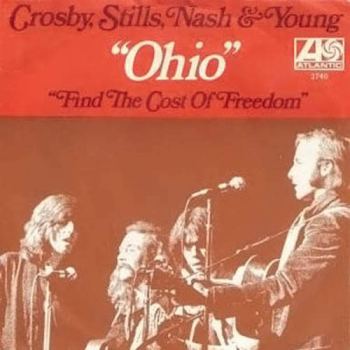
Thirteen seconds. That’s all it took. On May 4, 1970, National Guard soldiers fired into a group of Kent State University students protesting the Vietnam War. Four of the youths — Allison Krause, Jeffery Miller, Sandra Scheuer and William Schroeder — were shot dead, and nine others were wounded. The massacre, deemed “unnecessary, unwarranted and inexcusable” by President Richard Nixon’s Commission on Campus Unrest, triggered student strikes that forced hundred of colleges and universities to close nationwide. It also inspired Neil Young to pen “Ohio.”
Young is no stranger to protest songs. One of his most famous tunes, “Rockin’ in the Free World,” directed criticism at then President George H. W. Bush. On his 2006 album Living with War, he called for Bush’s son George W. to be impeached. But it was with “Ohio” that Young first displayed discord in verse. He wrote the song after seeing photos of the Kent State shootings in an issue of LIFE magazine and quickly released the tune with Crosby, Stills and Nash. “Tin soldiers and Nixon coming … Soldiers are gunning us down … Four dead in Ohio.” Group member David Crosby once said that Young’s direct criticism of Nixon was “the bravest thing I ever heard.” The song was banned on some AM stations but was played on underground FM stations and, unsurprisingly, gained a lot of popularity on college campuses.
[youtube=http://www.youtube.com/v/wJqFwCFeosg&hl=en_US&fs=1&]