
Tuned In

HBO's The Pacific: What Fresh Hell

HBO

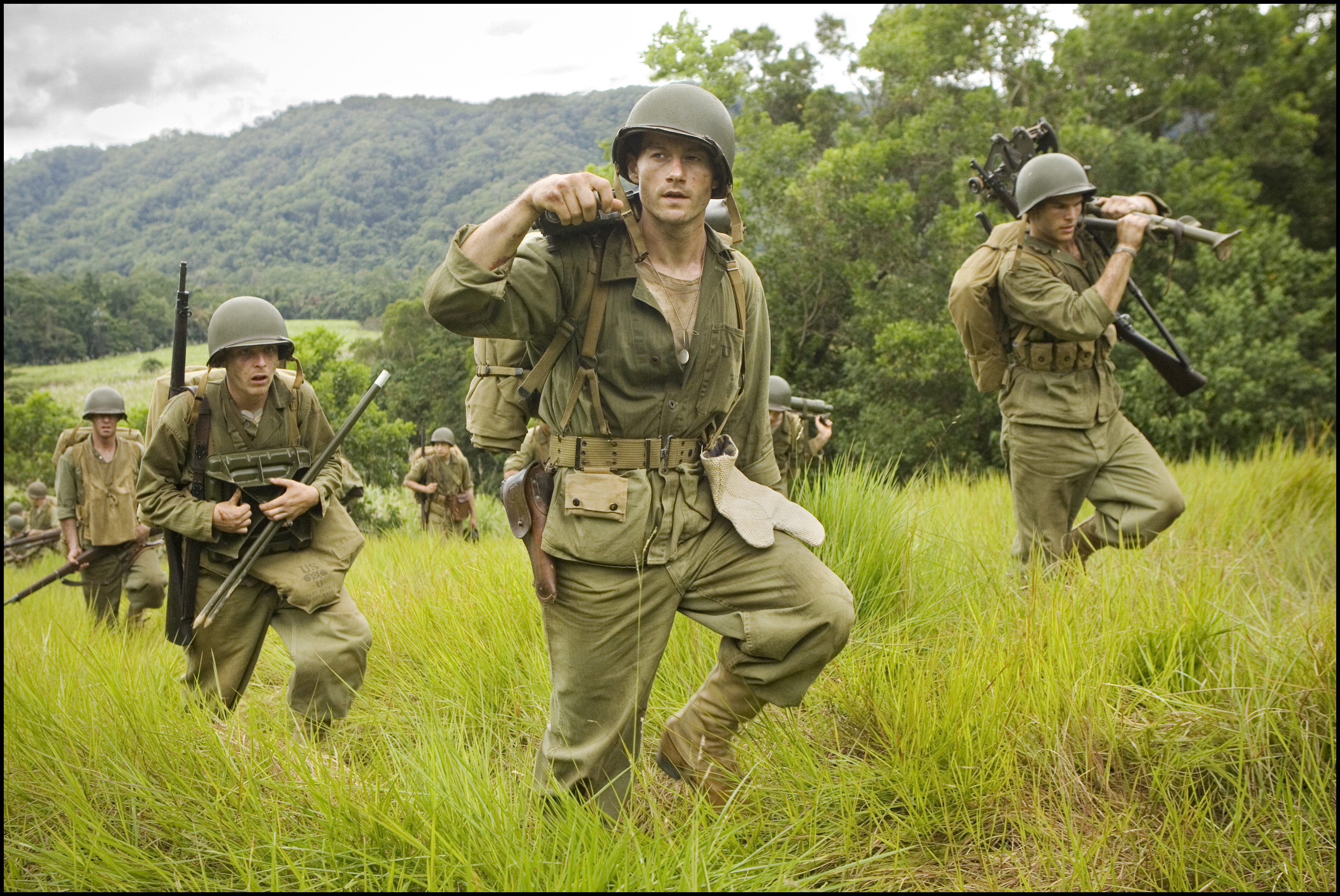
If you watched the ten brutal episodes of HBO’s Band of Brothers–in which war was not glorious but miserable, and death sudden and ignominious–you were probably not thinking that there was an even uglier side to World War II that this miniseries was not showing you. But there was, and showing that side is the project of The Pacific, the ten-episode bookend that in nearly every way improves on its 2001 European-theater predecessor.

The war against Japan was different from the war against Hitler militarily, topographically and psychologically. WWII in Europe was, for all its mechanized death and horror, in some ways a throwback: it was the last great (so far) land war in Europe, fought in places with recognizable names by great massed armies. The men fighting there may have not known the big picture or cared about the geopolitics, but they at least recognized the war.

(As did we. For whatever reason, the movies have had more success with war-in-Europe stories than with war-in-the-Pacific stories like Letters from Iwo Jima and The Thin Red Line. Even WWII videogames, like Call of Duty, involve Nazi-fighting more often than Pacific-war scenarios.)

In the other theater, The Pacific makes painfully clear in its early episodes, the Marines that it follows had no idea what they were getting into. On the one hand, the war was simple: Japan attacked the U.S. at Pearl Harbor, and now we were going to get those bastards back. On the other hand, they were going to be introduced to a kind of war they had scarcely imagined, on islands they didn’t know, at a cost they could not conceive. “I might have jumped into Normandy, but at least I got some liberties in London and Paris,” a Europe vet tells a Marine after the war. “You got nothing but jungle rot and malaria.”

The Pacific’s Marines are not naive: they know they’re going off to face a fierce enemy. But they go into the war in December 1941 talking about being home by next Christmas. Some expect a “cakewalk.” No one can pronounce “Guadalcanal.” We can, and the reason we know it is how horrible it—and Iwo Jima, and Okinawa, and Peleliu—became for them.

If Band of Brothers’ soldiers were fighting the last kind of war, in many ways The Pacific’s are going to fight the next one. They land on their first beach in a flotilla of armored ships, and we, like them, are dreading the kind of D-Day firefight we saw in Band, and before that in Saving Private Ryan. They land: quiet. For the moment.

Instead of tank columns and shelled European cities, they find oppressive heat, disease and an enemy using guerilla tactics, suicide missions and sometimes civilians. There are poisoned wells and bugs in the rice (“Think of it as meat”). It’s part Vietnam, part Iraq, part horror movie. (In some of the most tense scenes of waiting, in the jungle, in the dark, it is–and I don’t mean this to be glib–like the sense of menace in a scene from Lost.)

But there’s little History Channel-like attention to the sweep and strategy of the war; really, The Pacfic is not about “war” as practiced by generals, but fighting as done by grunts. And unlike Band of Brothers, which spread its attention among a wide ensemble fighting together, The Pacific focuses mainly on three Marines, in different units, whose stories and battles are mostly separate.

Robert Leckie (James Badge Dale) is a smart, cocky aspiring writer who struggles to keep his body and mind intact through some of the war’s fiercest fighting; Dale nails the role, making Leckie a soulful rogue. John Basilone (Jon Seda) is a Medal of Honor winner whose heroism wins him a trip home to sell war bonds—a prize, and a role, he’s uncomfortable with. And Joe Mazzello has maybe the most psychologically tricky role: Eugene Sledge, who has a guaranteed out from fighting—a heart murmur—and enlists anyway, over the objections of his father, who worries he’ll come back dead-eyed and broken like men he’s seen from WWI.

The deeper Sledge gets into the war, the more he sees that his father may have been right. This is a kind of war that tries soldiers’ souls, and minds. Threats seem to be everywhere. Rumors fly (the Japanese have poisoned the coconuts, goes one). Witnessing atrocities and an almost incomprehensible willingness of the enemy to die takes a toll, and brings out ugliness in some soldiers along with the best in others. There are acts of bravery and self-sacrifice, as well as casual racism toward the “yellow monkeys.” After one savage battle, a few Marines amuse themselves by taking potshots at a stranded enemy soldier, to kill him slowly; disgusted, Leckie dispatches the soldier with his sidearm to end it.

(A personal note: my dad was a Marine in the Pacific in WWII–he was in his 50s when I was born–and the clichés about what war like that does to men are true: the lifelong nightmares, and above all, the reluctance ever to talk about what happened, other than funny stories about the lousy food shipboard. So though I’m younger than the Baby Boom audience, and the Baby Boomers Tom Hanks and Steven Spielberg who produced this, I can understand that generation’s attraction to Band and to this story: it’s a way of having a conversation you could never have in life.)

As the Marines island-hop from one meat-grinder to another, The Pacific ventures into morally grey territory that begins to recall later wars; at times, it’s like watching a Vietnam movie. Like Band of Brothers’, the miniseries tone is stark but nonjudgmental; it challenges but it doesn’t preach. Late into it, we see some of its most horrible images, on Okinawa, where civilians are mixed up in the fighting. A Marine shoots an unarmed, underage civilian point-blank—”We’re here to kill Japs!”—and you identify with Sledge as he scolds the man. Shortly after, we hear that the U.S. has just dropped a bomb and vaporized Hiroshima. (“It killed a lot of Japs.”) The Pacific isn’t drawing lines or passing judgments; it’s saying that this is what the war was.

But it’s also showing us how the war felt. One weakness of Band of Brothers, for all its gut-punch power, was that it was so committed to verisimilitude, to its ensemble approach and to the model of Stephen Ambrose’s book that the soldiers were often indistinguishable, despite fine performances from the likes of Damian Lewis. It was as if the war was the star, not the men. The Pacific—based on wartime memoirs and follow-up research—is no less committed to realism, but its tighter focus on three men makes it easier both to follow and to commit to. Its narrative is more movie-like, while being no less honest.

That said, there’s plenty of war in The Pacific, treated with documentary devotion. Tom Hanks’ $250 million shows on the screen—in enormous vistas of fighting ships, in jarring explosions that come from just outside your field of vision, in spectacular firefights you can feel in your bones. But—even harder to take—it shows the small horrors of war too: children fleeing battle, torture victims, bone and guts and people begging for death. And while it’s hard to convey tropical heat and chronic weariness onscreen, The Pacific manages to viscerally sell the agony of noncombat too, the terror, disease and hostile weather. It even rains loud on this show.

This is where it feels like I should say that to understand the sacrifices these men made, you should watch The Pacific. But I won’t. For one thing, I don’t know “what it was like”; I didn’t fight in a war, I watched a damn miniseries in the comfort of my home. Nor do I have any business lecturing you that you should watch an HBO series out of moral obligation, as if whatever debt we have could be repaid by watching TV.

But if you want to watch The Pacific, it will repay you with a brutal but eloquent story that’s finally less about how men fight and die than what happens to them when they fight and survive. It will show you how character and sheer, unfair randomness combine to produce cruelty or decency. And it will make you feel deeply for the men who return, tentatively coming back to peaceful towns, exploring their souls like men checking their body parts after a mortar explosion, anxiously feeling themselves out to see what’s still there.

Related Topics: the pacific, Uncategorized
  • Latest on Entertainment

    IFC Films

    Kerouac's On the Road Comes to Cannes: Where's the Beat?

    Walter Salles’ film of the Beat Generation classic wastes a strong cast, including Twilight‘s Kristen Stewart, in a needless tribute to ’50s wanderlust

    Adele Crosses Huge MilestoneHuffington Post

    Adam Rose/FOX

    Glee Watch: NYADA, NYADA, NYADA

    Spoilers for the season finale of Glee below:

    One beef I often have with Glee episodes is that they move too fast, go in too many directions, try to cram in too much at once. You might say that about “Goodbye,” the season 3 finale, but in this case that approach seemed about right. It’s an episode about graduation, and graduation is something that, no matter how much you plan for and anticipate it, still goes too fast. Graduating is something you do, but in the moment it feels like something that happens to you, suddenly and all at once, like going over a waterfall.

  • chriskw

    Great review James. It was interesting to learn that your father fought in World War II. I didn’t expect that considering your age.

    About five or six years ago, I did a mini-documentary about soldiers in Vietnam (it was a high school project). I interviewed a couple of my dad’s friends and definitely saw them in a way I had never seen them before. In fact, I asked my godfather how he got injured and he almost went into shock as he was telling the story.

  • moryan

    Terrific review, James.

    My English father in law fought in WW2, in Europe. He enlisted right at the start — he was 16 and too young, but the enlistment officer looked the other way. He enlisted because he’d graduated from school and was “bored,” in his words.

    He landed at Anzio and was shelled (sometimes by the Allies, by accident). He fought all through Italy and was in the British Army for a total of 6-7 years (after the war he went to what was becoming Israel).

    He doesn’t talk about it — and I’m unsure how much to press him on it (he’s 86). I would like to know more, but the few scraps I do know are horrifying. And to watch The Pacific and Band of Brothers just makes me realize all the more that I’ll never have any idea what he went through.

    He did once say that he did some “funny business” in Italy, later in the war. We eventually figured out that he became a spy. My father in law is essentially James Bond crossed with Dick Winters. And he once wrote a memoir but later burned it — too painful, I think. I don’t think anyone else ever saw it.

    All I know is he was “mentioned in dispatches” during the war and has a shelf full of medals. And his brother, Christopher, was killed by a sniper in Burma two weeks before the war ended. He’s the most proper English gent you can imagine, but he can hardly talk about that.

    My mother in law’s family is Chinese and fled to Malaysia during the war. Sometimes they literally had to hide in the jungles from the Japanese. Once when they were hiding, my mother in law’s brother was bit by a rabid dog. He died because they couldn’t get him to a hospital in time, thanks to all the checkpoints etc.

    I think about what they’ve gone through and it just reinforces to me what a lucky, lucky, lucky life I’ve had.

    Sorry if that’s oversharing. Your reminiscences about your dad were quite moving, and I guess that started me off.

  • fundedm

    This is an excellent review, although I don’t know if I can actually watch it now. I loved Band of Brothers and this looks equally compelling. James – I really don’t know how you go from writing a review about this to something like American Idol or Survivor (oh wait! – a fight to the death on an island in the South Pacific) – sorry, bad joke.

  • petemooney

    Jim, Great review. I didn’t realize that your father fought in the Pacific theater. My mother knew veterans of the war growing up, and tells similar stories about their nightmares and their reluctance to talk about their experiences.

  • evolve1

    Great review. I’ve been looking forward to this miniseries for awhile. I grew up in the Pacific, mostly on Okinawa, though also on Guam and the Philippines. On Okinawa, I lived right next to one of the invasion beaches, and my first day there I found the rusted remains of an M1 Garand. The island at the time was still littered with the leftovers of that horrendous battle – rifles, bullets, shells, grenades, bombs, etc. There was no way to be there, even at my young age, and not understand that something awesome and terrible had happened there.

    I’ve always been disappointed with the American preoccupation with the war in Europe, when so much of what we were, and what we’ve become, has been shaped by the events in the Pacific. We all recognize Pearl Harbor, Iwo Jima, and Hiroshima; but these were just some of the important stories of the Pacific war, and in some ways not even the most compelling.

    Okinawa was the last major battle of the whole war, and was still being fought when Germany surrendered. While Americans were dancing in the streets back home, soldiers and marines were still dying by the thousands on The Rock. The amphibious assault there rivaled that of the D Day landings at Normandy, with the addition of a major naval battle thrown in. The battle was one of the deadliest of the entire war. Lt. Gen. Simon Bolivar Buckner, the army commander during almost the entire battle, died in combat there, the highest ranking American to be killed in the entire Second World War. And yet most Americans know little or nothing about it.

    Add to that battles such as Guadalcanal, Peleliu, Saipan, etc., and you have an almost unimaginable history of land warfare that should be even more familiar to us than many of the battles that are commonly known. It’s a long-overdue tribute to those who lived through those experiences, and to those who didn’t, that these stories are being given such a high-profile telling.

  • http://quantumcosmos.wordpress.com morgansjc

    Moryan, thanks for your post. Great reading. My grandfather lost his leg in the last days of WWI when a German tossed a grenade into his machine gun nest. I think of all the hours I spent with him, a quietly funny man, understated, and never did I hear a war story, despite my childish pleading. A common thread with all soldiers, it seems. Their hells are private.
    I was reading an article on men who flew against the Germans and then were sent to the Pacific. The Japanese pilots were harder to kill, flew and fought in a way the Europeans didn’t. D-Day is mentioned by evolved1, and he’s right. Try Iwo Jima or Okinawa in comparison to any European battle. The main difference lay in attitude. The Germans treated combatants differently than the Japanese did. In Europe, surrender was accepted, usually. In the Pacific, it wasn’t. If you surrendered you were scum, worthless, fit only to die in some manner.
    There were two diffrent sets of Marines in the Pacific. The “China Marines” and the new Marines. You could tell the difference in one way because the “Old” Marines called them “Nips”, for Nipponese, and the new Marines called them “Japs”. It’ll be interesting to see if this series shows that.
    A good article about a theater of war that was, in many ways, more horrendous than Europe. The Russians bore the brunt of the war in Europe, killing 75% of the Germans that never got home. The Pacific was ours. We spilled our blood like it was water. Some doubt we could do it again. I don’t. If called upon, if forced to it, this generation or the one after, would be the next “Greatest Generation”. It’s an American, not a generational attitude. I live near Basilone Road, named for the man you’re going to be seeing in the series. His spirit lives on. I’m thankful for it.

  • http://www.thesmogger.com Michael
  • http://barleyblair.wordpress.com barleyblair

    these aren’t fictional characters, are they? i recall the interviews with eugene sledge, “sledgehammer.” his were chilling, painful accounts from “hell in the pacific.” his were also some of the most disturbing.

  • thethirdcell

    I remember the first time I went into the United Nations building in New York City. There in the lobby was the “Atrocities of the United States against Japan” in photographs. Here were pictures of Nagasaki and Hiroshima after being destroyed by nuclear weapons. No where’s did I see photos of Pearl Harbor, The Bataan Death March, or the genocide committed against the 6,000,000 Chinese, Indonesians, Koreans, Filipinos, and Indochinese, among others, including Western prisoners of war. This was another attempt to rewrite history showing America as the aggressor in World War II instead of the Japanese. I was outraged and expressed the same to those who were manning the desk and lobby of the United Nations. Finally my friends had to coach me outside, least I be arrested for disturbing the peace.
    My hat is off to Steve Spielberg, Tom Hanks, and all of those associated with this HBO mini-series to show the horrors of conflict and war. Our armed forces casualties during the World War II were just under 10,000 per month, a number that seems inconceivable today. This mini-series should be required viewing by every high school student in the United States. Let us not forget the sacrifices that the “Greatest Generation” made, that now allow us to live with the freedom that today’s children take for granite.

  • Victor Horchar

    I suggest strongly that before you watch “The Pacific”, you read the books written by the survivors upon which this series is based. Robert Leckie wrote “Helmet for my Pillow’, Eugene Sledge wrote “With the Old Breed”, and R.V. Burgin wrote “Islands of the Damned”. You owe it to yourselves and to these Marines.

    This is the only way that you can develope an understanding of what they went through. A movie will never be able to replicate their experiences, but at least it will make people aware of the insanity.

    Experiences with Marines at Camp Pendleton near Las Pulgas Road many years ago during a ceremony with some of the “Old Breed” convinced me that the Pacific War was a meatgrinder, destroying in an instant the lives of the many who were lost to the random nature of battle.

    One survivor of Okinawa asked me to read “Imperial Cruise” recently. He would not give me the book until after I read the first three accounts.

    Now I understand why.

  • mkivela

    “in some ways a throwback: it was the last great (so far) land war in Europe, fought in places with recognizable names by great massed armies. ”

    The “recognizable names” glances on the key difference about the Western front in World War II — the throwback was more an ethnic familiarity and, for lack of a better word, respect.

    The American melting pot was largely English, Scots, French, Irish, Italians, Germans, Poles, and the like — basically northern European countries plus Italy.

    And we fought in Northern Europe, plus Italy.

    In that respect it was similar to the American Revolution, 1812, the Civil War, or the first World War. Even if people did not personally know each other, they shared a common culture. Without American participation, it was also something present in the Napoleonic and Franco-Prussian wars.

    The war in the Pacific, for the U.S., was much more a clash of cultures. And so was the Eastern Front in Europe with Germany and Russia. These areas of operations, lacking the shared cultural history, is where the war was consistently at its most brutal.

    The view from the US was to defend England, liberate France, and not so much the destruction of Germany but also to “liberate” them from rule of the National Socialists. Towards Japan is was nothing more then their total defeat; and between Germany and Russia nothing more then total victory by one or the other would have been acceptable.

    Its a different mindset, not that there wasn’t great acts of violence in the Western Theater, or acts of strategic destruction knowing many civilians would die (the fire bombing of Dresden, which killed more then nuclear bombings of Japan).

    But it was fought between groups that had been friends before, and knew they would be friends again.

    That common set of cultural values was not as deep in the Indian Wars, or Mexican-American and Spanish-American wars; or with Korea or Vietnam or the current conflicts.

  • http://aanke.wordpress.com aanke

    My dad fought on Iwo Jima and never talked about it. He did once mention that he would never forget the smell of burning flesh. I got his military records and saw where he fought in the Pacific.

    He’s gone now and I’m sorry I never asked him about his experiences…not that he would have said much.

  • http://playbeautifully.wordpress.com playbeautifully

    @ thethirdcell:

    its: GRANTED.

    GRANTED GRANTED GRANTED GRANTED GRANTED GRANTED GRANTED GRANTED GRANTED GRANTED GRANTED GRANTED GRANTED.

    If I take anything for “granite” It would be pretty heavy now, wouldn’t it?

  • thethirdcell

    To playbeautifull,

    That’s what I get for writing anything before my morning coffee! Thanks for the correction.

  • richardmichaellewis

    For all you Guadalcanal old timers, Remember Tropic Lightening at Gifu Ridge, Sabo Island? Remember all the times without water, food, supply lines, and the way they threw themselves at you relentlessly. Malaria, Dengue Fever, Encephalitis, Dysentery, the Nightmares of Battle, the enemy always creeping around in the dark. Those dam machine guns cris-crossed on the ridges.
    My Dad was one of eight left of the original two hundred that arrived in his contingent. For a seventeen year old that survived an orphanage, the depression, enlisted at fourteen spent a year and a half in Hawaii carrying equipment to the top of the hills, then getting bombed in the Pearl Harbor hospital, moving on to the Solomon Islands fighting to stay alive from the enemy and the bugs, what a way to start life out. He never got his health back and he never ever forgot how tough his enemy was. For R&R they swam around with the plane pontoons and had boat guards shoot the sharks and croks that came near. I salute Cpl. Richard Auburn Lewis, and all you men that fought with him, you truly defined toughness………………………His son Mike

  • justmy02cents

    James,
    .
    Thank you for your insightful review and sharing of your own personal experiences regarding WWII and the war in the Pacific.

    I found the first episode to be rather dis-jointed and I did not feel that the squad level tactics of the Marines reflected my impression of how they were trained.

    I MUST clarify, I was not a Marine nor in the military, but am from a WWII era Marine family and had the USMC foisted upon me by my SSGT US Marine father. I revere the USMC and have read extensively both non-fiction and fiction and had many, many conversations with my dad about the Corp.

    The episode (and other previews) depicted Marines running helter skelter while under attack by the enemy and casually strolling on their way to “aligator creek” with their carbines on their shoulders.

    The chain of command did not seem evident, squad integrity was not maintained, there was no indication of platoon level integrity nor company level integrity.

    All of the above said, I will attribute much of the above to dramatic license on the part of Hanks and Spielberg.

    More than anything, I am delighted that at long last, the historic counter-attack at Guadalcanal and subsequent island hopping amphibous landings are being given the place in American history and the public’s mind that they have always deserved.

    My dad was an aerial gunner in an SBD Dauntless “dive bomber”, he landed on Guadalcanal’s Henderson field and showed me pictures of some of his exploits there. I am extremely proud of his service to the USMC and America.

    He and my Mother ( also a US Marine truck driver ) have returned to the National Cemetery – Quantico on their final journey.

    ooh rah!

  • filam61

    Im of Filipino background and the stories I heard from my grandmother and older relatives of what happened during the war,stories like that of the next village where everyone was killed by the Japanese because they killed an injured Japanese soldier,of them ,including my toddler mom and her brother hiding in the mangroves up to their knees in mud,of my grandfather questioned with other men on their knees in the baking sun by the Japanese soldiers close to be being beheaded maybe, starvation, disease, the smell of death everywhere.Strangely my grandfather spoke about that war in general terms and never about what happened to him personally.it must have been really bad.
    I dont think I have ever seen a WW II Pacific war movie that had Filipino soldiers ,who fought with America during the war, or Filipino civiilian characters, other than as background with maybe one or two lines.
    I guess it will be told one day. My grandparents ,greataunts and greatuncles on both sides are dead, my recollection of their stories are now hazy and incomplete.My parents ,aunts and uncles who were children then I think prefer not to remember at all, it was that traumatic.
    But the one thing they all had and have in common is the firm Belief that the United States America saved them all and can forever do no wrong.

  • vestjacket

    playbeautifull…,

    I bet you can’t tell us how many grammar, style, and usage mistakes you have in your post. Hint: your user name is misspelled and improperly punctuated—that’s two.

    vest jacket

  • http://markinnh.wordpress.com markinnh

    James ; Wonderful review and comments.

    My dad served in the Pacific from 1942-1946.
    Like all the others, he never talked about it, and this makes me appreciate all the more, the men who actually relived the horrors in their memoirs. My dad just relived them in his nightmares.

    While growing up in the fifties, I never understood why, among all my friends and relatives families, that my dad was the only father in his twenties, with pure white hair.

    In my teens, I found an old enlistment picture of him, in uniform, at the age of 17. His hair was shoe polish black, with not a speck of white.

    It was then that I realized what the war had done to him, and why he never mentioned it, and would never go to a war movie or watch it on TV.

    I’m sure that this series will re-create the war as well as Band of Brothers, but I’m not sure that I’ll be able to watch it. If there’s someone in it, similar in appearance to my dad, I think I’ll have to shut it off.

  • thegenerousweb

    “Men” is the operative word in all this.”
    This is what we are, this is who did it, and this is who does it now, everywhere, all the time.
    We haven’t really evolved to adequately handle our violent nature. For all the music, medicine, art, science, literature… we have not, as a species, addressed the violence in men.
    Every man should teach his son about his violent nature. It will come up. And if you teach him, warn him, he will be able to handle it. And he’ll have a much better chance at staying alive.

  • sallienaatz

    My husband & I watched the 1st episode – and plan to watch the whole thing – although I’m not sure I can. I was 10 when Pearl Harbor was bombed. My brother – Jack Naatz – was 20 and enlisted in what was then The Army Air Corps. His profound near sightedness barred him from combat & Officers Candidate School (tho he had been in ROTC in college). My cousin, Harold Whitham, however, wound up as a Marine in the Pacific. His first action was Guadalcanal & he fought through till the end and was awarded the silver star. I remember his mother saying that – when he came home – she would find him asleep in the morning with his back against the headboard of the bed and his knees drawn up to his chest. She would waken him but not with a touch because he might flail out.

    One of my brother’s friends, Marshall Skiff, is still hale and hearty at 87. He was in the Army and stationed on Luzon – today I think they’d term it ‘embedded’. He lived there in the jungle with a primitive tribe with whom he has kept contact. (I don’t think he ever rose above the rank of Private). Recently, the native people dedicated a museum there to Marsh’s late wife, Joan, and he was invited back for the event. If you go to Syracuse.com (Syracuse Post Standard) & search either his name or that of columnist Dick Case, you should find a recent article & photo of him with a carved wood statue of an American G.I. that the people presented to him.

    As far as the difference between the cultures of the Germans & Japanese – like everyone else I thought – ‘the Germans are like us – the same skin color, the same religions’ – and my grandparents came from Germany. It wasn’t until I saw photos in magazines & newsreels of Gen. Eisenhower & troops threading their way amidst piles of naked, emaciated bodies in the death camps in Germany that I realized that wasn’t true. Hitler proved that white, western, Christians were fully as capable of atrocities as the Japanese.

    I was glad when the war against Japan was ended with the atom bomb & still think it was the right thing to do – when you think of the cost of a final battle on the Japanese home island against an enemy who would never surrender – it would have been a blood bath worse than that caused by any bomb.

    Finally – I thank Tom Hanks & all associated with this film. They have preserved the history of the war as a living thing – more than any book could. It will be a resource far into the future.

    I am so interested in the posts here. This is what the show is all about – the stories of those who were there – who lived it. The memories of their children & grandchildren are of great importance now as fewer and fewer men who fought survive.

    People forget….

  • http://barbc24.wordpress.com barbc24

    My dad served in the USMC in the pacific in WWI but when I was growing up he never talked about it. I never really knew or understood what he had done.

    He’s gone now and I feel sorry that I did not know and that only recently did I even find out what unit he was in. It turns out he was in the FMFPac V Amphibious Recon Battalion and they went from island to island before the invasions scouting out the beaches and landing sites at night. He told my brother a story about being in a sub going to a mission and being depth charged by US Navy ships who didn’t know they were Americans and thought it was a Japanese sub. I know his company also participated in some of the landings – he did talk to my brother about it and my brother remembers Saipan and Eniwetok for sure as being batttles my dad was in and either Iwo Jima or Okinawa.

    I wish I knew more about what he had done but my guess is that it was bad there which was why he never talked about it. Just before he died he was watching a WWII movie with my husband. My husband said he kept saying “It was nothing like that.” I guess not.

    I am in awe of what these young men did and what they endured and understand so much more about my dad now. He is buried in Quantico National Cemetery and at the end he had his military honors funeral with the Marine honor guard there for him – as my mom said at the time “The Marines take care of their own.”

  • semperfi3rddiv

    “Semper Fi …3rd Division!” That is the only response I use to get from my favorite uncle and my Dad’s brother & best friend. He was in the 3rd Div 3rd Battalion 3rd Company. When I would meet up with the my uncle in Las Vegas he always bet 3 or 33.

    He fought at Bougainville, Guam, Kwajalein and Iwo Jima. I get a few stories, like watching his buddies get killed by “friendly fire” from a destroyer that came in close to shore to provide support with it’s 5 inch gun. It turns out that his cousin (my dad and uncle grew up with this cousin and are very close) was an officer on the ship. They still bust the cousin’s chops (they are in their 80′s) about the Navy not being any good and being more of a danger than some of the enemy.

    In terms of this series I’m not a big fan. My uncle now (a bachelor all his life..I wonder if the war was a cause) lives on $15K a year in CA. Can’t get help from the government. (he makes too much) and Speilberg and Hank is making all of that money off the experiences of these men (and women) who sacrificed so much and asked for nothing. I hope rich cats are giving something to the agencies that try to support these “heroes.” When you see one the members of that generation, recall what they did on the front and at home for us.

  • bigdenl

    I watched A Band Of Brothers countless times and I loved it, But, The Pacific I don’t know what to say, I give them alot of credit for the historical accuracy and the authenticity of it but I kind of think I would compare “The Pacific” to “A Band of Brothers” like I would probably compare “Saving Private Ryan” to “Pearl Harbor”, the one they made about 9 yrs ago. But it still has alot of action,. Nothing wrecks a war flick like putting romance in it. But I have only seen 5 episodesso far. I still have hope for it.

  • bigdenl

    Man I wish I had been with you, We would have both gone to jail. I can’t believe that there are people who would believe such BULLS–T like that. The Japs committed more attrocities than all of the Allied Countries put together. I’ve seen CRAP like what you are discribing before and it sickens me. I can’t imgine any American buying in to such lies, BUT THERE ARE. I think we should have dropped a couple hundred A-Bombs on them they deserved it, GOD KNOWS. It is funny how the JAPS talked about fighting with honor, when they fought such a cowardly and disshonorable war like they did. If they want to talk about attrocities they should talk about what the JAPS did to NANKING,The PHILLIPINES and everywhere else they occupied. I saw on 60 minutes a couple of years ago about how the JAP school children are taught that they didn’t lose the war, Thats SICK!!! I blame our polititions for allowing this kind of crap. I was looking at my Niece’s home work one day she is in 11 grade and she was reading something about world war 2 in this history book and there was only 3 pages about it. I think the school system is trying to be a little bit to politically correct, Very Sad

  • bigdenl

    Maybe I should have watched episode 6 before I posted my earlier comment. Episode 6 is more of what I expected. I hope the rest of the series is like that it was pretty excelent. GOD BLESS ALL OF OUR VETERANS!!!!

  • sloates

    I have to say as a huge fan of “Band of Brothers” that so far I am disappointed with “The Pacific”. I have no clue who any of the characters are other than the 3 mains and as such I find it hard to relate to their story. I don’t want to take away from the men who fought this horrible campaign in the worst conditions, but I feel that the storyline lacks any sense of time, I can’t tell how long they have been anywhere, they arrive, do sod all and then have a 30 second firefight before shipping off elsewhere. Leckie ends up in an asylum for Enuresis and you get no idea of how longhe is there, is it 15 mins or 3 weeks? Also, he meets a guy he served with, who the hell was he, I am completely lost! The cinematography is excellent as is the acting, I just think the screenplay is lacking so far, I really hope it gets better! I will stick with it, but it is nowhere near as good as “Band of Brothers”.

  • http://flushing55.wordpress.com flushing55

    I agree totally with sloates. This mini series does not compare to Band of Brothers on any level. It is shocking how Speilberg and Hanks could forget to tell a story. What these heroes went through was hell in every respect. God bless every one of them for the sacrifices they went through.
    But why do two of the greatest movie making talents of our time not provide perspective to see how these sacrifices played out. The battle scenes do convey many differences between ETO and PTO but PTO was a concerted effort to start (at Guadacanal on the ground and Midway at sea) to push the Japanese empire back towards Japan. The battles lasted longer than The Pacific lets on and we get zero sense of history. Guadacanal was much more than a few night battles where Basilone (RIP) earned his Medal of honor and then everyone went to Australia. It was long and protracted. Get a narrator (Hanks does some at the beginning) to tell the story as these heroes deserve.

  • moucon

    My father was also in WWII – in fact he was there with Curtis-Wright Co. under a commission with the British millitary – working on P40 planes long before we were at war in Europe and batting clean-up after V-J Day. I was hoping to get a little more insight about the war from this series- was not to be.

    I totally agree with Sloates and flushing55. There’s no story here – no character development – in fact I’ve watched 9 of the 10 episodes now (carefully, many more than once) and I can’t tell you the names of a single character. There’s somebody named “Bill” – which one is he ? Not sure. Lots of war scenes, people getting blown up. Slow motion shrapnel blowing all over the place – lots of rain. I get it – war is miserable. But what about the people… the places… the aftermath? The woman who was in the marines whose husband went back overseas (name?) and was killed. What happened to her? I seriously doubt any of this is going to be revealed with only one episode to go. Band of Brothers was an order of magnitude better production than “The Pacific” in every way. I think Time should hire a new reviewer – somebody with a clue about what they are watching.

    The producers blew it – and so did Time’s review.
    EPIC FAIL.

  • kingdom529

    I agree that the story lines are very poor and there is almost no character development at all. In Band of Brothers you could identify with the characters through the entire war. In The Pacific I haven’t even learned their names. The cinematography was far superior in BoB as well.

  • martinhai4

    I agree partly with the previous posts that the Band of Brothers was slightly better (at least less confusing). But, it could also be that we are more familiar with the European scene of war.
    As ex-infantry (in a Northern European army) I recognised the “fire-manouvre” tactics on squad level that was used quite often in Bands of Brothers but I haven’t seen much of that kind of fighting in “The Pacific”. Perhaps the Marines of that time had different training in squad level combat compared to the Airbornes? Can anyone comment on that?

blog comments powered by Disqus