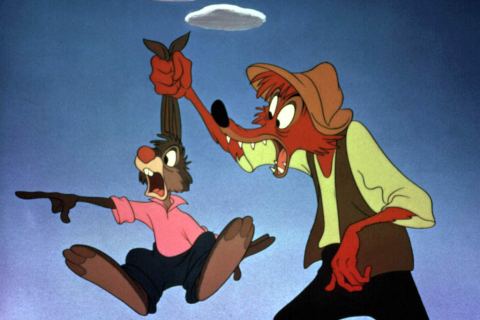
Song of the South

You probably haven’t seen Disney’s 1946 film Song of the South, but you’ve definitely heard it. Its signature song, “Zip-a-Dee-Doo-Dah,” won a 1947 Academy Award, and the Br’er Rabbit animation sequences have been used in several TV spots and Disney specials over the years. But there’s no denying the fact that by today’s standards, the film is rather racist. Set in the post–Civil War South, the movie — in which a former slave named Uncle Remus regales children with amusing stories — depicts an offensively “idyllic” master-slave relationship, as the NAACP once described it. Adam Clayton Powell Jr. considered the feature’s depictions of happy slaves an “insult to American minorities.” Disney has declined to release the film on video in the U.S., fearing an outcry over the crude stereotypes.
Alice in Wonderland

When Disney first released its film adaptation of Lewis Carroll’s classic tale in 1951, moviegoers were not entirely pleased. British critics attacked the studio for “Americanizing” the story of Alice’s fall down the rabbit hole, while American viewers criticized Disney for distorting Carroll’s prose. “Mr. Disney has plunged into those works … snatched favorite characters from them, whipped them up as colorful cartoons, thrown them together willy-nilly … scattered a batch of songs throughout and brought it all forth in Technicolor,” read a review from the New York Times. (In the studio’s defense, Carroll was a pretty twisted writer whose work the Encyclopaedia Britannica calls “nonsense literature of the highest order.”) The film enjoyed a revival of sorts in the 1960s and ’70s, thanks to Jefferson Airplane’s 1967 acid-rock epic “White Rabbit” — and, no doubt, Alice‘s own inherently hallucinogenic imagery. Suddenly the Mad Hatter, the Cheshire Cat and the hookah-smoking, vowel-blowing caterpillar were icons for hippies across the country.


