

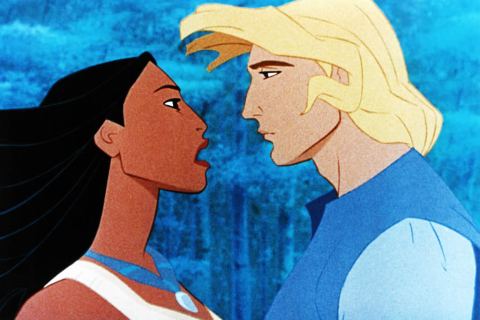
Disney thought it deserved a pat on the back when it released Pocahontas in 1995. Not only was it the studio’s first historically based animated film, but it also helped diversify a rather homogeneous group of past protagonists with its Native American lead — the second nonwhite Disney leading lady, after Aladdin‘s Princess Jasmine. But Native American groups complained that the studio strayed too far from history in the name of entertainment. For starters, there was no love story à la Romeo and Juliet between the real Captain John Smith and Pocahontas — a major theme in Disney’s version. In reality, Pocahontas was only about 10 years old when Smith arrived with the Virginia Company in 1607; she later considered him somewhat of a father figure but never a romantic interest. She did go on to save his life once, when Powhatan Indians wanted his head, which was how she earned the respect of the settlers. But there was no teary-eyed goodbye when Smith returned to England, as the Disney film depicts. Around 1613, Pocahontas was abducted by English colonists and taken to another part of Virginia; she was baptized as a Christian, married tobacco magnate John Rolfe and changed her name to Rebecca.
[youtube=http://www.youtube.com/watch?v=9q1QF8G47oU]