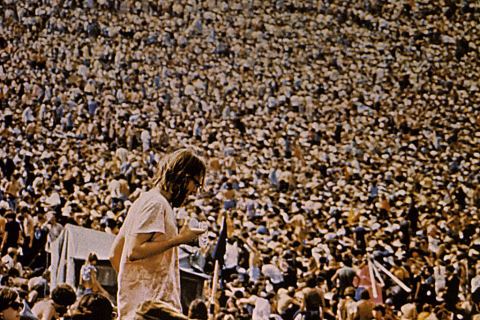
Woodstock

Perhaps in keeping with the vibe of the festival — which, as everyone’s parents has by now told them, took place over three days in the summer of 1969 at a farm in upstate New York, attracting 400,000 people — director Michael Wadleigh managed to miss some of the event’s key performances, including sets by the Grateful Dead, the Incredible String Band and Ravi Shankar. But when he did train his cameras on the protagonists, some of them came up with stirring contributions: Sly and the Family Stone; Crosby, Stills and Nash; and Jimi Hendrix, whose guitar solo of the national anthem remains one of the most indelible moments of the decade. But of course, if you can remember it, you weren’t really there.
TIME’s take: “Purely as a piece of cinema, it is one of the finest documentaries ever made in the U.S.”
Fade to Black

Raise your hand if you believed in 2003 that Jay-Z — the Brett Favre of rap — was serious about quitting the game when he staged a gala “retirement” concert at Madison Square Garden. Despite the fact that the multiplatinum-selling artist would go on to release a further three albums (thus far) and was performing live again sooner rather than later (a certain Minnesota quarterback must have been taking notes), this film was too enjoyable an opportunity to miss. We get the buildup (in a variety of locations) to the show and hear the likes of Johnny Cash gushing, “He doesn’t write anything down. I have never seen anything like it.” While Michael John Warren took the director’s credit, Fade to Black is billed as “a film by Shawn Carter” — Jay-Z’s real name. But as much as these enormous displays of ego may make some viewers hope that Fade to Black would hurry up and do so, the hip-hop talent on display at the eventual concert — featuring R. Kelly, Mary J. Blige and Jay-Z’s future wife Beyoncé — is nothing short of thrilling.


