
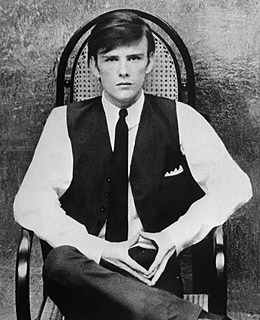
Wanted: One Bass Player. No Experience Required

Stu Sutcliffe was a key figure in the Beatles’ early history, playing bass guitar and, many say, helping the group settle on a name. Not bad for a guy who wasn’t even a musician. Sutcliffe was a promising painter who lived with John Lennon while both were students at the Liverpool College of Art. After Sutcliffe sold a painting for the princely sum of £65, Lennon persuaded him to buy a bass guitar and join his group, the Quarrymen, in 1959. According to some versions of Beatles lore, Sutcliffe helped shape rock n’ roll history by suggesting the group change its name to play off Buddy Holly’s band, the Crickets. A welcome addition for his good looks and bohemian fashion sense, Sutcliffe’s elementary musical abilities never matched that of his bandmates and he left the group in 1961 (George Harrison later said of his playing: “It was a bit ropey, but it didn’t matter at that time because he looked so cool.”) Sutcliffe died of a brain hemorrhage the following year, just 21 years old.
A Rock 'n' Roll First
The opening riff of the Beatles’ 1964 single “I Feel Fine” is frequently cited as the first use of feedback on an album. “I defy anybody to find an earlier record,” John Lennon challenged in a 1980 Playboy interview, “unless it is some old blues record from the ’20s.” As it turns out, Lennon’s caveat was necessary; blues musicians such as Johnny “Guitar” Watson had been using intentional feedback for years, but “I Feel Fine” was the first time it appeared in a popular rock ‘n’ roll song. In a 1994 interview, Paul McCartney said the effect was discovered by accident; Lennon absentmindedly leaned his guitar against an amplifier and liked the sound so much he used it in the song. The riff paved the way for later artists such as Jimi Hendrix and the Who, who took that screeching and made it their own. The Beatles would later pave the way again, becoming one of the first popular acts to use backwards tape loops in their 1966 song, “Rain.” Some of these backwards messages would be used by conspiracy theorists as “proof” that Paul McCartney was dead.


