

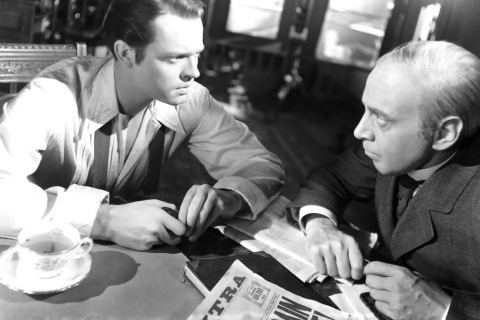
“I run a couple of newspapers, what do you do?” asks Charles Foster Kane (Orson Welles) of a young woman he will take as his mistress. Never forget that Welles’ directorial debut, routinely sanctified as the World’s Greatest Film, is also and mainly a bracing study of a tycoon publisher who bears a strong resemblance to William Randolph Hearst. Kane uses his millions to assemble the best journalists money can buy; he more or less invents a war to sell papers; he uses his newsprint empire to promote his candidacy for governor — and, when he loses after the sex scandal, runs the headline “Fraud at Polls.” A two-hour demonstration that absolute wealth corrupts fascinatingly, Kane was a box-office flop, in no small part because Hearst exercised his muscle to suppress and then condemn it.
[youtube=http://www.youtube.com/watch?v=YXIr1P9Fm5A]