

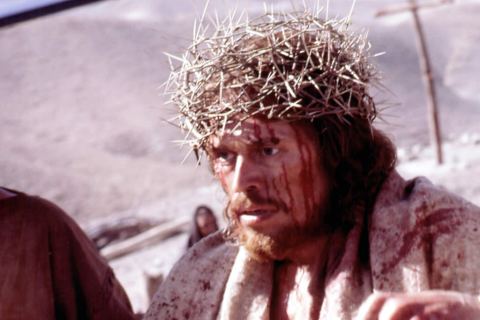
In Morocco, on a pinchpenny budget of $6 million, Scorsese recreated a Palestine of sere deserts and balding meadows. His style is impatient, intimate, conspiratorial, the camera scurrying ever closer to the heart of the matter — X-rays of souls in stress. In the Nikos Kazantzakis novel and Paul Schrader’s script, the director found a story like the one he has made again and again throughout his career, from Mean Streets to Raging Bull, from The King of Comedy to The Color of Money, from Goodfellas to Gangs of New York to The Departed: a toxic buddy movie, in which two men are bound by love or hate; one must betray the other and thereby help certify his mission.
The Scorsese Jesus (Willem Dafoe) is not God born as man; he is a man who discovers — or invents — his own divinity, and he’s both tormented and excited by the revelation. The Judas (Harvey Keitel) is a strong, loving activist. He wants to overthrow the Roman occupiers, while Jesus wants freedom for the soul. To fulfill his covenant, Judas must betray not Jesus but his own ideal of revolution. He must hand the man he most loves over to the Romans.
The faithful picketed the executive offices of the movie’s distributor, Universal Pictures. Some said the film was a plot by Jews to discredit Jesus — odd, since the director was raised Roman Catholic, the screenwriter Calvinist and the author of the source novel Greek Orthodox. Any Jesus film with sex and violence is bound to stir the anger of people who would never see it anyway. But these elements were simply bold colors on the canvas, images of the life Jesus must renounce and redeem. So no matter that The Last Temptation of Christ was a flop. It’s a great film, full of love for the dilemma of a god-man.