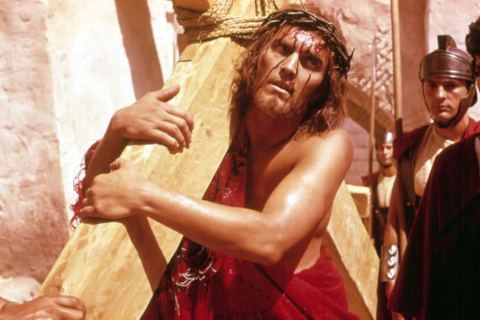
King of Kings

From director Nicholas Ray, who had turned James Dean into a neurotic teen Jesus in Rebel Without a Cause came this biblio-pic with a Method tinge; humorist Arnold Roth dubbed it “Suddenly, Last Supper.” As Jesus, Jeffrey Hunter, who played John Wayne’s young partner in The Searchers five years earlier, has star quality to spare. In orange hair and what looks like portable Nativity-color underlighting, Hunter is such an erotic slab of beefcake, he turns every Messianic agony into an ecstasy. The film, though, has an antidramatic tone that the melodramatic music tries to vivify. Count on the pictorials to keep you awake; watching the movie is like having someone thumb, slooooowly, through a book of religious art history.
The Gospel According to St. Matthew

Worlds removed from Hollywood’s elephantine Biblical epics, Piero Paolo Pasolini’s Il Vangelo secondo Matteo was a low-budget black-and-white pastoral Christian film, made by an atheist Marxist homosexual. Pasolini said he responded to the literary brilliance and narrative propulsion of the Matthew gospel he wanted to show that the greatest story ever told was, among other things, a great story. His dark-haired, dark-eyed, unibrowed Jesus (played by Enrique Irazoqui, a Basque Jew who, like the other performers, was not a professional actor) spits out the parables and prophesies with a brisk ferocity, like a union organizer with a spiel to finish before the end of the lunch break. He is testy with his inquisitors and abrupt with his Apostles. He’s a man-God in a hurry to fulfill his mission. Sooner dead, sooner resurrected.
One of the mob scurrying after him toward Calvary screams, “His blood be on our children!” This is the verse from Matthew that implicitly condemns Jews for the murder of Christ. Yet here, with Italians chasing Italians, the curse seems one not of race or religion but of tribe. In this light, the crucifixion is a clan battle the Corleones could appreciate.


