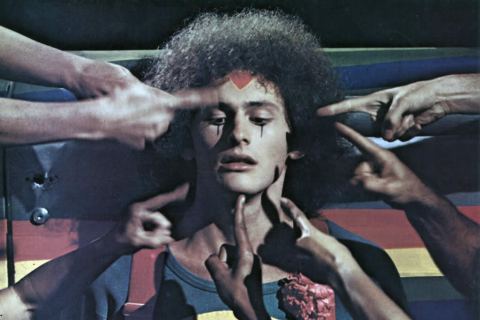
Godspell

One of two Jesus-rock musicals transferred that year from Broadway to movies — Tim Rice and Andrew Lloyd Webber’s Jesus Christ Super Star was the other — this Hasidic hippie show, by John-Michael Tebelak and composer Steven Schwartz (Wicked), spawned the Top 20 charter “Day by Day.” Director David Greene set the film on Manhattan’s city streets, and the climax in a city playground. On The Daily Show in 2004, Rob Corddry accurately described the Godspell‘s Christ figure as “a ’70s pop rainbow suspendery kind of Jesus.” Victor Garber (later Jennifer Garner’s father on Alias) stresses the Messiah’s gentility in sensitive-clown makeup: teardrop eyeliner and a cute heart on his forehead. The rest of the young cast follows suit, miming up a storm, sipping imaginary sacramental wine from invisible chalices. Drinks for the Last Supper are served in paper cups. Was the Peoples Temple’s Jim Jones watching?
Gospel Road

A big year for Jesus musicals, 1973 also saw the emergence in the Bible belt of a family production: Gospel Road, produced in Israel by Johnny Cash and June Carter Cash. The Man in Black, who had recently embraced Christ, ambles through the Holy Land while telling a story of Jesus’ life and sacrifice. As Cash intones the words, “This is My beloved Son, in Whom I am well pleased,” it’s easy to imagine that God must have a Southern accent. The pauper-budgeted simplicity and good intentions of Gospel Road overwhelm the weirdness of a movie in which the director (blue-eyed, blond-haired Robert Elfstrom) plays Jesus and the star’s wife is Mary Magdalene.
Cash, who also wrote the script with Larry Murray, sings eight fine Christian songs, written by himself, John Denver, Larry Gatlin, Kris Kristofferson, Joe South and other top country singer-composers. In the movie’s climactic Passion section, Jesus is lashed, kicked and spat on a few clumsy times, then totes his cross up a deserted city street. He dies in close-up, and the camera pulls back to reveal a modern American city (L.A.? Nashville?) — a strange but potent payoff, indicating that the Savior died not only for the sins committed up to His time but for the ones we are still committing.


