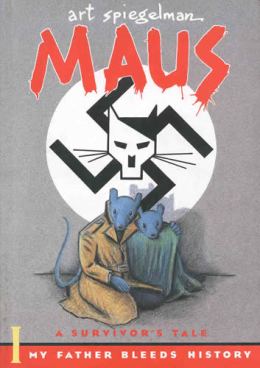
Maus

Art Spiegelman’s father Vladek was a Polish Jew who survived the Holocaust. When Spiegelman told his father’s story in Maus, he depicted all the Jews as mice and all the Nazis as cats. Strangely, the cartoonish conceit doesn’t trivialize the story, it makes it viscerally real — it strips away our practiced indifference to an all too familiar story. Those mice are more human than most people. Alongside his father’s tale Spiegelman lovingly but honestly depicts his own relationship with his father, who has aged into a difficult, prickly, fearful man. Maus won a Pulitzer in 1992, a landmark event in the history of the medium — its sheer power forced the mainstream world to take comics seriously.
The Adventures of Tintin: The Black Island

From his luxurious seat at Marlinspike Hall, Hergé’s tufted, virtually sexless reporter investigates mysteries ranging from the criminal (counterfeiting) to the science fictional (a mysterious meteorite that causes things to grow at an astounding rate), in the company of a drunken ex-sailor, a half-cracked scientific genius, two identical bumbling detectives, and of course his white, apparently sentient dog Snowy.
Tintin is a weird mix of comedy, mystery and adventure — you never quite know what you’re going to get when you open one of those skinny, oversized volumes. (Though you can be pretty confident that Tintin is going to say “Crumbs!” and that Captain Haddock is going to get drunk and fall down.) Hergé’s art is an utterly inimitable mix of cartoonishness and photographic hyper-realism, inked in luminous, oversaturated colors, which renders Tintin‘s timeless, ambiguously European (Tintin was Belgian) world utterly believable. We’ll see how well Steven Spielberg and Peter Jackson can reproduce it onscreen when the movie comes out in 2011.


