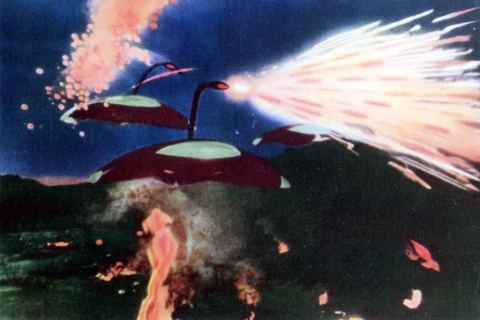
The War of the Worlds

From the fertile mind of H.G. Wells came this vision of a nation under aerial alien siege. It might have been London under the Nazi blitzkrieg, but this is Los Angeles taking a hit from sleek Martian saucers. Oh, they were handsomely designed — as gorgeous as the actual Martians, once they landed, were spindly and grotesque. Producer George Pal’s fantasy thrillers, such as Destination Moon, When Worlds Collide, Conquest of Space and The Time Machine boasted the snazziest special effects of the day. His vision of trans-world Armageddon has terrors both epic (Angelenos zapped by the planes’ death rays) and intimate (a few people hiding in a basement, hoping to elude a Martian probe that looks like a TV screen on a metallic snake). Much superior to Steven Spielberg’s frantic 2005 remake.
It Came From Outer Space

A meteor crashes outside a desert town, and, before it disappears into the earth, the local astronomer (Richard Carlson) notices it’s really a space ship. The townspeople scoff at his story, but soon some of them are turned into alien hosts after coming into contact with a soft-focus Jell-O-y entity that looks like a glaucomatic eye as seen from the inside. (The effect was creepier in the movie’s original 3-D version.) Jack Arnold, director of many sci-fi near-classics (Creature from the Black Lagoon, Tarantula, The Incredible Shrinking Man), gives the film the matter-of-fact tension of a police procedural. But the best thing about the movie is Ray Bradbury’s story, the blueprint for a decade of sci-fi paranoia. Bradbury says that the most toxic alien invasion is not of our skies but of our minds — especially if we only think we’re being invaded.


