

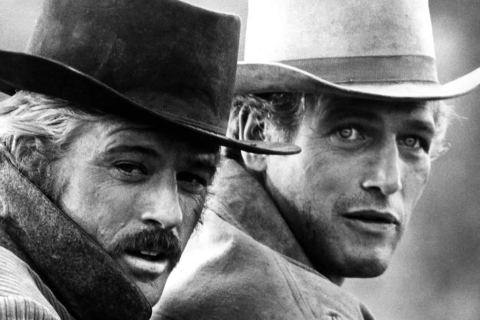
“When I was a kid,” Butch (Newman) muses — and he does a lot of musing in this pointedly larkish Western — “I always thought I’d grow up to be a hero.” Instead, he and his pal Sundance (Redford) became Hollywood’s answer to the much darker, better Bonnie and Clyde two years before. The crooks still crack wise, but here their relationship is less complicated, they being both ostentatiously heterosexual men, played by the King of Movie Cool and his blond dauphin. Between heists they dally with sunshiny moll Etta Place (Ross), ride bikes to Burt Bacharach’s Raindrops Keep Fallin’ on My Head and dream of retirement in Bolivia. Audiences devoured the stars’ camera-derie like two scoops of ice cream; their banter was the fudge topping.
Redford and Newman somehow made only a pair of films together, this gigantic hit and the even more popular The Sting. By the time the stars came up with another congenial project, the studios wouldn’t finance it — who’d pay to see two old men? But plenty of good came out of this first pairing. Redford named his Institute, which would become the fountainhead of U.S. indie filmmaking, after his character. And when Newman, as one of his many philanthropic undertakings, created a summer home for children with life-threatening diseases, he named it the Hole-in-the-Wall-Gang Camp.
[vodpod id=Video.13962300&w=425&h=350&fv=]