


Antea, Parmigianino, ca. 1531-34. / Image: SOPRINTENDENZA SPECIALE per il POLO MUSIALE NAPOLETANO
It’s been a rainy week of catch-up for me on shows about to leave Manhattan, so I jumped a cab over to the Frick yesterday to take a good long look at their one-painting loan show built around Antea. That’s a portrait from the 1530s by Parmigianino of a delicately beautiful and elegantly dressed young woman. It heads back soon to the Museo di Capodimonte in Naples and friends were telling me not to miss it. I was also looking to get away from the stupid chatter about Miley Cyrus — Miley who? — and that picture of her by Annie Leibovitz. I figured this would be a good way to clear my head. But wait.
Three-quarter length Mannerist portraits, the good ones, are one of the most enjoyable contrivances of Western art. In the mid-16th century a few Italian painters, Bronzino, Pontormo and Parmigianino among them, hit on a way to present the figure poised just so between direct address to the viewer and elegant reserve. What they give you is the human being in full array, the utmost in lustrous mammals, but with something held back. Among many other things, the 20th-century notion of hauteur begins with them. Just think what they would have done with Charlotte Rampling.

The portait of Antea is one of those pictures, though it may not be a portrait in the sense we usually think of one. It’s unknown whether she represents a real person. She was described by one contemporary as the artist’s mistress and it’s been conjectured that she might have been a well known Roman courtesan. Then again, she may simply be an idealized emblem of virtue. Or, even more interesting, an idealized version of a woman about to say yes. It all depends on how you read the signs.
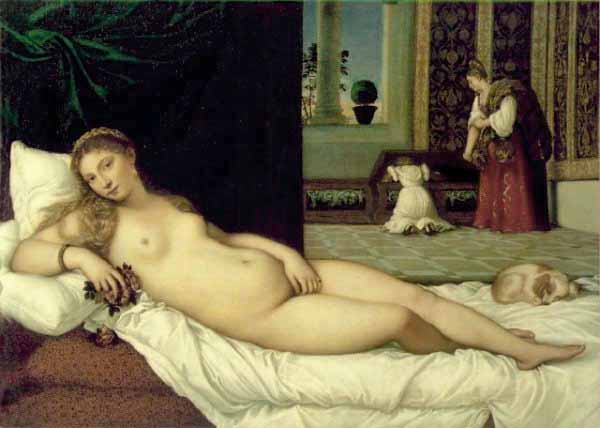
What are those? Well, for one thing there’s nothing blowsy about her. Her white apron is as stable as a fluted column. Her beautiful face is tentative. She’s not some Venus on one of Titian’s couches.
But in other ways she gives off a different message. The Frick tells us that much of what she’s wearing would have been understood by her contemporaries as gifts from a lover, including the pearls that form a triangle around her head, a ring on her exposed hand, and the marten, that furpiece that ends with its head nipping at her hand on the left. (Whether there’s a meaning in the way its teeth are so visibly bared is a mystery I won’t pretend to solve.) Once you know that, it’s hard not to notice that her necklace forms a vaginal delta that duplicates her cleavage. And that she fingers that triangle at the lower point. Her unoccupied right hand is gloved but on the hand that matters the gloves are off.
So what is she saying to us? Is she poised at some threshold between innocence and experience? If that’s what it is, it’s hard to think of another picture that so perfectly conveys that ambiguous moment, though it’s a type of image that has a long pedigree in Western art. And then it occurred to me. I guess it isn’t over yet.