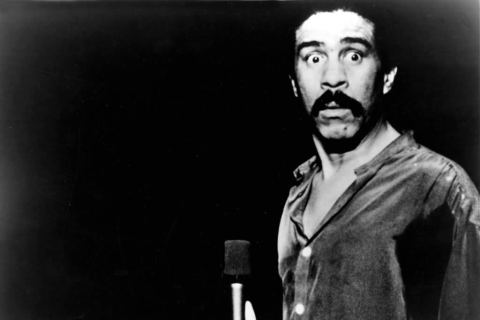
Richard Pryor Live in Concert

For about a decade, Pryor was the soaring demon angel of movies, concerts and Grammy-winning albums. He partnered with Gene Wilder for Silver Streak and Stir Crazy, two of the biggest and earliest black-guy-white-guy comedies. As a stand-up monologist, he was without peer. Drawing his material from the black hole of ghetto life and death, he used his dramatic power to magnetize his listeners into the fire-flash fear of the moment — even as his skewed comic perspective provided distance, safety, reassurance. As a film actor, he had the uncanny knack of educing raw emotions from himself and his audience. Vulnerability, untempered rage, urchin craftiness, a rough dignity — all these moods seeped through him. In fact, the two Richard Pryors — kamikaze comic and sensitive actor — are overlapping parts of the same intricate talent.
In his concert films Live in Concert and Live on the Sunset Strip, Pryor showed his gift not just for expressing his demons, but for becoming other people, other creatures. He could mimic bad black dudes, whining white liberals, Mafia hitmen and a stuttering Chinese. He conjured a menagerie of horny monkeys, a neurotic Doberman, a scared and suspicious deer, a killer rabbit, two suave malamutes in need of an exorcist. Physical pain was a constant, chatty companion. It could visit him as a sharp twinge while he jogs, and speak in the argot of an officious tax accountant: “Hello! I’ll be messin’ with you the next hour or so. I’ll be moving from side to side, down your groin and up your ass. When you drop dead, I will stop.” Onstage, Pryor re-creates his 1977 heart attack, and now pain arrives as an all-business mugger: “Don’t breathe. Was you tryin’ to talk to God behind my back?” Sometimes the pain turns to fear, and his mind tells his body: “Run!”
No one who did as much damage to his body as Pryor did could expect to outrun fate. In a line that runs from Pentecostal preachers to Moms Mabley and Redd Foxx (and, to mention a token white comic, Lenny Bruce), onto Eddie Murphy, the Kings of Comedy and Def Comedy Jam, Pryor is the crucial link. the most daring comic firebrand, the most lasting influence. Everyone who followed is still running after him.
A Soldier's Story

Richard Pryor had ruled the movies for years as a comedy star and standup comic guru, but Hollywood was hurting for the next Sidney Poitier. Could America even accept one? “I don’t think the country is ready for black leading men,” Eddie Murphy told TIME. “White guys won’t accept their ladies’ going nuts over a black actor.” He said this in 1984, when the great black hope for young dramatic actors was Howard E. Rollins, Jr., who had earned an Oscar nomination for Ragtime. Rollins was the star of this excellent racial murder mystery, based on Charles Fuller’s Pulitzer-winning A Soldier’s Play. But the real news, in retrospect, was the eye-catching performance by a young African American making his first bid for dramatic stardom in movies. Denzel Washington played a glowering G.I. in A Soldier’s Story, and he stole a little of the limelight from Rollins, who was saddled with the kind of lead — a quiet, noble lawyer who checks his rage at the door — that would automatically go to Poitier before him and Washington after.
There was cunning and pride in Washington’s work here, and subtlety too. His potential seemed unlimited for playing memorable heroes or villains, Othello or Iago. But he was too handsome, dammit, for Hollywood not to cast him as Mr. Righteous. That he did soon become something like the next Poitier was both a blessing and a pity. It meant he got plum roles: as Stephen Biko in Cry Freedom and as Spike Lee’s Malcolm X, while denying him the character roles that are often showier and more fun. Stardom did suit Washington’s gifts: the surface aplomb that often masked sulfurous anger. A whisperer, not a shouter, Washington counted on his magnetic screen presence to show that he wouldn’t ingratiate himself to anyone, least of all the audience.
After five Oscar nominations (and one win as supporting actor in Glory), he cashed in with a rare meanie part, in Training Day, and become the first black star to win Best Actor. Last year, curiously, Washington was weaker as a Harlem drug king in Ridley Scott’s American Gangster (his silky geniality deprived the role of magnificent maleficence) than he was under his own direction in The Great Debaters. As a demanding teacher at a Negro college in the 1930s, he managed a combustive blend of charm, threat and mystery — the factors that for two decades have sustained the black leading man Eddie Murphy thought America wouldn’t accept.
More Best & Worst Lists
View AgainHollywood on Race
- About the List...
- Body and Soul
- Hallelujah!
- Judge Priest
- Imitation of Life
- God's Step Children
- The Duke Is Tops
- Gone With the Wind
- The Blood of Jesus
- The Jackie Robinson Story
- Native Son
- Carmen Jones
- The Defiant Ones
- In the Heat of the Night
- Sweet Sweetback's Baad Asssss Song
- Lady Sings the Blues
- Cooley High
- Killer of Sheep
- Richard Pryor Live in Concert
- A Soldier's Story
- Do the Right Thing
- Boyz N the Hood
- Eve's Bayou
- Bamboozled
- Madea's Family Reunion
- I Am Legend


