

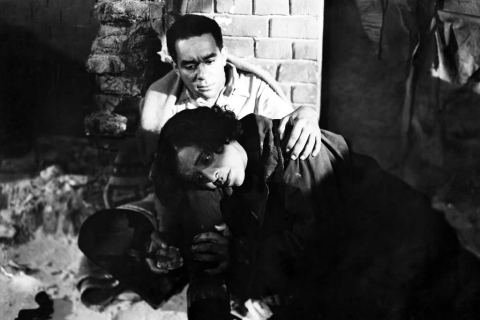
Richard Wright’s Native Son was the first major black novel to speak against American racism in an angry voice. The tale of Bigger Thomas — a Chicago youth who is hired as a white family’s chauffeur, goes joyriding with the family’s rebellious daughter and accidentally kills her and is pursued for her murder — was a sensation on its publication in 1940. The following year, Orson Welles (fresh from Citizen Kane) dramatized it on Broadway, but Hollywood wouldn’t touch the property, though one producer said he’d do it if the main character could be changed to an ethnic white kid. By the late 40s, Wright had moved to Paris, where he hooked up with director Pierre Chenal and revived the project. The French government, fearful of official American reprisals, offered no funding, so Chenal made the movie in Buenos Aires, with non-actor American tourists in the supporting roles and Wright himself as Bigger. When the film got a furtive release in the U.S., it was cut from nearly two hrs. to 87 mins. So far as I know, it has never been restored.
The surviving shards suggest a movie bold by the standards of its day, tepid compared to the book. Stripping the story of its Communist subplot and a scene where Bigger kisses the white girl, this Native Son is still the first boyz-n-the-hood movie — the first to examine, with a kind of documentary dispassion, the downward pull of a restless young man into the black underclass and his resentment of the white bourgeoisie he is expected to revere. Wright was no actor — here he is miscast as someone half his age. But his very stiffness reflects Bigger’s alienation from the white and the black worlds; he is critical of both societies that have rejected him, an outlaw and an outcast. When his fairly genial employer puts a paternal(ist) hand on Bigger’s shoulder, Wright throws him an instinctive suspicious glance. If you learn one thing growing up in a black ghetto, “a prison with no bars,” it’s wariness.
Even when Native Son devolves into a long climactic chase through streets that look nothing like Chicago’s, it summons the pressures not only on Bigger, but on the film itself — a project as doomed as its young antihero to end in tragic frustration. Today the picture is notable as a forgotten sire of angry black cinema, and for the rare sight (Mickey Spillaine as Mike Hammer in The Girl Hunters being the only other example that comes to mind) of a best-selling author playing his own creation.
[youtube=http://www.youtube.com/watch?v=ckBvNE0qc9Y]