

Nobody loves Tyler Perry except for his audience (and Oprah). The nine plays this Atlanta-based writer-director-producer-composer-star put together in a five-year burst have been hits on the Christian chitlin’ circuit throughout the South. All were recorded for DVD, and three — Diary of a Mad Black Woman, Madea’s Family Reunion and Why Did I Get Married? — were made into “real” movies that grossed perhaps 10 times their cost in movie theaters alone. Perry’s stuff is loud, sentimental, badgering — a gigantic gallimaufry of broad comedy, primal scream and (in the stage versions) musical numbers. The dramaturgy is part Neil Simon, part Oscar Micheaux that starts as wildly churning comedy, then stops in its tracks for a confession of spousal or child abuse. The music mixes elements of Dreamgirls and the Ebenezer Baptist Church choir; the tone is a violent blend of the earthy and the evangelical.
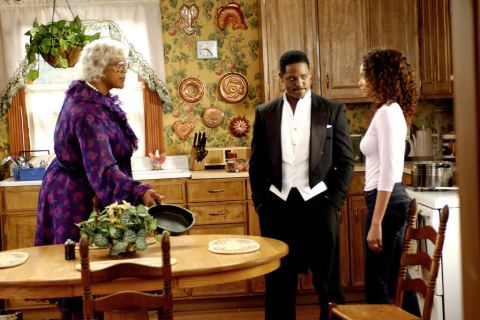
Usually, the supporting players carry the melodrama, and Perry’s Madea — christened Mabel Simmons — shoulders the comedy. Black actors playing fat women is not exactly an innovation, as Martin Lawrence and Eddie Murphy can attest. But the 6ft.5in. Perry, who in civvies has the smooth good looks of a Will Smith, cuts a startling figure. Outfitted in a purple print dress, giant glasses and sandbag bosoms, carrying a purse with three handguns and punctuating every comment with the wave of a cigarette, the star stomps around the stage shouting out advice and ridiculing the supporting players for being too short, too fat or insufficiently black. He’s part bully, part brassy black conscience.
The movie version of Madea’s Family Reunion has an impressive cast, including Blair Underwood, Lynn Whitfield, Jenifer Lewis, Cicely Tyson and Maya Angelou. But you should get the DVD of the original play, both for the hoots and hollers of its live audience and because the shows, unlike the films, are essential musical drama-comedies. It’s when the characters launch into song, which they do seven or eight times a show, that these works sound most authentically black. The songs (by Perry and his musical director, Elvin Ross) are more than serviceable, ranging from R&B to Broadway to flat-out gospel. And some of the singers are extraordinary. For Family Reunion, Terry Phillips and D’Atra Hicks have a powerful reconciliation duet, toward the end of which Hicks pours out one note for 30 secs., escalating the passion and the ache with astonishing precision and intensity. It’s a seriously thrilling stopover in the pop-cultural express train that is Tyler Perry.
[youtube=http://www.youtube.com/watch?v=r6H0pQ2WiXs]