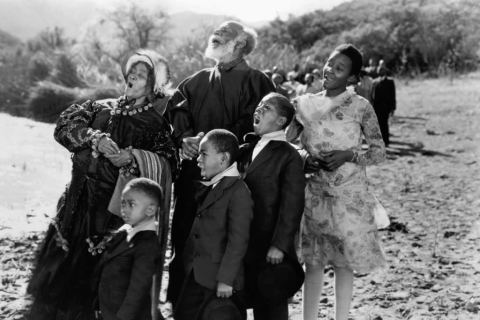
Hallelujah!

Talking pictures broke over Hollywood like the first thunderclap on a clear day, and by the end of the 20s, movie theaters were inundated with musicals. Director King Vidor, who’d had a huge hit with the war drama The Big Parade, wanted to capture the music of rural black Americans — what they sang and how they felt. The result was Hallelujah!, about Zeke (Daniel L. Haynes), a decent man led astray by the wanton girl-woman Chick (Nina Mae McKinney). McKinney was just 16 when she got the part, and had never been in a movie. But she seduced the camera as fully as Chick did Zeke. She gives a volcanic rendition of Irving Berlin’s “Swanee Shuffle,” using the exact leg and hop moves that would make Elvis Presley a star. Sashaying toward Zeke, she purrs, “Let ya baby sit on yo’ lap and make you feel so good,” taking a heavy breath before “feel” and giving it an extra erotic syllable. Mainstream movies had never seen such thrilling sexuality.
Even MGM, the staid studio that financed Hallelujah!, knew it had something in McKinney. It signed her to a five-year contract, then came to its idiot senses and ignored her. In the 30s she toured Europe concert halls, where she was billed as “the black Garbo,” and made three films in Britain, including Sanders of the River with Paul Robeson. In the 40s she got some work playing the one character available to black actresses: maid. She was dead at 55.
Judge Priest

One of the hallmarks of Hollywood racism was that no matter how substantial (if demeaning) a black actor’s part might be, he or she was typically billed below the white actors, however minor their roles. The two exceptions were Bill “Bojangles” Robinson, the Broadway star who famously danced down plantation manor steps with the seven-year-old Shirley Temple, and Stepin Fetchit, Hollywood’s prototype of the slow, shiftless black man. Robinson, essentially a specialty act in his movies, was admired, even cherished, by audiences of all colors. But Fetchit (born Lincoln Perry) was an embarrassment to many blacks, both then and especially later in the dawning of the civil rights movement. The lazy befuddlement of his characters seemed to represent the most contemptuous caricature of the race.
I don’t deny that. And I’m not rationalizing the racial gaucheries of his movies by saying, well, that was a long time ago. But anyone looking at Fetchit’s performances today has to notice their subversive, anarchic, movie-altering force. His drawn-out drawl and living-dead pace instantly stopped any scene in its tracks, brought the pace to a halt and monopolized the screen. When Fetchit was on, you watched him, because his acting style was unique. The rest of the players were striving for movie naturalism, and he, with a turtle’s intensity, was doing Kabuki. That no director said, “Stepin’ a little faster this time?”, indicates that the style worked for contemporary movie executives and audiences. So does this fact: Stepin Fetchit was the first black actor to become a millionaire.
He was one of director John Ford’s regulars, appearing in five films spanning a quarter-century. We’re choosing Judge Priest, where he plays Will Rogers’ handyman and, more or less, lawn jockey. In one scene, Rogers, whose pacing was nearly as leisurely as Fetchit’s, sends him on an errand, asking, “Gonna put your shoes on?” “Savin’ ‘em case my feet wear out,” is the eventual reply. Rogers: “As much settin’ around as you do, won’t be your feet that wear out.” Judge Priest, set in 1890, has bushels of this sort of humor, plus a quartet of mammies apostrophizing the Old Confederacy by joining Rogers in a chorus of “My Old Kentucky Home.” Yet the film is so relaxed, so amiable, that it might exist in some alternate universe where blacks weren’t chattel, and the races got along fine.
More Best & Worst Lists
View AgainHollywood on Race
- About the List...
- Body and Soul
- Hallelujah!
- Judge Priest
- Imitation of Life
- God's Step Children
- The Duke Is Tops
- Gone With the Wind
- The Blood of Jesus
- The Jackie Robinson Story
- Native Son
- Carmen Jones
- The Defiant Ones
- In the Heat of the Night
- Sweet Sweetback's Baad Asssss Song
- Lady Sings the Blues
- Cooley High
- Killer of Sheep
- Richard Pryor Live in Concert
- A Soldier's Story
- Do the Right Thing
- Boyz N the Hood
- Eve's Bayou
- Bamboozled
- Madea's Family Reunion
- I Am Legend


