

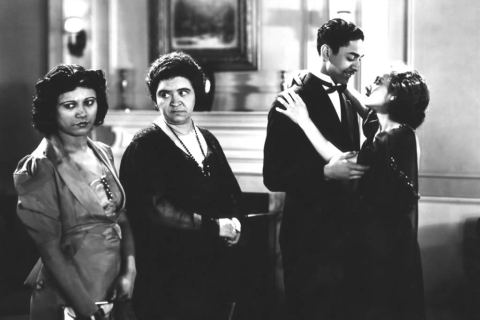
The first black to direct a silent feature, and the first to direct a talkie feature, Oscar Micheaux was the D.W. Griffith of race cinema. And also its Edward D. Wood, Jr. An unquestioned pioneer who wrote, produced, directed, financed and distributed his own films, Micheaux made movies for 30 years, yet remained ignorant of the basic craft and the visual grammar of the medium; by any normal standard, his no-budget, no-retake films are defiantly, fascinatingly bad. His declared mission was to “uplift the race,” but did it by showing light-skinned blacks (usually women) as ethically superior to those of a darker shade (usually men, who are derided as slaves to crap games and numbers rackets). God’s Step Children may not be Micheaux’s masterpiece, but in going even farther than his other films in its wildly jumbled plot lines, its twisted racial politics and its ability to storm past coherence toward an anguished emotional epiphany, the movie is certainly his most-erpiece.
A fantastic gloss on Imitation of Life, the two-generation story focuses on Naomi, a pretty child who’s all sugar and spite. She tries to enroll at a white school but is sent back to her black class. When she literally spits at her teacher, she’s carted off to a convent school. Naomi returns as an adult and falls in love with with the neighbor’s son Jimmie — a boy she had been raised to think of as her brother, and who is really in love with the teacher’s daughter. And that’s the streamlined synopsis. To make matters more complicated, Micheaux has two actresses play one character (Naomi as a child, then an adult) and another actress play two characters (Naomi’s teacher and, later, the teacher’s daughter). After surrendering to Jimmie’s plea that she marry a poor but noble farmer, Naomi gets restless again. She decides to leave, and tells the woman who raised her, “I’m leaving the Negro race…I’m going away from all I ever knew, to the other side…If you see me, you don’t know me. Even if you pass me on the street, I am a stranger.”
Micheaux lifted Naomi’s big speech from Peola’s in Imitation of Life; but he learned more from Victorian novels — from their teeming plots, principled masochism, highfalutin speechifyin’ — than he ever did from movies. And while he wants his audience to condemn Naomi’s ambition to “pass” in the white world, he is canny enough to see the pathos in her plight. The excellent performance by Gloria Press also helps to tilt the modern viewer’s feelings toward a troubled soul exiled from two worlds. In this and other Micheaux films, his would-be whites cry out across the decades. They make themselves heard, poignantly, above the distractions of incompetent film technique and naive acting styles. They reach out to those outsiders (outside in race and time) who may approach Micheaux films as so-bad-they’re-funny antiques. We may come to sneer; but if we have any capacity to be touched by a naked cry of pain from 70 years past, we leave in awe.