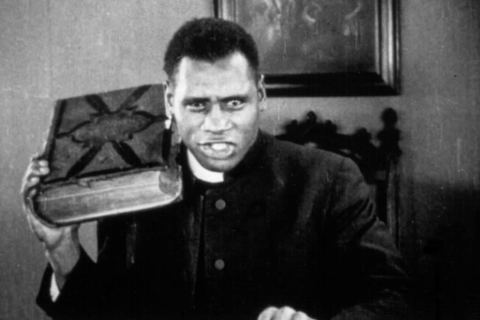
Body and Soul

In the silent era, black actors were hardly allowed on screen, even as maids or oafish comic relief. Hollywood would have loved a handsome, strapping presence like Paul Robeson, if only the industry hadn’t been blinded by racism. So the Rutgers football star and Columbia-educated lawyer made his film debut under the aegis of Oscar Micheaux, a go-it-alone entrepreneur who made his socially potent, artistically amateurish pictures on the super-cheap. In Body and Soul, Robeson plays two characters: the saintly Sylvester Jenkins and his venal brother, the “Reverend” Isaiah, an ex-con who wows the church ladies with his oratory, then sullies their virgin daughters and makes off with the victims’ life savings — in a Bible. It’s Isaiah who gets the screen time, which allows Robeson to radiate his unique movie appeal.
In a sensible society, the movie men out West would have seen the raw power of Robeson’s performance and signed him up. He did get a few supporting roles in Hollywood, notably in the 1936 Show Boat, singing “Old Man River” and playing opposite Hattie McDaniel. But his unapologetic charisma and machismo — call it charismo — had no place in the official American movie industry. Like Josephine Baker, the sinuous black dancer who emigrated to Paris and had several movies built around her personality, Robeson had to go to Britain to find leading roles. In these medium-budget dramas, he was always billed above the white stars; and in one of these films, 1937′s Jericho, he surely became the first movie man of color to call a white man “boy.” Back home, movie people pretended Robeson didn’t exist. That was a great loss, for him and for the strong characters he might have been able to embody. Not for the last time, we whisper: If only….
Hallelujah!

Talking pictures broke over Hollywood like the first thunderclap on a clear day, and by the end of the 20s, movie theaters were inundated with musicals. Director King Vidor, who’d had a huge hit with the war drama The Big Parade, wanted to capture the music of rural black Americans — what they sang and how they felt. The result was Hallelujah!, about Zeke (Daniel L. Haynes), a decent man led astray by the wanton girl-woman Chick (Nina Mae McKinney). McKinney was just 16 when she got the part, and had never been in a movie. But she seduced the camera as fully as Chick did Zeke. She gives a volcanic rendition of Irving Berlin’s “Swanee Shuffle,” using the exact leg and hop moves that would make Elvis Presley a star. Sashaying toward Zeke, she purrs, “Let ya baby sit on yo’ lap and make you feel so good,” taking a heavy breath before “feel” and giving it an extra erotic syllable. Mainstream movies had never seen such thrilling sexuality.
Even MGM, the staid studio that financed Hallelujah!, knew it had something in McKinney. It signed her to a five-year contract, then came to its idiot senses and ignored her. In the 30s she toured Europe concert halls, where she was billed as “the black Garbo,” and made three films in Britain, including Sanders of the River with Paul Robeson. In the 40s she got some work playing the one character available to black actresses: maid. She was dead at 55.
More Best & Worst Lists
View AgainHollywood on Race
- About the List...
- Body and Soul
- Hallelujah!
- Judge Priest
- Imitation of Life
- God's Step Children
- The Duke Is Tops
- Gone With the Wind
- The Blood of Jesus
- The Jackie Robinson Story
- Native Son
- Carmen Jones
- The Defiant Ones
- In the Heat of the Night
- Sweet Sweetback's Baad Asssss Song
- Lady Sings the Blues
- Cooley High
- Killer of Sheep
- Richard Pryor Live in Concert
- A Soldier's Story
- Do the Right Thing
- Boyz N the Hood
- Eve's Bayou
- Bamboozled
- Madea's Family Reunion
- I Am Legend


