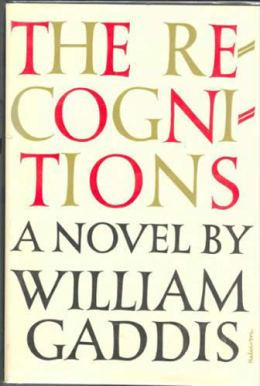
You approach this immense book wondering whether you should have done a week of roadwork and calisthenics to get ready for it, and not just because of its more than 900-page length. Gaddis’ ferocious discontent with the world as he finds it and his daunting erudition make for a demanding read, but also a hugely rewarding one. Wyatt Gwyon is a forger. In the service of a crooked art dealer he expertly counterfeits Early Renaissance masterpieces. He longs to live in a more authentic time, one unlike his world of simulations, substitutes, impostures and pale resemblances. What Wyatt wants in every realm of life is the true antecedent, and he struggles across three decades and three continents in search of it. This is a serious book, but it’s also the highest of high comedies, full of outraged wit. It took decades for The Recognitions to be recognized as the masterpiece it is and as a book that inaugurated the great age of black humor in American fiction that would come into its own in the 1960′s with Pynchon, Vonnegut and Roth.
Where did we first hear the voice of the world-weary American tough guy in its purest distillation? In Dashiell Hammett, a former Pinkerton detective, and in this book, his first novel. Though less famous than The Maltese Falcon or The Thin Man, which both have the advantage of their pitch-perfect movie adaptations, this tale of omnidirectional treachery is the man at his deadly best. (For the record, there is a movie of this book, too. Transferred to samurai-era Japan, it was the basis for Kurosawa’s great film Yojimbo.) With the Continental Op, a detective he had been developing for years in short stories, Hammett created the prototype for every sleuth who would ever be called “hard-boiled.” And with his witty, economical prose—”I said: ‘Hello.’ “—Hammett gave machismo its own terse lyricism. Here the Op finds himself in a corrupt western town where there’s a power struggle among contending factions. Virtually all of them, the hoods, the lawmen, the lowlifes, the local grandees, are lying and corrupt. Short, overweight, often a little drunk, the Op is no movie star. He’s a hero all the same, a man on his own, maneuvering among the crocodiles, frequently with fists and firepower, always with a brutal and amusing efficiency.
The Foo Fighters captured five Grammys and Adele won four, including the song of the year trophy for “Rolling in the Deep,” at a Grammy ceremony that had the difficult task of celebrating music’s best while mourning the loss of one of their greatest, Whitney Houston.
From Nicki Minaj’s Red Riding Hood getup to Katy Perry’s head-to-toe blue ensemble, TIME rounds up some of the best (and worst!) sartorial choices at the annual music awards show.