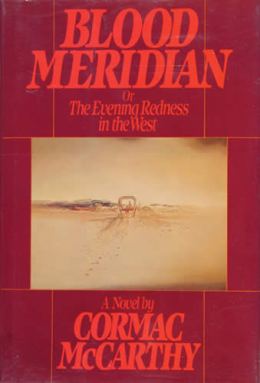
“The floor of the playa lay smooth and unbroken by any track and the mountains in their blue islands stood footless in the void like floating temples.” McCarthy’s prose has the character of the landscape it describes: Harsh and pure, as if it had been sculpted by wind and sand, like a naturally occurring phenomenon. In Blood Meridian McCarthy uses it to spin a yarn of gothic violence: In the 1840′s a young boy joins a band of cutthroats who hunt Indians on the border between Texas and Mexico, under the leadership of an amoral, albino arch-monster known as the Judge. Rarely has literature presented spectacles of violence more extreme or less gratuitous. Blood Meridian summons up shadows of Dante and Melville, and demands of every reader that they reexamine why and how they cling to morality in a fallen world.
Once and only once in his career the bitter, urbane, howlingly funny satirist Evelyn Waugh screwed up all his nerve and his talent and produced a genuine literary masterpiece. Though it’s saddled with a faded doily of a title, Brideshead Revisited is actually a wildly entertaining, swooningly funny-sad story about an impressionable young man, Charles Ryder, who goes to Oxford in the 1930′s and falls in love with a family: the wealthy, eccentric, aristocratic Flytes, owners of a grand old country house called Brideshead. In the first half of the book the exquisite, hilariously fey Sebastian Flyte, who is Charles’s classmate, teaches the young man about beauty, booze and witty conversation. In the second half every one grows up and everything goes spectacularly to smash. Told in flashbacks from the dark days of WWII, Brideshead is aglimmer with the guttering-candle glow of an elegant age that was already passing away.